Have you seen a kindergarten readiness list recently?
Most contain several different sections. Some are pages long. And what each emphasizes tends to vary widely from one list to the next, although most do include these overarching categories: independence, gross and fine motor skills, and academic and social readiness. But which of these do kindergarten teachers actually prioritize for their incoming students?
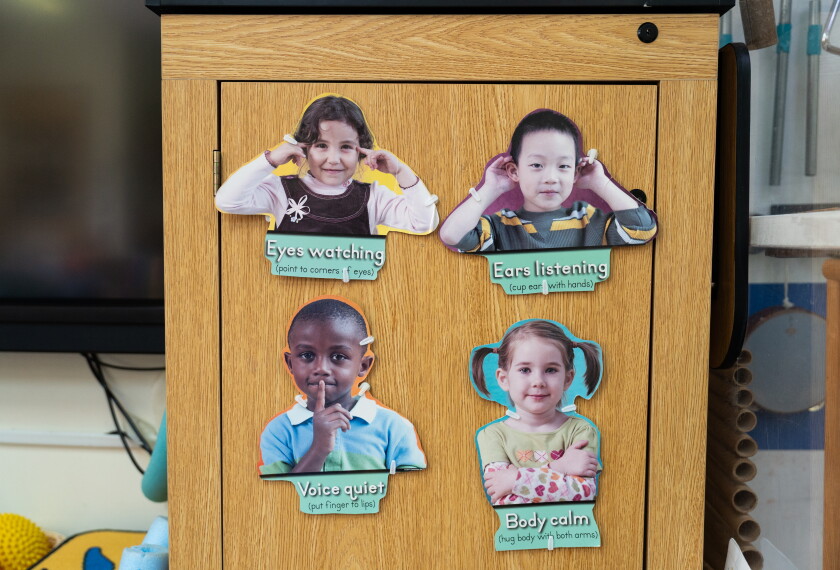
In response to a poll EdWeek posed on social media asking teachers what skills they think are most important for “kindergarten readiness,” we received 574 responses and several related comments. The majority of respondents cited emotional self-regulation as the skill incoming kindergartners most need for success.
This input adds to growing evidence that today’s early learners are struggling to self-regulate.
Fifty nine percent of early educators (1,163 K-grade 2, including 877 preschool teachers) surveyed in January 2026 by the EdWeek Research Center agreed that their students’ behavior had gotten worse in the past two years; 49% of preschool teachers responding to the same national survey said students’ behavior interrupted class instruction “multiple times a day.”
“We’ve seen a large increase in the inability for students to cope when things don’t go their way. We see a lot of crying, yelling, shutting down, gross overreactions,” Ian Knox, the principal of Hamagrael Elementary School, part of the Bethlehem central school district in upstate New York, told EdWeek.
“Teachers are kind of at the end of their rope. It’s disrupting to the climate in classrooms.”
As kindergarten teachers target emotional readiness, schools focus on reading
That “emotional regulation” trumps “academic readiness” on teachers’ kindergarten readiness wish list may come as a surprise—especially given the heavy emphasis that schools place on reading readiness at ever-earlier grades.
A decade ago, the national study “Is Kindergarten the New First Grade?” illuminated teachers’ growing expectations that most children complete kindergarten knowing how to read. Since then, most kindergarten classes have continued emphasizing academic rigor, especially reading, according to early education experts such as developmental psychologist Susan Engel.
“At the vast majority of the schools I visited, reading is a main goal of kindergarten,” said Engel, who spent time in 29 public kindergarten classes reporting for the book, American Kindergarten: Dispatches from the First Year of School.
She said that it wasn’t uncommon to observe kindergarten classes spending up to four hours of instruction per day on reading instruction. “Some kids need that kind of explicit instruction to get the basic idea of reading,” Engel said. “But [in some classrooms] it’s taken over.”
And yet, classroom learning of any kind—whether reading or other subjects—can suffer if students struggle to regulate their emotions or routinely witness their peers doing so.
Kindergartners’ struggle to regulate their emotions starts at home, experts say
Marc Brackett, an expert on childhood development, doesn’t seem surprised by kindergartners’ struggles to regulate their emotions. “What my research shows is that 90% of the adults who are raising and teaching kids have not ever had a formal education on emotion regulation. They don’t know what it is,” said Brackett, the founding director of the Yale Center for Emotional Intelligence and a professor in the Child Study Center at Yale University.
That lack of knowledge, paired with modern-day realities like job stress and financial instability, can put parents on a collision course of sorts that affects their children. Distraction is another factor. “Psychologically, many parents are absent; they’re distracted. They’re on their phones all day long. They’re not really spending time with their child in terms of supporting their healthy emotional development,” he said.
And increasingly, young children are on devices, too. Two- to 4-year-olds spend an average of two hours and eight minutes on screen daily, according to a 2025 national report by Common Sense Media. Tiffany Munzer, a developmental behavioral pediatrician at the University of Michigan, says some parents allow young children access to electronic devices in part to calm them down.
“Of course, families are going to find solutions to help their kids feel calm and soothed. And one solution that some families have come to is around digital media use,” Munzer said. “But what that does, unfortunately, is that it makes it harder for kids to learn.”
In a social media poll posted on Facebook and LinkedIn, EdWeek asked kindergarten teachers: What skills do you think are most important for “kindergarten readiness?”
Here’s how some of them replied:
"Some impulse control: ability to wait and take [a] turn."—Lisa B. F.
"Being able to tolerate not getting what they want (especially at the exact moment they want it)."—Lisa B. F.
“Being able to sit still for more than 30 seconds."—Sheri A. H.
“Ability to attend to something[a] non-preferred [task] for more than 2 minutes."—Lisa B. F.