Years ago, preschool generally was seen as an opportunity to allow young children to play and socialize in a safe setting. Asking to see a preschool’s curriculum likely would have been met with a blank stare. Now, the terms tend to be inextricably intertwined.
“It’s a sea change,” said Dale C. Farran, an emerita professor at Vanderbilt University whose extensive research on early education includes a seminal study on Tennessee’s federally funded prekindergarten program for disadvantaged children.
While most, if not all, preschools today operate from a set curriculum, there’s no clear consensus on what it should look like.

In a recent online forum, EdWeek Managing Editor Sean Cavanagh interviewed Farran; Brittnii Pina, director of quality education at Cincinnati Preschool Promise, an organization working to expand equitable access to high-quality preschools; and Darrell Turner, a teacher at Martin Luther King Jr. Preschool in Richmond, Va.
They shared their professional opinions on what students need from preschool, how teachers can guide that growth, and what today’s preschools sometimes get wrong about teaching the youngest learners.
The following excerpts from the interview have been edited for length and clarity.
What do you think 3- to 5-year-olds need from preschool?
Farran: What kids really need is the opportunity and activities that will lead them to develop self-regulation, internal control, the ability to get along with other children, the ability to get involved in an activity, and [the ability to] be frustrated, but persist. And those require a lot more thinking about what kinds of activities you provide for children that would create and facilitate those skills than we see in most curriculum.
Pina: Students will get the academics when they reach grade school. We want them ready and prepared to learn those things once they get there.
Turner: I feel that the curriculum needs to be research-based, and focused on some of those academic skills—literacy and mathematics.
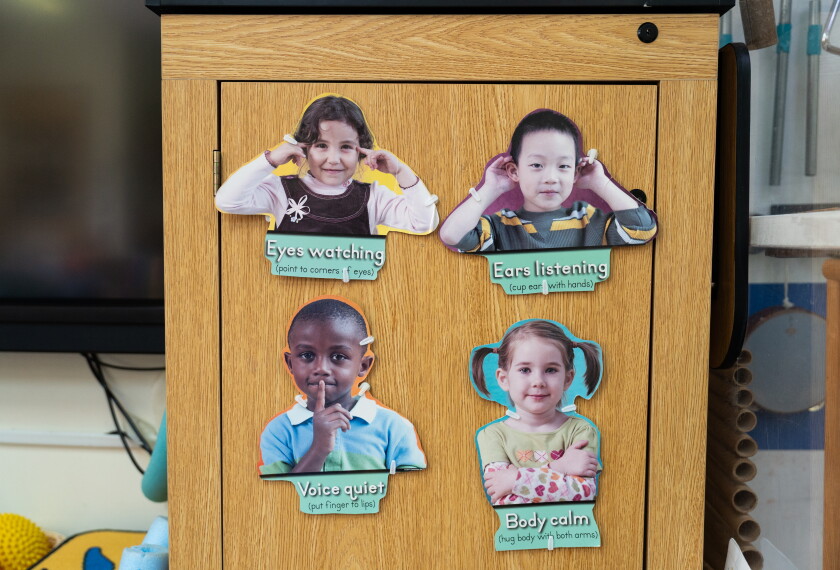
However, more importantly than the academic piece, it should really focus on the social-emotional: teaching children how to be in a group setting, how to interact with other children, how to build relationships, how to develop empathy for their classmates. We can drill academics day in and day out. But if children don’t have those soft skills, they’re not going to be ready when they get to grade school.
Turner: I also feel like the curriculum should be play-based. … Children are like curious little scientists, and when they can play and they’re having fun, that’s when they’re really learning.
When you look at the landscape of preschool curricula, where do you think it tends to fall short?
Farran: In many curricula, we spend too much time making children sit still and follow a really rigid and predetermined set of objectives, instead of allowing the teacher to figure out what each child’s interests are, or to engineer things that are going to get them interested. Some of these curricula put a lot of pressure on teachers. There are some principals who actually check to see if teachers are on the right page on the right day.
There’s really good evidence that kids who’ve been in this kind of high-academic drill setting in pre-K, their teachers actually rank as less tolerant, and as having more problem behaviors in the classroom. That’s not so unexpected if you’ve done research in this area, or if you understand young children’s development.
Freeing teachers from a rigid curriculum does not free them completely from the kind of work you really have to do in an early childhood classroom. When you find things that students are curious about and that they enjoy, you as the teacher can use these to facilitate the learning that’s expected to happen under benchmarks from states or districts.

How do students practice social-emotional skills at this age?
Turner: I have a lot of students in my room with disabilities, a lot of them are on the autism spectrum. We talk a lot in my classroom about what I call “gentle hands”—using soft hands with your classmates.
Today, we read a story, Hands Are Not for Hitting. I had a puppet that was soft, and for my children who are nonverbal, I gave them a soft object to hold in their hands so they had something concrete to understand soft. And some of my more verbal students got up, and they started saying, “Well, soft hands could be handshakes,” and they started showing examples of that. Something that curricula can often overlook is that it’s not always best to be teacher-led.
A teacher could have the most perfectly planned out whole-group instruction, but sometimes it’s the children themselves that really make that [learning] magic happen.
How can preschool teachers strike a balance between following curriculum and personalizing instruction?
Pina: The curriculum is a road map for intentional planning. It’s to ensure that your classroom is set up appropriately, that you’ve designed or created a daily routine and schedule, and to help you mark the milestones that students need to aim for.
But essentially, you want to ensure that it is individualized for every child. You could have a classroom of 24 children. There should be something individualized for each child on your daily lesson plan. It doesn’t have to be something monumental, but it should reflect some type of support for each individual child.
How does the accountability pressure that some teachers feel influence how curriculum is used?
Farran: When you talk to principals, one of the reasons they say they like having a pre-K program in their school is because that’s where the children learn to do school. You can make learning to do school the focus of your entire pre-K curriculum. They’ll learn to stand in line and wait quietly to get their tray in the cafeteria room, but it’s a negative outcome.
It’s as though the U.S. education industry contracted a virus about 25 years ago, which believed that the earlier you learned the [academic] skill, the more likely you were to be successful in school. And that meant concrete skills—not skills [that address] frustration, tolerance, or internal regulation, but knowing your letters of the alphabet.
We have no data that says that children who get those [academic] skills early, at 4, are better off than children who get those skills in kindergarten or 1st grade. We need K-12 schools to help children learn those skills. But teaching them earlier and earlier because of the accountability pressure is counterproductive.