Includes updates and/or revisions.
Despite declining revenues and budget shortfalls, state funding for prekindergarten is expected to increase by about 1 percent, or $5.3 billion, nationally in fiscal 2010, says a report from a group that advocates high-quality early-education programs.
In fact, 27 of the 38 states with existing pre-K programs, as well as the District of Columbia, increased or maintained funding for early education in their 2010 budgets, according to the Pew Center on the States’ Pre-K Now campaign, based in Washington. In addition, two states—Alaska and Rhode Island—launched pre-K pilot programs this fiscal year.
“We weren’t sure exactly what we were going to find this year, because the economic situation is so bad in the states,” said the annual report’s project manager, Albert Wat. “But most states that have funded pre-K programs in the past are still prioritizing early education in the state budget and, overall, they ticked up modestly by about 1 percent.”
Ten states, though, decreased funding for state-led pre-K programs, and another 10 states do not have state-funded early-education programs in place, according to the report released Oct. 22, “Votes Count: Legislative Action on Pre-K Fiscal Year 2010.”
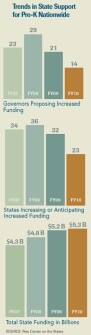
Despite widespread fiscal problems, states overall moved to boost funding for early education in fiscal 2010.

SOURCE: Pew Center on the States
“In Illinois, Michigan, and Ohio, in particular, a failure to make tough choices that put proven programs ahead of politics will cost thousands of young children the opportunity to enter kindergarten better prepared,” the report says. “These cuts leave families without essential supports and lead states astray from the path to recovery.”
Yet some states with significant budget shortfalls made efforts to sustain prekindergarten programs, said Mr. Wat.
“There’s an indication that even in states that are really troubled by the economy, they prioritized this,” he said. “Policymakers really see this as something that has important returns for children.”
In Rhode Island, officials decided to launch a program despite difficult fiscal conditions, considering it a good investment.
“This gives us the opportunity to grow a quality program from the beginning,” said Deborah A. Gist, the state’s commissioner of education.
Sustainable Investments?
In California, funding for the state’s preschool program increased by 2 percent, even though the state is in the midst of a budget emergency and faces a deficit of more than $25 billion.
“We are really pleased by the fact that we were able to maintain our programs,” said Nancy Remley, an education administrator for the California Department of Education. “We know that early education is really one of the best indicators that children are ready for school, and the achievement gap can really be reduced by this reduction in the readiness gap.”
Like many other states, California tapped into money from the American Recovery and Reinvestment Act—the federal economic-stimulus program—to help maintain pre-K programs. But that money is available on a one-time basis and is not a sustainable funding model, Ms. Remley said.
Mr. Wat shares such concerns. “While we think that [the stimulus money is] helpful for states, ... they have to be careful about how to sustain those investments,” he said.
One of the most stable ways of paying for pre-K programs is by including them in school funding formulas, said Mr. Wat. That can mean that such funding “has the chance of growing over time as more kids go into the system,” he said.
Looking to Congress
States might also pin some hopes on the proposed federal Early Learning Challenge Fund, part of a student-loan bill now pending in Congress. The fund would provide up to $1 billion a year for eight years for pre-K programs, the report notes. Legislation setting up the fund passed the House of Representatives in September and is expected to be considered by the Senate this month.
The report recommends that Congress add several requirements to the proposed fund, such as setting aside a certain amount of money specifically for 4-year-olds considered to be at risk of academic challenges, and requiring that each state demonstrate its processes and policies for “meaningful engagement of families in children’s early education.”
“The House version of the bill requires states to demonstrate the steps they are taking to improve program quality for low-income children but lacks specific directives to serve more of the roughly half-million at-risk children who still do not have access to pre-K,” the report says. “It also does not ensure specific quality standards to raise the bar for all early-childhood programs.”
The report calls on Congress to create a federal funding stream specifically for pre-K programs, either through the Early Learning Challenge Fund or other legislation.
“With rising unemployment and reduced public expenditures in states across the country,” the report says, “Congress cannot afford to wait any longer to provide true federal support for programs that generate strong returns on investment and promote better school readiness and achievement for young children.”


