Parents visiting their children’s kindergarten class for the first time may think they’ve arrived at the wrong room, especially if they expect it to resemble the kindergarten they attended as 5-year-olds.
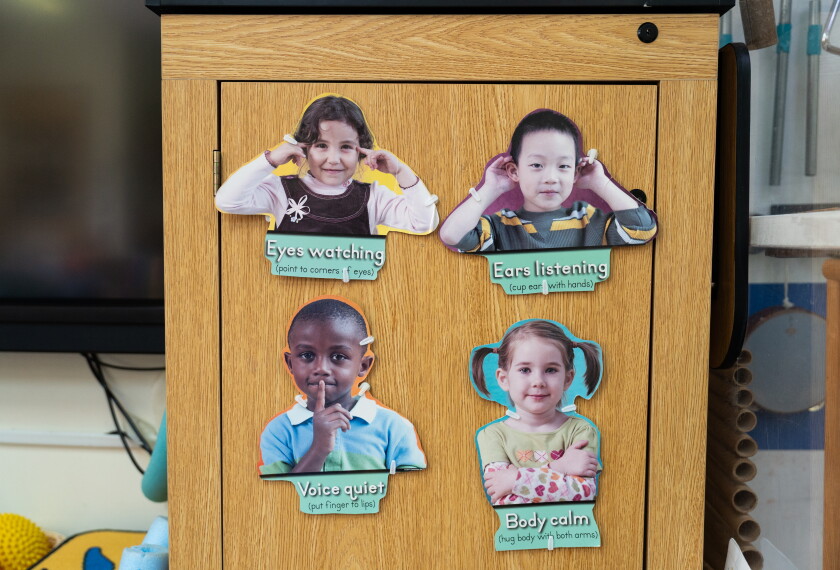
Imaginative play areas that once occupied a dominant part of the kindergarten landscape—think dress-up corners, easels and paints, stacks of blocks—have, in many instances, been replaced with literacy corners and science centers. Getting along with classmates and learning to follow simple instructions from a teacher also have been sidelined as the primary goals of kindergarten. Now, most kindergarten teachers are focused primarily on preparing young learners for future academic success.
The changes have not gone unnoticed by educators, parents, and policymakers.
“What I was noticing as a kindergarten teacher is that the opportunities for kids to come in and have chances to play, to experiment and test how the world works, were being pushed out for more academic instruction that wasn’t necessarily aligned with where their skill levels were or the experiences they had,” said Christopher Brown, the associate dean for teacher education at the University of Buffalo’s Graduate School of Education and a former kindergarten teacher who taught in the late 1990s. “That’s continued to be a concern with teachers that I’ve talked to for the past 20 years.”
Decisionmakers in some states and districts have begun to heed concerns raised by Brown and other education experts about the direction kindergarten has taken. As a result, some schools are returning play to its prominent role in kindergarten.
Here’s a closer look at why the pendulum of play in kindergarten has begun to swing again and how it looks different today.
When and why did play get pushed out of kindergarten classrooms?
As Brown noted, teachers have been raising concerns about changes to kindergarten for two decades. That time frame coincides with the passage of No Child Left Behind, the federal education law in place from January 2002 to December 2015. The law, which sought to improve public education for all children, led to an increase in standardized instruction and accountability measures related to academic achievement.
Experts say the pressure schools felt for their students to perform academically trickled down to even the earliest grades.
“We have this expectation that by 3rd grade, kids are going to take these standardized tests, and we need to know, ‘Are they on grade level or not?’ Then it just gets pushed back to 1st grade, and now it’s being pushed back into kindergarten, and to some extent, even pre-K,” said Kimberly Turner Nesbitt, an associate professor of human development and family studies at the University of New Hampshire.

Nesbitt attributes the pressure to ensure that students are performing on grade level to the rise in what she calls “passive, didactic, large-group instruction” in grades as early as kindergarten.
“Nobody wants to not see students being able to read at grade level or be at grade level in math,” said Nesbitt. Still, she said, this goal inadvertently may have led schools to “push down” expectations that were not developmentally appropriate for young students.
The Every Student Succeeds Act, which replaced NCLB in 2015, took steps to reduce standardized testing in K-12. But teachers continue to report stress related to standardized test prep.
In a 2023 EdWeek Research Center survey of 870 teachers, principals, and district leaders, 41% of respondents said the amount of time they and teachers in their districts spend preparing students for standardized tests has grown since 2018-19. Further, 51% of respondents said they felt a “large” amount of stress from school and district administrators to ensure their students perform well on state-mandated standardized exams; 28% reported feeling a “moderate” amount of stress.
In several states, children begin taking standardized assessments throughout the school year as early as kindergarten.
Is the pendulum swinging back toward play-based learning in kindergarten?
In recent years, some educators have begun to push back against the “academization” of kindergarten. These voices have gotten the attention of state policymakers; in turn, a few states have begun to push for a return to play in kindergarten, including Connecticut, New Hampshire, Oklahoma, and Oregon.
New Hampshire in 2018 amended its education legislation specific to kindergarten, noting that this grade level is “structured upon a play-based model.” Language for the state’s official kindergarten tool kit says: “Educators shall create a learning environment that facilitates high quality, child-directed experiences based upon early childhood best teaching practices and play-based learning that comprise movement, creative expression, exploration, socialization, and music.”
Connecticut in 2023 passed legislation requiring play-based learning in public preschool and kindergarten classrooms, and permitting it in 1st through 5th grades. Members of the Connecticut Education Association, led by CEA Vice President Joslyn Delancey, pushed for the return to play-based learning in early elementary classrooms. Delancey taught elementary school for 17 years before being elected to the association.
“It was a commitment of mine to really understand where other educators were around play,” Delancey said. “It turns out that our members also were particularly excited about pushing a play as a legislative agenda.”
The legislation passed within a year of its introduction. Delancey credits its success to the CEA’s work to educate various stakeholders on the benefits of play-based learning, and its alignment with the state’s focus on creating and maintaining a positive school culture.
“I think that you can’t talk about improving school climate without talking about bringing play back into our classroom,” Delancey said.

In Massachusetts, the education department and the state association for school administrations issued a joint statement in 2021 asserting play as an instructional strategy in the early grades.
The state education department’s Early Learning Team then launched a Playful Learning Institute pilot initiative for administrators and educators in pre-K through 3rd grade. During the 2022-23 school year, the pilot involved monthly coaching in classrooms.
Is all play created equally?
Not all play designed for today’s kindergarten classrooms looks like it did in the 1970s and ‘80s, when kids played together without much direction or input from teachers. Still, free, or unstructured, play retains an important place in the kindergarten classroom, believe some education experts. It allows children to explore, imagine, and socialize independently. But it’s generally not tied to any specific academic goals.
“I love free play, and free play has its own rights. It’s great for social development. It’s great for helping kids build their confidence,” Nesbitt said. “But it’s not going to organically, on its own, teach kids how to read.”
Instead, schools are starting to adopt play-based or playful learning, in which teachers guide students in playful activities designed to grow specific skills. For example, when students are building with blocks, the teacher could ask facilitating questions like, “What do you think will happen if you add this heavier block on top?”
Play-based learning can boost students’ academic skills, research shows. A 2022 review of 39 studies that compared guided play to direct instruction (when a teacher delivers clearly defined, planned lessons in a prescribed manner) in children up to 8 years old found that guided play has a more significant positive impact than direct instruction on early math skills, shape knowledge, and being able to switch from one task to another.
But kindergarten isn’t just about acquiring academic skills, note education experts. Play-based learning also has the potential to help teach young learners lifelong skills.
“A lot of people are leaning heavily into the importance of play-based learning for the kinds of soft skills they can teach. I call them unconstrained skills,” Nesbitt said. “These are the skills that are not based on content-specific knowledge but rather, things like: How do we teach kids to collaborate with each other? How do we teach kids to be good communicators? How do we help them be critical and creative thinkers? How do we give them the motivation to want to be a learner?”