
Many years ago, when I was a 5th grade teacher in a high-needs, urban school, one of my biggest frustrations was how many of my students were uninterested in reading. My students were often bored with the textbooks that the district mandated they read. They questioned why they had to bother with stories that had “all these white people in them?” Why should they read when there wasn’t anything worth reading?
There were rare occasions, however, when my students became excited and really interested in reading. One year, I had my students read Roll of Thunder, Hear My Cry by Mildred D. Taylor. The novel captures a Black family’s struggle to maintain their integrity, pride, and independence in the face of racism. The book addresses racial segregation, discrimination, resistance, and agency during the Jim Crow era. I recall my students who were often not interested in books coming alive and being engrossed in the content. Those moments were truly magical, full of excitement, thinking, and learning.
A promise of education in a pluralistic democracy is for students to be able to explore, imagine, think about, learn from, and analyze content by and about people of the many different backgrounds represented in our nation. Immersing students in worlds like their own—with familiar language and depictions of people, neighborhoods, and home life that reflect their own experiences—helps them connect to learning. It’s also important for students to learn about environments that are different from theirs. That helps them to gain not only knowledge but understanding and empathy. Schools can be laboratories for a democratic society but not when the very few or the politically motivated can dictate the learning experiences of the many.
Hence, there is a danger in the recent trend of banning books in states and districts across the United States. In 2022, the number of banned books surged to notable levels. PEN America, which advocates free creative expression, cited 1,477 instances of books being banned during the first half of the 2022-23 academic year. The group notes, moreover, that more than 4,000 books have been banned since it started tracking cases in July 2021. What is more troubling than just the large number of books being banned is that 30 percent of the titles are about race or racism or have main characters of color, while another 26 percent have LGBTQ+ characters or themes.
PEN America’s research also revealed that Texas led the nation with 438 bans, followed by Florida with 357 and Missouri with 315. At a time when the nation continues to become increasingly diverse, the removal of stories, struggles, histories, and experiences that are unique to people of color and LGBTQ+ people should concern us all.
There appears to be a politically motivated effort to make parents fearful that schools are indoctrinating students rather than teaching them.
The exclusion of marginalized groups from the books in our libraries feels quite Draconian because it essentially amounts to omitting life experiences that are all too real for countless adults and children in the United States and beyond. Students need to learn about these experiences so that they can fight all forms of discrimination and prejudice. Book banning is proving to be one of the biggest threats to inclusive education that we have seen over the past two decades.
For the most part, the book-banning charge is being led by politically conservative groups that want to paint a romanticized or idealized picture of America’s past and present. Those who are calling for book bans argue that content in the books they target is not age appropriate and deals with sexual orientation and gender identity, topics they think schools should not address. Or those advocating bans say the books they want removed promote critical race theories, which they believe are guilt-inducing.
In some states, a small minority seems to be attempting to control content for all students there. There appears, moreover, to be a politically motivated effort to make parents fearful that schools are indoctrinating students rather than teaching them.
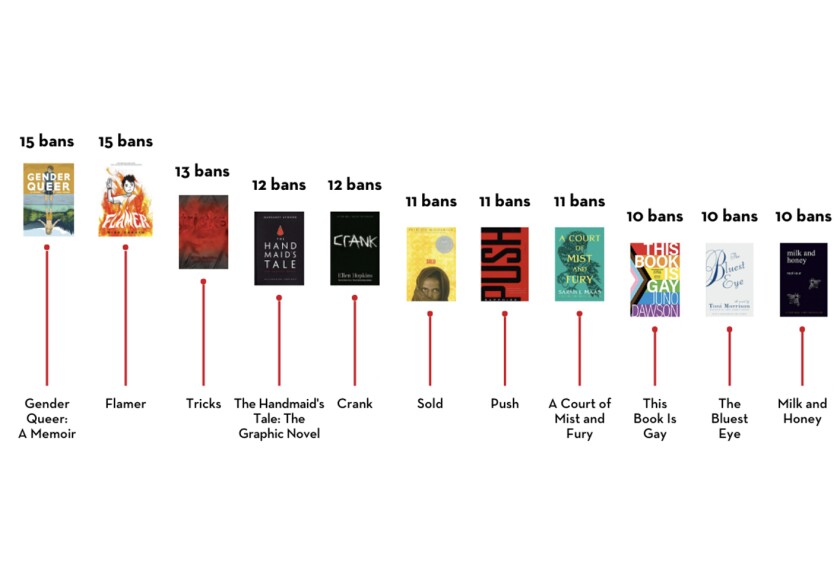
When the experiences of Black people, other people of color, and members of the LGBTQ+ community are excised from schools, students are not protected. Rather, they are harmed in several ways. One, students are denied the truth about U.S. history. Two, students are prevented from learning about the current realities and experiences of groups who face hardship. And three, students are deprived of an understanding of the challenges that groups have had to overcome to make our democracy better. Banning books like Amanda Gorman’s The Hill We Climb, All Boys Aren’t Blue by George Johnson, and The Hate U Give by Angie Thomas (all books that have been banned in Florida) threatens the powerful American tradition of sharing the stories of a diverse and changing America.
Education scholar and multicultural literature pioneer Rudine Sims Bishop has written extensively about the need for literature to be what she refers to as “windows and mirrors” wherein students see themselves reflected in what they read (mirrors) but also get to learn about the histories and experiences of others (windows). Sims Bishop has talked about how children from dominant demographic groups have always found their mirrors in books but says they, too, have suffered from the lack of availability of books about others. She asserts that all students need books that will help them understand the multicultural nature of the world they live in, as well as their connections to all other humans. This is the essence of education in a democracy, where students learn in a community of diverse peers with different experiences.
Now is the time for teachers, principals, school board members, superintendents, and parents to speak out and stand up against politically motivated book banning. Our students—and our nation—deserve better. If we want schools to truly include children of all backgrounds, if we want our democracy to be strong, the banning of books must stop.


