Opinion
Social Studies Opinion

What the Rejection of African American History Means for Students

Shrinking from the truth has never led to progress
By Monica Washington — February 17, 2023 | Corrected: February 21, 2023 3 min read
Illustration of a blank history book on a background collage of historic documents and the American Flag.
  • Save to favorites
  • Print

Corrected: A previous version of this opinion essay inaccurately characterized the Florida education department’s reasoning behind its rejection of AP African American Studies.

In the Advanced Placement American Literature course I taught for a decade, my students and I spent our time reading and analyzing writers who have been given a stamp of approval by being “canonized” for embodying the American story, struggle, and spirit. I always taught my students that it was important to situate our reading within the greater context of American history. “Whose story is being told?” “Whose stories are not reflected on these pages?” Those questions often prompted me to pull in additional standards-based texts so that we could, indeed, understand the full American story.

This past fall, I learned that the College Board was piloting an AP African American Studies course. This gave me hope that students would now learn some of the content pivotal to the American narrative that had been excluded from the traditional American literary canon.

I was encouraged by the thought that this history that is often seen as tangential to American history, to the American spirit, would finally be studied by young people across the country. For far too much of their K-12 experience, many students have only seen African American history treated as a subset of “real” history.
See Also

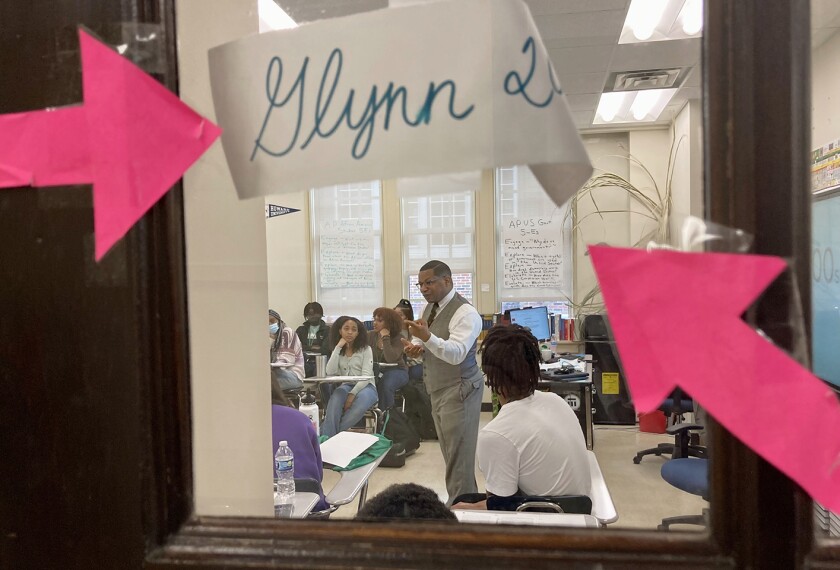
Emmitt Glynn is seen from just outside his classroom at Baton Rouge Magnet High School teaching his second AP African American studies class on Monday, Jan. 30, 2023 in Baton Rouge, La. Baton Rouge Magnet High School in Louisiana is one of 60 schools around the country testing the new course, which has gained national attention since it was banned in Florida.
Stephen Smith/AP
Social Studies How AP African American Studies Came Under Attack: A Timeline
Ileana Najarro, February 10, 2023
16 min read

But when Florida Gov. Ron DeSantis’ administration announced last month that AP African American Studies would not be taught in the state, my first question was, “Why not?” Remembering how well-sourced the College Board’s content is from my own certification process to teach an AP course, I was skeptical that the Florida education department determined that the course was “not historically accurate” and that it “significantly lacks educational value.”

AP African American Studies isn’t under fire for inaccuracies. On the contrary, the course is being banned because the content is accurate and valuable.

The ongoing rejection of African American history in Florida and many other states—including my own state of Texas—is a rejection of the stories that have been erased from the K-12 learning experience. It is a rejection of the struggles of Americans whose resistance forced this country to admit through new laws and constitutional amendments that our racism and discrimination were in conflict with our own stated values. It is the rejection of the lived experiences of the 7.4 million Black students in U.S. public schools, who need to learn how inextricably linked the work of their ancestors is not only to the work of Black people today but also to any progress that we label “American.” It is the absurd promise that the millions of students in our classrooms will one day inherit a country without knowing the full history of it. The irony is scary.

But however scary, this resistance to teaching students our shared history is not inevitable. Gov. J.B. Pritzker of Illinois recently wrote a letter to the College Board rejecting modifications to the AP African American Studies course. I hope that many other governors follow suit. Shrinking from the truth has never led to progress for all Americans.

Denying access to information does not lead to the preservation of democracy. In fact, access to information is a prerequisite for children to practice inquiry and the discourse they will need to exercise in society.

The DeSantis administration’s rejection of this course sends Floridians the message that African American history is “other.” It tells them that learning about the experiences of millions of Black people who helped build this country is more dangerous than learning a history that romanticizes the deeds of the colonizers and secessionists who continue to be celebrated in the curriculum and with monuments.

The greatest irony of all is that rejecting this history does nothing but hurt young people while legislators claim to be their saviors and protectors.

One thing I always told my students is that what the literary canon and history books include and what they leave out will always tell us who and what is considered important. Children who don’t see their stories in the curriculum will, in turn, feel disconnected from the learning process.

States, districts, and educators should look at the curriculum to determine whether it shrinks or expands knowledge, includes or excludes perspectives, erases or writes full history.

It’s only when we begin to have greater representation of all Americans in our academic content that we can say we are preparing children to be critical thinkers who will simultaneously love this country and demand it to do better for all citizens.

A version of this article appeared in the March 08, 2023 edition of Education Week as What the Rejection of African American History Means for Students

Events

Reading & Literacy K-12 Essentials Forum Supporting Struggling Readers in Middle and High School
Join this free virtual event to learn more about policy, data, research, and experiences around supporting older students who struggle to read.
School & District Management Webinar Squeeze More Learning Time Out of the School Day
Learn how to increase learning time for your students by identifying and minimizing classroom disruptions.
Recruitment & Retention Webinar EdRecruiter 2026 Survey Results: How School Districts are Finding and Keeping Talent
Discover the latest K-12 hiring trends from EdWeek’s nationwide survey of job seekers and district HR professionals.

EdWeek Top School Jobs

Teacher Jobs
Search over ten thousand teaching jobs nationwide — elementary, middle, high school and more.
View Jobs
Principal Jobs
Find hundreds of jobs for principals, assistant principals, and other school leadership roles.
View Jobs
Administrator Jobs
Over a thousand district-level jobs: superintendents, directors, more.
View Jobs
Support Staff Jobs
Search thousands of jobs, from paraprofessionals to counselors and more.
View Jobs

Read Next

Social Studies Reported Essay Students Have Questions About Our Democracy. Is Civics Class Up to the Task?
How today’s messy political realities are crashing against traditional civics education.
10 min read
The outside world seeps into a civics classroom.
Islenia Mil for Education Week
Social Studies Opinion What Should Civics Instruction Look Like?
States should take four policy actions for a rigorous approach to civics in the classroom, an educator explains.
6 min read
The United States Capitol building as a bookcase filled with red, white, and blue policy books in a Washington DC landscape.
Luca D'Urbino for Education Week
Social Studies A Hands-On Lesson in Civics Sees Surging Student Interest in the Age of Trump
The American Civil Liberties Union sees interest spike in its student advocacy institute, while conservative groups have their own programs.
10 min read
This summer, the ACLU expanded to three weeklong sessions of 300 students each, with participants coming from all 50 states, the District of Columbia, Puerto Rico, and, for the first time, Guam. Maddie Clements, 16, a rising junior at West Creek High School in Clarksville, Tenn. (center, ink hair) listens during Anu Joshi’s immigration rights keynote which packed an auditorium at American University.
This summer, the ACLU expanded to three weeklong sessions of 300 students each, with participants coming from all 50 states, the District of Columbia, Puerto Rico, and, for the first time, Guam. Maddie Clements, 16, a rising junior at West Creek High School in Clarksville, Tenn. (center, with pink and purple hair), listens during Anu Joshi's immigration rights keynote.
Melissa Lyttle for Education Week
Social Studies Opinion Patriotic History Education Doesn’t Mean Ignoring Our Country’s Troubled Past
History educators must reevaluate how to teach the subject to empower students to sit with historical tensions.
Zachary Cote
5 min read
Bird flying up into sky behind a broken chain. Freedom concept, liberty and human rights allegory, career or business ambitions, dove spread wings. United States patriotism.
Vanessa Solis/Education Week + iStock/Getty Images
