Sam, a 12-year-old student in one of my LitWorld programs for struggling readers, had a breakthrough moment recently. It happened at 3:30 p.m., after school hours, when he picked up Horton Hears a Who! and the volunteer smiled at him, and said, “That’s the perfect book for you, Sam. Dr. Seuss is one of the world’s greatest, most brilliant writers of all.” The book was the perfect level for him as an emerging reader, the perfect pitch of humor and art; in short, the perfect book for Sam.
Back in his classroom, Sam was required to read To Kill a Mockingbird. He struggled against this book every day. He could not decode or comprehend it. He faked his way through it. Ashamed, he did whatever he could to distract the teacher and his fellow students from recognizing his struggle, from fooling around while everyone was reading to acting goofy when the teacher asked a question. In no way was this book a refuge for him, or an inspiration. It did not help him learn to read, nor did it help him to become a lifelong lover of text. And he was alienated and isolated from his peers.
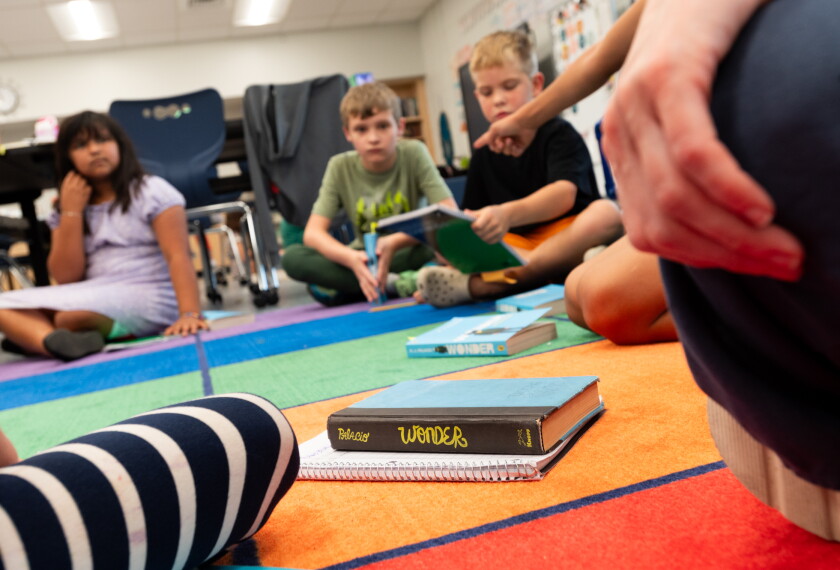
We have now reached a point at which teaching with neither the whole-class novel nor the basal reader, in which the whole class reads a selection together, is viable. We must end these practices. They are not benefiting our students. On top of that, our test-obsessed culture depletes our students’ energy, leaving them with little time for meaningful, authentic interactions with multiple kinds of texts.
The entire game is changing right now, right this minute, for two crucial reasons: One is the miracle of technological advances, and the second is the advent of the common-core standards. The instructional-reading landscape is being transformed.
Teachers, we have two choices: We can continue as we have been and appear completely disconnected from our students’ lives outside the classroom, where they live as readers and writers in a technological world and where we ignore the impact the common-core standards will have on our classrooms, or we can seize this transformational moment and allow these two “disruptions” to energize our own teaching.
We have now reached a point at which teaching with neither the whole-class novel nor the basal reader is viable."
I would choose the latter path, where we give students agency as readers; where we stop blocking or banning from our classrooms the kinds of reading and writing our students are doing outside of school. We should stop reacting as if all the ways students read and write outside school are wrong and superficial, and instead bring that mash-up of personal ideas and text variety into our teaching. We should utilize technology to help students engage with ideas and connect with one another around stories and poems. We should expect students will read across genres and engage in deeper, more critical and collaborative thinking about their own and others’ responses to text. We have an opportunity to revolutionize the teaching of reading, right now.
The whole-class novel is not good for anyone, but it is especially detrimental for boys. Choices tend to skew toward female interests and protagonists, probably because the vast majority of teachers are still women. We’ve turned reading into something that does not belong to boys at all. “To Read or Not to Read: A Question of National Consequence,” a National Endowment for the Arts study published in 2007, revealed that, by 12th grade, boys score an average of 13 points lower than girls on reading-proficiency tests.
We have relentlessly selected books about women, by women, mostly fiction, very, very rarely nonfiction. We have valued offline reading above online reading. And then, we have forced all of our students to read the same book, at the same time, in the same way, asking every time for the same outcome: the five-paragraph essay, the question-and-answer worksheet.
What’s the alternative?
To read in school what one is driven to read, every day. To read at one’s own pace. To read driven by one’s own passions. To read on whatever device makes the most sense for that particular reader, whether it’s a mobile phone or an iPad. To invite all students to become, in essence, the curators of their own reading lives. This should be our reading program.
If a student has found 16 blogs about boats, let him read those in school. And maybe that student will follow one of those blogs to a newspaper series about a regatta, or to Dove, Robin Lee Graham’s personal account of sailing around the world as a teenager. In these ways, our students will be exposed to a wider variety of genres than the whole-class novel ever allowed, and they will be more compelled to think critically across genres, as the common-core standards will require of them.
Teachers who champion a child’s reading life help our boys and girls build stamina. By reading a lot and reading every day, our students ingest. And the more they ingest, the faster and smoother they read. Stamina is vastly underrated. Reading DK Readers or Harry Potter or game manuals or a thousand mobile texts all help children learn to read longer, stronger, and faster.
Consider how carefully children and teenagers curate their interests. Think about how much they want to be recognized for what they like. This is especially true now: On Facebook, you broadcast what you like, because you know that what you like is part of who you are. Even the youngest child “curates” his shelf of toys or his stack of Lego creations. Now, more than ever, thanks in large part to technology, the act of reading can be a deeply personalized experience. A great and current example of this is the new iPad app called “Flipboard,” which allows us to pull from many different sources to create our own, online personalized magazine.
Now is the time to teach our students to empower their own reading lives and power them forward, rather than passively waiting for us to select what will move them. When a child curates his own reading life, he willingly and independently connects his writing life to it. His Facebook status message, texts, and conversation will reflect the experience of reading.
Of course, you will have books that you feel truly belong in a canon. Perhaps you are hungering for your students’ exposure to them. If so, consider reading them aloud, especially if a good number of students in your class are not reading independently at those levels. Or you could provide crucial beautiful excerpts from a beloved text that you then pair with a similarly themed selection from another book. Have your students respond and discuss the reading by text message, on a whole-class blog, or on a great website built just for these kinds of collaborations, such as voicethread.com.
Let’s motivate our students to become curators of their reading lives. With our guidance, they will discover the texts they want to stay up late to read. And they will come to school the next day wanting to read more. They will ingest not just hundreds, but thousands of words each day, to fortify and empower themselves for this radiant new era that is upon us.