|
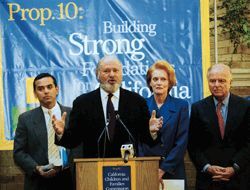
| Flanked by Speaker Antonio R. Villaraigosa, left, State Controller Kathleen Connell, and Los Angeles Mayor Richard Riordan, Rob Reiner announces the distribution of the first Proposition 10 money. --Chris Pizzello |
It’s been a year since California voters narrowly approved a measure called the Children and Families Initiative and radically changed the way services for young children are paid for in this state.
A 50-cents-a-pack cigarette tax, projected to bring in $700 million a year, will be used to supplement health care, child care, parent education, and other programs to help newborns to 5-year-olds.
But now, just as the money is starting to reach the hands of those who will decide how to spend it, the new law and its celebrity spokesman, the director and actor Rob Reiner, are facing challenges, both legal and academic.
Two lawsuits have been filed seeking to have Proposition 10, as the initiative was known on the ballot, thrown off the books. And the plaintiff in one of the cases, the president of a retail business called Cigarettes Cheaper, is also sponsoring a repeal effort, Proposition 28, that has qualified for the March 7 primary ballot. A new book, meanwhile, takes aim at the intellectual premise behind Proposition 10.
In The Myth of the First Three Years: A New Understanding of Early Brain Development and Lifelong Learning, John T. Bruer, the president of the St. Louis-based James S. McDonnell Foundation, questions the idea that the infant and toddler years are a uniquely critical period for cognitive growth and says Mr. Reiner has oversimplified a complex child-development issue.
“When you see the science abused like it has been in this case, it’s upsetting,” Mr. Bruer said in a recent interview. “It’s unfortunate that a referendum was waged in California on the basis of such misrepresentation.”
| Rob Reiner |
| Titles: Co-founder, Castle Rock Entertainment; Chairman, California Children and Families Commisssion. |
| Professional: Director and actor. Movies include: “This Is Spinal Tap,” “Stand By Me,” “When Harry Met Sally,” “A Few Good Men,” “The American President,” “The Story of Us.” Co-starred in the television series “All in the Family,” 1971-78. |
| Age: 52 |
| Family: Married to Michele Singer Reiner; three children, ages 8, 6, and 1. |
Another ‘Either-Or Issue’?
Mr. Reiner, who worked to pass the initiative and is now the appointed chairman of the state commission overseeing its implementation, is unfazed by such comments.
“I don’t understand John Bruer,” Mr. Reiner said in a recent interview in his Beverly Hills office at Castle Rock Entertainment, calling Mr. Bruer’s book a “denouncement of everything I’ve tried to do.”
“Let’s say there is no evidence” that the early years are critical in a child’s development, he said. “Would you then say, ‘Let’s not invest in child care for young children; let’s not invest in health care for young children’?”
He added that the national “I Am Your Child” campaign, a public-awareness effort he also chairs, has never been guilty of creating stress for new parents—something Mr. Bruer argues has resulted from the emphasis on early brain development.
“We’ve never made the case that you’ve got to play Mozart for your child, that you’ve got to use flashcards with your child,” Mr. Reiner said.
Jane I. Henderson, the executive director of the California Children and Families Commission chaired by Mr. Reiner, said she hopes Proposition 10 doesn’t become another “either-or issue"— something that for California, with its struggles over bilingual education and methods of reading instruction, is certainly not new.
Such criticisms aside, Mr. Reiner and the commission members are focusing on a more immediate concern: finding a balance between following the necessary procedures of a state enterprise—such as adopting guidelines, hiring staff members, and handling fiscal matters—and responding to mounting pressure from children’s advocacy groups anxious to see their programs benefit from the new source of funds.
At last month’s state commission meeting in coastal Santa Barbara County—where the wealthy stroll down streets lined with designer stores and quaint cafes—those who speak for the county’s less fortunate brought their requests before the commission. Homeless children, children with disabilities, and children without health insurance were among those represented.
But the Proposition 10 dollars are unlike most pots of government-controlled money. The cigarette-tax proceeds are deposited into a trust fund and will roll over from year to year instead of having to be spent by an annual deadline.
It’s that feature, one local commissioner from San Francisco says, that will allow the counties to determine the needs in their communities and carefully develop their strategic plans.
“We are really trying to pace ourselves. A lot of the counties are taking the time to do a comprehensive plan,’' said Deborah Alvarez-Rodriquez, a member of the children-and-families commission in San Francisco and the director of the department of children, youth, and families in the San Francisco mayor’s office.
‘A New Concept’
During these early months of Proposition 10’s implementation, officials at both the state and the county levels are making a deliberate effort to be nonbureaucratic.
| Officials at both the state and the county levels are making a deliberate effort to be nonbureaucratic. |
The state commission meets in a different location each month to give a broad range of people a chance to attend. Focus groups, parent surveys, public hearings, and other gatherings are on the agenda to give Californians a chance to voice their concerns and learn more about the goals of the initiative.
And eight counties have joined the Civic Engagement Project, an effort financed by four California foundations to help the local commissions stay in touch with the public. Each of the state’s 58 counties has its own local commission that will decide how to spend the money that comes in as a result of Proposition 10. As of late October, $362 million had been deposited into the accounts of the local commissions; $173 million of that went to Los Angeles County.
Still, Ms. Henderson worries that the only message that is getting out to the public is one of process and politics.
Indeed, in some counties, observers worry that the children-and-family commissions, which are appointed by each county’s board of supervisors, have become another political football.
“It’s a relatively new concept to elected officials, and that is to let go,’' said Carol Hatch, an assistant to U.S. Rep. George Miller, a Democrat who resides in Contra Costa County and has been interested in the implementation process there.
The law requires at least one county supervisor to sit on the local commission as well as a local school official. Joseph Munso, the chief deputy director of the state commission, said most local commissions are reaching the maximum number of nine members and are “getting a good variety of people.’'
Other counties have been criticized for dragging their feet.
A recent editorial in the Los Angeles Times read: “Los Angeles County leaders have not done much to ease the fears of the early opponents of Proposition 10, who wondered whether the initiative would live up to its goal of transcending politics-as-usual.’'
If there has been any interference from county supervisors, it’s because of poor wording in the law itself, Mr. Reiner said. The initiative was silent on whether the local commissions could enter into contracts with providers to deliver services. The supervisors, he said, just don’t want to be held accountable for those funds.
The state attorney general is expected to issue an opinion soon to clarify that the commissions are indeed autonomous.
‘It’s Not Fair’
That’s one aspect of the law that the author of the repeal effort, Ned Roscoe, finds troubling.
“We are not in love with the manner in which this money is being handled,’' said Thomas Hiltachk, Mr. Roscoe’s lawyer. “That’s a lot of money out of the hands of elected officials.’'
In fact, a review of Proposition 10 written earlier this year by the California legislative analyst’s office said that “with up to 58 commissions and the broad discretion that they have in allocating their revenues, it will be a challenge to ensure that the funds will be spent effectively.’'
The report also recommended that the legislature consider establishing incentives, such as matching-grant programs, to encourage the counties to spend their money on proven early-childhood programs.
Mr. Hiltachk said his client, whose Benecia, Calif.-based business sells cigarettes at about 230 outlets throughout the state, also believes that targeting smokers is simply unfair.
“This is a program that benefits the public generally,’' Mr. Hiltachk said. “It’s not fair to single out a small segment of society and ask it to pay for something.’'
Mr. Reiner said that he was concerned about the repeal effort, but that opponents were in a weaker position than when Proposition 10 was on the ballot.
“We’ve fought them before,’' he said. While proceeds from the extra 50-cent tax can’t be used to fight the repeal, he added, a public-awareness effort about Proposition 10, which was mandated by the law, is likely to coincide with advertisements by the opposition.
The question, Mr. Reiner said, is whether “big tobacco will throw its weight behind’’ the repeal.
Policy and Entertainment
Mr. Reiner keeps daylong commission meetings moving with a blend of parliamentary procedure and a quick wit.
“I think Mr. Reiner has more credibility than most politicians,’' said a member of the audience who addressed the commission.
“That’s not saying much,’' Mr. Reiner quipped.
While becoming a public official hasn’t completely kept Mr. Reiner away from his other job—as the recent release of his newest film, “The Story of Us,’' shows—Proposition 10 business now occupies about half his time.
And his devotion to children’s issues hasn’t knocked him out of his position as “one of the top directors in town,’' said Stephen Galloway, an executive editor at The Hollywood Reporter, a trade newspaper.
“This is a very liberal town,’' Mr. Galloway said. “If you want to join the Flat Earth Society, that’s your business.’'
While it may be disappointing to those who provide services to children in the state, Mr. Reiner and others say it’s too soon to know just how the money will be spent—whether it will be used to supplement existing programs or start new ones. Many of the local commissions won’t have their strategic plans ready until spring.
And something else could keep the counties from spending the money right away.
Because Proposition 10 is meant to discourage smoking, the revenue from tobacco sales is expected to decline over time. In fact, officials already have reported a 30 percent reduction in tobacco sales statewide since the collection of the tax began in January.
So the state commission is advising counties to consider investing some of the revenues from Proposition 10 instead of committing the money to a large program right away.
Whether or not counties decide to do that, Mr. Reiner said it’s likely that child care will get a lot of the added resources. But he would also like to see new ideas.
“To me, the best practice hasn’t been invented yet,’' he said.


