

Jafiah Holly, a senior at Lindbloom Math and Science Academy in Chicago, wants to be a criminal defense lawyer one day.
In her high school law class, she’s studied verdicts that have left her with big questions about the justice system—like how to handle the cases of kids and teenagers charged with serious crimes, including murder.
“He was so young, and there was no counseling,” said Jafiah, 18, of the defendant in one of the cases she’s learned about in school. “They were just really quick to put him behind bars.”
So when Jafiah had the chance to put questions to a panel of Illinois state judges last week, she wanted to know how they weighed decisions like these.
“What is the role of a judge in ensuring that courts proceed fairly and that the law is equally applied?” she asked.
It’s a question that’s coming up nationally, too, as federal courts weigh the legality of far-reaching Trump administration policies in immigration, tariffs, funding cuts, transgender rights, and other issues.
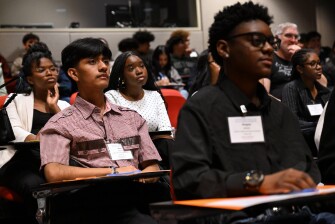
The panel, held at the Chicago-Kent College of Law March 13, offered about 100 students from Lindbloom and George Washington High School in Chicago the opportunity to pose their questions about the judicial system directly to state court judges. The event was part of Justice250, a statewide civic education initiative organized around this July’s semiquincentennial.
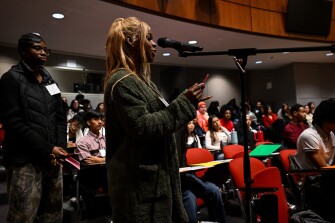
At the event, students wanted to know how the judges rose to their positions, what their day-to-day work entailed, and what they thought about state and national issues. A common theme in their questions was how the justices made their decisions, and what factors they considered—a process that’s been in flux, and the site of controversy, since the founding of the country itself.
For some of the high schoolers, the judges’ answers underscored how legal ideals don’t always play out practice the way they do in theory.
In response to Jafiah, the panelists emphasized the judicial system’s stated commitment to impartiality.
“Everybody gets treated the same. Doesn’t matter who you are, how much money you have,” said Ankur Srivastava, the supervising judge of the Circuit Court of Cook County’s Pretrial Division.
“We have to put what we personally believe to the side,” said Cynthia Cobbs, a judge of the Illinois 1st District Appellate Court.
Jafiah felt they were being sincere. But not every judge is the same, she said, in an interview after the event.
“Obviously, that’s what we want to hear,” she continued. “But when we actually look back at the reality we are looking at as civilians, that’s not what we see.”

Immigration issues are top of mind for some students
The country’s courts have played an especially significant role in national politics over the past year of President Donald Trump’s second term.
Hundreds of lawsuits have been filed in federal courts challenging the administration’s policies, according to a tracker maintained by the New York Times. By the end of 2025, the Supreme Court had been asked to rule on more than two dozen of these cases.
Some teachers have said that the flurry of action has offered a ready-made lesson opportunity about the finer points of constitutional law. Others are concerned that it’s getting harder to reconcile the version of government laid out in their textbooks with what’s happening on the ground.
Though the justices at the March event were Illinois state judges, some students asked questions about federal issues, too. One 9th grader asked how courts are handling cases related to Immigration and Customs Enforcement.
Lawsuits against the administration have alleged that ICE activities have violated individuals’ constitutional rights as well as the 10th Amendment, which limits federal powers to those identified in the Constitution.
The judges said they couldn’t speak directly to ICE cases at the federal level. “We can’t give our opinions on certain things,” said Srivastava, before adding, “We can all agree it’s important that people feel safe coming to work.”
The 9th grader, who asked that her name not be used, said she would want to know what the federal judges adjudicating these cases thought. If she could talk to them, she said in an interview after the event, “I’d probably ask, what are you doing to help the community feel safer?”
Students want to know how judges weigh difficult cases
Most students, though, asked about the nuts and bolts of how the state court system works.
If judges see hundreds or thousands of cases a year, the students wanted to know, how do the courts handle that volume? For cases that deal with difficult or heavy topics, how do judges manage their emotions outside of work? When judges are faced with complex cases, how do they reach agreement? How do they make tough decisions?
“I encounter that every day,” said Srivastava, giving an example that has cropped up in the state recently.
Illinois eliminated cash bail in 2023, but prosecutors still sometimes ask him to hold defendants in jail before trial.
That’s always a hard decision to weigh, he said: “When do you do that? If you think someone’s not going to come to court, or they’re dangerous?” Holding people in jail has consequences—defendants are separated from their families; they might lose their jobs, he said. “There’s a cost in that time period for their life,” Srivastava said.
Elizabeth Rochford, a justice on the Illinois Supreme Court, talked about her experience serving on family court.
“You’re making decisions about children and their future, and doing it the very best you can based on the facts that are before you … but you can have sleepless nights over it,” she said.
“Every case is the most important case to the parties who are before you, and so treating it that way, giving it the attention and the care, is essential. But you’re not going to get them right 100% of the time, and that’s also one of the reasons that they are reviewing courts.”
Getting this inside look at the court system, and the people who work inside it, left some students imagining themselves in those roles. Several of the teenagers at the event told Education Week that they wanted to be lawyers or judges.
Jafiyah, the Lindbloom student, completed an internship two years ago in the Circuit Court of Cook County’s Chancery Division, which handles issues including contract matters, mortgage foreclosures, and wills and trusts. The high school senior, who is Black, said she didn’t see many Black women in the office.

“It was more a white, male-dominated field,” she said. “It discouraged me a little bit, and it kind of actually scared me. How am I supposed to find my way in this path, when I don’t see anybody that looks like me?”
After the panel, she approached Cobbs on stage, and asked her about being a Black woman in the legal field. How did she avoid getting discouraged, Jafiyah asked? Cobbs told her about finding a mentor who believed in her.
Hearing more about Cobbs’ path, Jafiyah said, made it easier to envision it for herself.


