
A few years ago, Rock Rest Elementary school went all in on phonics.
The K-5 school outside of Charlotte, N.C., had been spurred to action by the “science of reading” movement. Teachers and administrators realized that students weren’t being taught how to effectively sound out words, said Elaine Shobert, the school’s literacy curriculum facilitator.
“When we watched kids and listened to kids,” she said, “we were like, ‘Yeah, they’re not reading.’”
Rock Rest adopted a program to systematically teach students how to decode—how letters represent sounds, and how to blend those sounds together to read words. It helped students become better readers. But it didn’t solve everything, Shobert said.
In the upper elementary grades, students still stumbled through longer words. They’d skip words they didn’t understand. Shobert was left with a persistent question: “What are we missing?”
A nationwide gap in phonics instruction galvanized the science of reading movement. But as the movement has matured and evolved, it’s become a truism that phonics alone isn’t enough. It’s a message that many researchers cautioned about in the early days of the movement, but is now beginning to gain more attention nationwide.
Teaching students how to sound out words is a crucial foundation. Without it, kids can’t access text at all. But reading well is the product of a host of skills and knowledge that researchers say schools should continue to develop well past the point when students learn how to decode.
Through collecting student data and watching children read, staff at Rock Rest realized their students still struggled with some of these skills, like vocabulary and complex sentence structure.
“All of these things need to be taught,” Shobert remembers thinking. “When are we going to do it?”
A 30-minute lab helps kids grapple with language structure
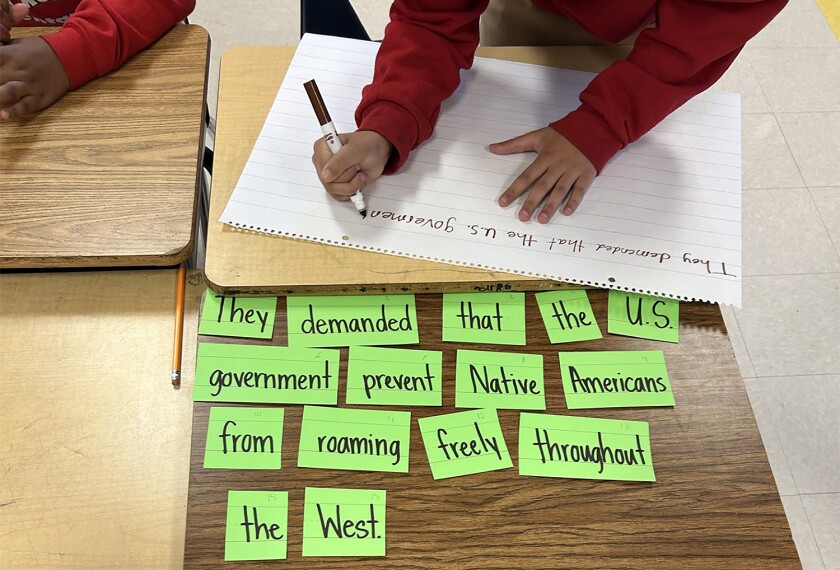
So leaders at the school decided to block off time at every grade level each day, a 30-minute period for what Rock Rest would call a “language lab.” There, students would practice using academic vocabulary, explaining their ideas out loud and parsing those of the authors they read—skills that didn’t always receive time in their English/language arts curriculum.
It’s an idea with “interesting potential,” said Susan Neuman, a professor of childhood and literacy education at New York University.
“Bravo to them for focusing on language,” she said. “It’s an area that really, really needs attention.”
Even though more than 40 states have passed laws requiring schools to adopt evidence-based approaches to reading instruction, some researchers have argued that much of this legislation takes a too-narrow view of the component skills that comprise reading ability.
Most state laws include references to phonics, reading fluency, vocabulary development, and reading comprehension, according to an analysis of the legislation published by Neuman, Esther Quintero of the Shanker Institute (a think tank affiliated with the American Federation of Teachers), and Kayla Reist of the University of Virginia. But fewer mention oral language, writing, or building background knowledge—all of which are also key components of reading development, the authors write.
It’s a pattern some educators at Rock Rest noticed in their curriculum materials, too.
“In the past, we had tried to incorporate morphology work and spelling and writing. We tried to tuck that into places,” said Julia Schaperjohn, a literacy curriculum support for grades 3-5 at the school. (Morphology refers to how parts of words, like prefixes and suffixes, connote meaning.) “It wasn’t getting the attention that it needed.”
These gaps were especially detrimental for the school’s English-learner students, said Shobert.
In the language-lab period, teachers do a deeper dive into the vocabulary and syntax that students are working with their reading classes. Most of the instruction is done orally, with students speaking and listening to each other.
At the word level, students might learn the meanings and spellings of common prefixes and suffixes that they will encounter in grade-level reading, said Shobert. They dissect texts, talking about how the use of different action words and modifiers, like verbs and adverbs, convey different meanings.
“A lot of how language lab is designed is by looking at what 3rd, 4th, 5th graders are reading at the time, and seeing what the demands of the text are,” said Schaperjohn.
Recently, for instance, 5th graders were assigned a historical text about Abraham Lincoln, she said. The sentences were long and complex with lots of clauses. So in 5th grade language labs, teachers explicitly taught students how to parse parentheticals and other “sentence interrupters.”
By the time students were reading the Lincoln text in their classrooms, Schaperjohn said, most weren’t tripped up by the sentence structures. It made it easier to focus on the text’s meaning.
Sometimes, these skills transfer in unexpected ways, said Judy Ames, a 3rd grade teacher. Third graders have worked on sentence interrupters at points, too, she said, which they’ve then noticed in word problems in math class.
Schools should aim for an ‘aligned system,’ researcher says
Rock Rest doesn’t have hard data on language lab’s effect on students’ literacy skills, said Shobert. And it’s only one part of the school’s overall literacy approach.
But Shobert says she can see the effect of the language lab in students’ work.
“Where I see it the most is in kids’ writing,” she said. “You walk down the hall, and you see evidence of more complex sentences being crafted.”
Still, said Neuman of NYU, other schools would want to track data on the effectiveness of an approach like this before adopting it.
And while developing students’ language abilities is an important part of reading instruction, it’s essential that schools connect this skill-building to their core curriculum, she said.
If kindergarteners, for example, are learning about how the suffixes “ing” and “ed” modify the word “jump,” they can practice with those words in isolation first.
“But then they should see it immediately in sentences, and then they see it immediately in connected text,” Neuman said. “All of that creates an aligned system.”


