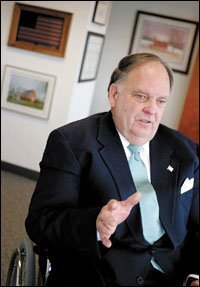
John H. Hager could not have picked a busier time to join the Department of Education as head of the office of special education and rehabilitative services.
After two years of wrangling, Congress reauthorized the Individuals with Disabilities Education Act last Nov. 19. A day later, the Senate confirmed Mr. Hager as the assistant secretary in charge of the department’s special education office, which administers the IDEA and a multitude of other programs.
Two months later, the Education Department got a new secretary, Margaret Spellings.
“Change has been the order of the day here,” Mr. Hager said in a recent interview in his office. “But I think it’s constructive change.”
The former lieutenant governor of Virginia and tobacco-company executive said he plans to bring his business acumen to bear in a 350-employee office that handles hundreds of millions of dollars in grants and programs that affect people with disabilities from toddlers to adults.
“My background is more in business management and structure and organization,” said Mr. Hager, 67, whose last position was overseeing security issues in Virginia as the assistant to the governor for homeland preparedness. “I think that’s the strength I bring to the table.”
His predecessor, Robert H. Pasternack, left the position in January 2004.
His current projects include ushering through the Education Department’s regulations for the reauthorized IDEA, and he has outlined an ambitious one-year time frame to get them in final form. After the last reauthorization of the act, in 1997, the corresponding regulations took more than two years to complete. Among the issues the new law covers are rules for teacher qualifications, discipline of students in special education, and special education monitoring.
This time around, Mr. Hager said, the draft rules should be out by May, followed by several public-comment sessions to be held around the country this summer. The final regulations should be complete by December, he said.
“We have a timetable, and if we don’t stay on task, an alarm clock goes off,” he said.
Other projects include providing technical assistance to the states as they implement the reauthorized IDEA, improving public awareness and outreach from the department, and overseeing the transfer of responsibility for special education research from the office of special education programs, which he supervises, to the 3-year-old Institute of Education Sciences, which oversees other educational research.
Nancy Reder, the director of government affairs for the Alexandria, Va.-based National Association of State Directors of Special Education, said the assistant secretary met with members of her organization in January.
“He seemed very receptive to addressing the issues they tossed out at him,” Ms. Reder said.
And in March, Mr. Hager addressed an event sponsored by the Virginia Department of Education and several organizations that oversee transition programs for residents with disabilities.
“He spoke of being in favor of transition services and said that needed to be in the spotlight,” said Dale W. Matusevich, a planner of the forum. “He also spent probably a good 45 minutes to an hour afterwards talking to us in a smaller group. That was greatly appreciated.”
The forum’s focus matched one of Mr. Hager’s own interests. Special education services, rehabilitation for adults, and research should all be focused on the outcome of job readiness, he believes.
“We have tried to refocus ourselves on employment and work outcomes,” Mr. Hager said.
Coming Back
Mr. Hager has firsthand knowledge of disability issues, from both his personal and professional life. He contracted polio in 1973, at age 36, from the unlikeliest of sources—his infant son Jack, who had received a defective oral polio vaccine that included enough live virus to infect his father. Weeks after his son was vaccinated, “I was hauled off on a stretcher, basically paralyzed up to the neck,” Mr. Hager said.
At the time a high-ranking executive with the American Tobacco Co., known for the brands Lucky Strike and Pall Mall, Mr. Hager was about to move his family from Richmond, Va., to Connecticut for a promotion. Instead, he found himself in the hospital and then in rehabilitation for four months. He now uses a wheelchair.
Age: 67
Education: Bachelor of Science in Mechanical Engineering, Purdue University, 1958 Master of Business Administration, Harvard University, 1960
Career: Assistant secretary for special education and rehabilitative services, U.S. Department of Education, December 2004-present Virginia director of homeland security, January 2002-May 2004 Lieutenant governor of Virginia, 1998-2002 Senior vice president and other positions, American Tobacco Co., 1961-1995
Family: Married to the former Margaret Dickinson Chase since 1971. Two sons: Henry Hager works for the U.S. secretary of commerce; Jack Hager attends the Darden Business School at the University of Virginia.
SOURCE: Department of Education
During his recuperation, friends urged him to get involved in civic life and Republican Party politics, which he did while continuing to climb back up the corporate ladder. Mr. Hager retired from the tobacco company in 1994.
In 1997, he ran successfully for lieutenant governor of Virginia. He gained a reputation as a plainspoken and active campaigner while crisscrossing the state during what he called his “Rolling Across Virginia” tour.
As a part of his duties as lieutenant governor under then-Gov. James S. Gilmore III, Mr. Hager chaired the Virginia Disability Commission, which recommends priorities to the legislature on disabilities issues.
“It was to help people with disabilities improve their lives,” he said of the commission’s role. “In essence, what we’re doing here.”
In 2001, he campaigned unsuccessfully for the GOP nomination for governor. It was also that year, he said, that he started talking with the Bush administration about a possible job in Washington. However, in the wake of the Sept. 11, 2001, terrorist attacks, Gov. Mark Warner of Virginia, a Democrat, appointed Mr. Hager as state security chief, a position in the governor’s Cabinet.
Since his arrival at the Education Department, he’s probably one of the few of his rank whose name has made it into the gossip column of The Washington Post. His son Henry, who works for Secretary of Commerce Carlos M. Gutierrez, has been linked romantically to first daughter Jenna Bush, reportedly a teacher at a Washington charter school.
To that, Mr. Hager offers a good-natured no-comment.
“We don’t talk about them. That’s not fair to them,” Mr. Hager said. “They’re both good kids.”
Settling In
As Mr. Hager has settled into his position, the Bush administration’s position on some of the programs he oversees continues to evolve.
Secretary Spellings has signaled her willingness to be flexible on some of the requirements of the No Child Left Behind Act. Education Department regulations for the law currently say that no more than 1 percent of students with severe cognitive disabilities who take assessments below their grade level can be counted as “proficient” under the law’s accountability mandate.
“With a new secretary coming in, it’s a normal process to take a fresh look at what we’re doing with the 1 percent cap,” Mr. Hager said. He offered no hint on when or whether a change may occur, however.
Many special education groups and school districts have long contended that the federal government is not fully funding its share of special education costs. The federal government currently devotes about 19 percent of the national average per-pupil cost to special education, but when the forerunner of the IDEA was first passed in 1975, some say Congress incorporated a goal of devoting 40 percent of average national per-pupil costs to special education
“The concept of full funding is arbitrary to begin with,” Mr. Hager argued. President Bush has increased special education funding faster than any president before him, the assistant secretary said. The president has requested a 4.8 percent increase for special education funding for fiscal 2006.
“I’m not discouraged about the funding situation at all,” Mr. Hager said.
Mary Kusler, the senior legislative specialist for the Arlington, Va.-based American Association of School Administrators, agreed funding has increased. “But I’d be remiss in not stating that they are nowhere near the levels that Congress has set.”
Organizing the department has given Mr. Hager little time so far to chat with special education advocacy groups, he said. “We really are trying to settle down and grab hold of all of the challenges here,” he said, adding that the summer will be a busier travel time for him, with the IDEA hearings, major conventions, and other department programs. “It’s important to get out there,” he said.