
Walking out of the classroom is generally seen as a last resort in teacher contract disputes because of the damage it can do to community-school relationships, but a new study suggests the tactic has become more common—and largely effective at boosting wages and benefits—even in states that do not permit strikes.
Since 2007, teacher strikes on average are associated with 8 percent higher compensation for their teachers, as well as slightly smaller class sizes, according to a new study released this week by the National Bureau of Economic Research, a clearinghouse.
“The nature of teacher strikes and the way the public sees teacher strikes has shifted and expanded beyond teachers,” said Melissa Lyon, the lead author of the study and an assistant professor of public administration and policy at the University at Albany.

Teacher strikes are an organized refusal to work, coordinated across a district, region, or even statewide, which can shutter schools for days or longer. Lyon and her colleagues, Matthew Kraft of Brown University and Matthew Steinberg, managing director of research and evaluation for the education nonprofit Accelerate, analyzed 772 teacher strikes that occurred between 2007 and 2023, which resulted in a 48 million days in which students were “idle,” or out of class, across all students enrolled in schools subject to the strikes.
While strikes most often occur when a teacher contract expires and the local union and district cannot agree on terms for a new one, the strikes during the 16 years of the study have incorporated both broader swathes of teachers and more expansive issues, from state funding for schools to policies affecting immigrant students.
“Teachers are intricately interwoven with recent shifts in the nature of labor actions,” Lyon said. “There are differing estimates, ... but I think it’s safe to say that at least a third of union members in the United States right now are teachers.”
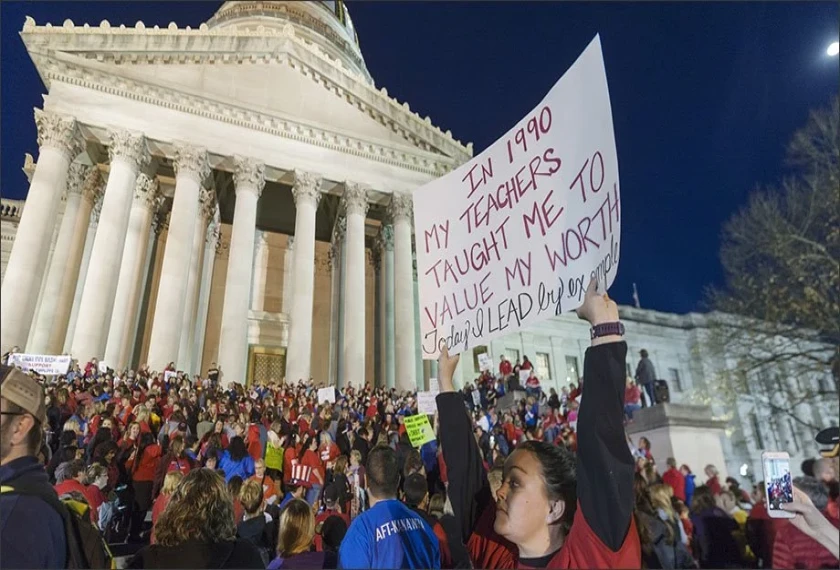
Teacher labor activism ballooned during the study period, accelerated by the “RedforEd” protests in 2018-19, in which thousands of teachers walked out of classrooms nationwide. They included statewide strikes in Arizona, Oklahoma, and West Virginia, and large urban strikes in the Chicago and Los Angeles districts to rally for higher teacher compensation and school funding more broadly.
That’s important, because the study found that the 8 percent average increase in teacher compensation—about $10,000 in 2018 money—by five years after the strikes was driven by new money from states, not just districts shuffling their budgets.
Districts which had teacher strikes also spent about 7 percent more per pupil on compensation for non-instructional staff, such as counselors or aides.
U.S. teacher strikes averaged only two days
Illinois still holds the nation’s record for the longest teacher strike—a Homer, Ill., strike that lasted 156 days, from October 1986 to June 1987—but modern teacher strikes during the study period lasted only two days on average.
That’s far shorter than strikes that have occurred in Brazil and Sweden, which sometimes lasted a month or more and which prior studies have found set back student achievement in those countries.
By contrast, student achievement changed little in the five years following the U.S. strikes that were studied, though math performance fell off in the months following the handful of strikes that lasted longer than 10 days. (Several of those strikes took place in cities, including an 11-day walkout in Chicago in 2019 and two weeks in Oakland, Calif., in 2023.)
Most strikes took place in states that didn’t allow them
Lyon found that a majority of the strikes researchers studied took place in states that explicitly outlaw such work stoppages—and on average, those teachers garnered similar wage increases as strikes in states where they were legal. They also helped reduce class sizes by an average of 0.5 students.
In part, Lyon said strikes in the states that prohibit them were by necessity bigger, more coordinated, and addressed broader systemic problems beyond compensation than those in states where striking is legal. Often they focused on increasing per-pupil funding.
“One of the major functions of teacher strikes is not just this two-way negotiation with local school districts, but is also the broader importance of the public signal,” Lyon said. “Teachers are signaling to the public that there’s an issue. And the public in general, at least over the past 15, 16 years, has found that signal to be credible.”
About 1 in 10 teacher strikes included a focus on a non-education issue considered important to the community, such as affordable housing or or improving policies for immigrant students. Those demands are sometimes referred to as “bargaining for the common good,” and have become more common over the last decade.
Even in Connecticut, which requires labor disputes go to mediation instead of strikes and which had no walkouts during the period covered by the study, strikes in other states increased the number of people interested in entering the profession, according to Kate Dias, president of the Connecticut Education Association, the state’s NEA affiliate.
“We’re seeing this real surge in interest among our early career educators and those who are in college,” Dias said. “There is actually more dialogue around what are all of the conditions surrounding teaching [beyond compensation] ... conversations about affordable housing, affordable childcare, the same things that sort of the community at large is talking about.”
Still, it can take time for teachers and schools to recover from “damage to the relationships in the community, even when the community is largely supportive and rallies with educators,” Dias said.
“Striking is a form of collective action, but it is the last straw; it isn’t the first one,” she said. “We try to create pressure around other spaces where we draw widespread attention to particular concerns.”


