College & Workforce Readiness Photo Essay

College Competencies Take Root

By Education Week Photo Staff — September 14, 2015 1 min read
  • Save to favorites
  • Print
A teacher helps 8th grader Kristopher Cody plant lettuce in a greenhouse at the STAR School, at the edge of the Navajo Nation near Flagstaff, Ariz.

Nick Cote describes his experiences photographing a school on the Navajo Nation in Northern Arizona that integrates cultural experiences, such as working with local farmers, with students’ academic studies to nurture the necessary skills, and motivation to attend college.

In the event of a zombie apocalypse, the students at the STAR School in northern Arizona would be relatively well-off. The K-8 charter school, which lies just outside the boundary of the Navajo Nation and about 30 miles from Flagstaff, is completely off the grid. The school has its own water well, and electricity is provided by solar panels. Students work with local farmers to grow enough organic vegetables to stock the cafeteria’s salad bar twice each day to feed 150 people.

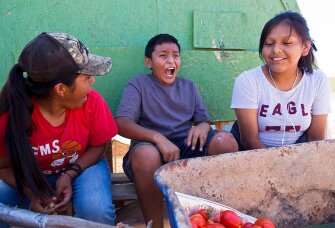
As I photographed students working on a nearby farm, it was clear that all were enjoying the work. While the teachers and farmers did most of the heavy lifting, the students did their fair share of the work. On this particular day they were harvesting tomatoes and chiles, and daring each other to eat the latter was the afternoon pastime. While most schoolchildren spend most of their time indoors, these kids go on field trips each week to learn firsthand how their ancestors thrived in the desert.

If the school were located in a less remote area, organic vegetables and greenhouses on campus would be a novelty, but “food sovereignty,” as the school’s CEO Mark W. Sorensen calls it, is a necessity. In an area the size of West Virginia with about 300,000 people, there are only 10 grocery stores, he tells me. There are convenience stores in some remote areas, but they mostly sell junk food. The Navajo have been farming the desert for centuries and the school’s curriculum taps into the knowledge of the local farming community. Not only do the students take pride in growing their own food, they even claim to love kale.

STAR School 8th graders Mia Stos, left, and Kristopher Cody check the soil in a greenhouse at the school.
Gardening and home economics teacher Tyrone Thompson checks on the school's greenhouses. Local farmers teach children how to grow organic crops in the desert greenhouses.
Students head to class at the STAR School.
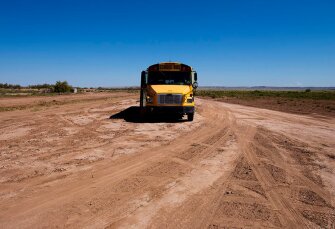
A school bus waits for STAR School students as they spend time at the North Leupp Family Farm on the Navajo Nation in Leupp, Ariz.
Ian Salt, an 8th grader at STAR School, carries a harvest of tomatoes and peppers grown at the farm.
STAR School 7th grader Leonardo Gonzalez reacts after tasting one of the hot peppers grown at the farm.
North Leupp Family Farm manager Stacey Jensen helps STAR School students harvest tomatoes and peppers.
STAR School 8th grader Charliegh John helps harvest tomatoes and peppers grown at the farm.
A STAR School student takes a break from harvesting at the farm.

A version of this article first appeared in the Full Frame blog.

Events

This content is provided by our sponsor. It is not written by and does not necessarily reflect the views of Education Week's editorial staff.
Sponsor
School & District Management Webinar
The Principal's Role in Collective Efficacy and Student Outcomes
Learn practical strategies that help principals translate their confidence into stronger collective teacher efficacy and student outcomes.
Content provided by Otus
This content is provided by our sponsor. It is not written by and does not necessarily reflect the views of Education Week's editorial staff.
Sponsor
Education Funding Webinar
What Schools Need to Know About the Federal Education Freedom Tax Credit
What schools need to know about the federal Education Freedom Tax Credit: A practical guide from a licensed teacher and policy expert.
Content provided by LearningSpring
This content is provided by our sponsor. It is not written by and does not necessarily reflect the views of Education Week's editorial staff.
Sponsor
School Climate & Safety Webinar
Building Your School Safety Roadmap: Key Priorities for the Upcoming Year
What should be on your school's safety roadmap this year? Join experts to discuss priorities, preparedness, and best practices.
Content provided by Evolv Technology & IdentiSys

EdWeek Top School Jobs

Teacher Jobs
Search over ten thousand teaching jobs nationwide — elementary, middle, high school and more.
View Jobs
Principal Jobs
Find hundreds of jobs for principals, assistant principals, and other school leadership roles.
View Jobs
Administrator Jobs
Over a thousand district-level jobs: superintendents, directors, more.
View Jobs
Support Staff Jobs
Search thousands of jobs, from paraprofessionals to counselors and more.
View Jobs

Read Next

College & Workforce Readiness Why Schools, Colleges, and Employers Aren't Connected on Career-Technical Education
Too much data on education and the labor market exist in silos, a new report finds.
6 min read
South Career and Technical Academy student ambassadors and student councils hand out wristbands to new students as they arrives at CCSD’s newest high school, opening its doors for the 2025-2026 school year, on Aug. 11, 2025 , in Las Vegas .
South Career and Technical Academy students hand out wristbands to new students as they arrive at their school system's newest high school on Aug. 11, 2025, in Las Vegas. A new report recommends that school, college, and workforce leaders break down silos in their data, in order to better coordinate career-technical education goals.
Bizuayehu Tesfaye/Las Vegas Review-Journal via TNS
College & Workforce Readiness How Can Schools Connect Students to Careers? A New Compact Has a Plan—and Money
The compact comes at time of rising uncertainty for young workers due to AI.
5 min read
Leaders in education have a panel discussion about offering a path for students from schools into careers.
Industry leaders discuss the new Compact for America’s Youth during a launch event in Washington on Sept. 10, 2026. The compact brings organizations together to work on solutions to scale up career-connected learning.
Courtesy of CareerWise
College & Workforce Readiness The Case for Expanding Access to Advanced Courses Before High School
Academic acceleration for 11th and 12th graders had little effect on college course choices.
•
3 min read
Mitchell High math teacher James Dye leads a Florida Advanced Course and Test (FACT) College Algebra course in September. The State Board of Education is set to update its rules so students can earn in-state college credit for successfully completing FACT courses in Trinity, Florida on September 09, 2025.
Math teacher James Dye leads a Florida Advanced Course and Test (FACT) college-level algebra course on Sept. 9, 2025, at Mitchell high school in Trinity, Fla. Some researchers suggest it is better to introduce students to academically rigorous courses far earlier than 11th or 12th grade.
Douglas R. Clifford/Tampa Bay Times via TNS
College & Workforce Readiness Q&A Why 'Portrait of a Graduate' Initiatives Struggle to Transform Instruction
Researchers examined how 15 districts are working to build "portrait of a graduate" expectations.
6 min read
Collage of a high school student with words in background and a white hand drawn line image of graduation cap.
Liz Yap for Education Week + Getty