College & Workforce Readiness Photo Essay

College Competencies Take Root

By Education Week Photo Staff — September 14, 2015 1 min read
  • Save to favorites
  • Print
A teacher helps 8th grader Kristopher Cody plant lettuce in a greenhouse at the STAR School, at the edge of the Navajo Nation near Flagstaff, Ariz.

Nick Cote describes his experiences photographing a school on the Navajo Nation in Northern Arizona that integrates cultural experiences, such as working with local farmers, with students’ academic studies to nurture the necessary skills, and motivation to attend college.

In the event of a zombie apocalypse, the students at the STAR School in northern Arizona would be relatively well-off. The K-8 charter school, which lies just outside the boundary of the Navajo Nation and about 30 miles from Flagstaff, is completely off the grid. The school has its own water well, and electricity is provided by solar panels. Students work with local farmers to grow enough organic vegetables to stock the cafeteria’s salad bar twice each day to feed 150 people.

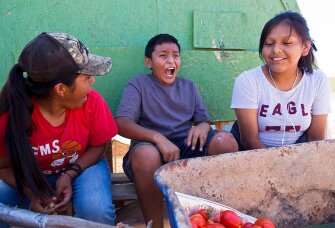
As I photographed students working on a nearby farm, it was clear that all were enjoying the work. While the teachers and farmers did most of the heavy lifting, the students did their fair share of the work. On this particular day they were harvesting tomatoes and chiles, and daring each other to eat the latter was the afternoon pastime. While most schoolchildren spend most of their time indoors, these kids go on field trips each week to learn firsthand how their ancestors thrived in the desert.

If the school were located in a less remote area, organic vegetables and greenhouses on campus would be a novelty, but “food sovereignty,” as the school’s CEO Mark W. Sorensen calls it, is a necessity. In an area the size of West Virginia with about 300,000 people, there are only 10 grocery stores, he tells me. There are convenience stores in some remote areas, but they mostly sell junk food. The Navajo have been farming the desert for centuries and the school’s curriculum taps into the knowledge of the local farming community. Not only do the students take pride in growing their own food, they even claim to love kale.

STAR School 8th graders Mia Stos, left, and Kristopher Cody check the soil in a greenhouse at the school.
Gardening and home economics teacher Tyrone Thompson checks on the school's greenhouses. Local farmers teach children how to grow organic crops in the desert greenhouses.
Students head to class at the STAR School.
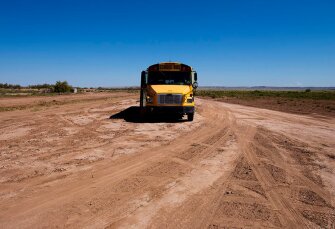
A school bus waits for STAR School students as they spend time at the North Leupp Family Farm on the Navajo Nation in Leupp, Ariz.
Ian Salt, an 8th grader at STAR School, carries a harvest of tomatoes and peppers grown at the farm.
STAR School 7th grader Leonardo Gonzalez reacts after tasting one of the hot peppers grown at the farm.
North Leupp Family Farm manager Stacey Jensen helps STAR School students harvest tomatoes and peppers.
STAR School 8th grader Charliegh John helps harvest tomatoes and peppers grown at the farm.
A STAR School student takes a break from harvesting at the farm.

A version of this article first appeared in the Full Frame blog.

Events

This content is provided by our sponsor. It is not written by and does not necessarily reflect the views of Education Week's editorial staff.
Sponsor
College & Workforce Readiness Webinar
Smarter Tools, Stronger Outcomes: Empowering CTE Educators With Future-Ready Solutions
Open doors to meaningful, hands-on careers with research-backed insights, ideas, and examples of successful CTE programs.
Content provided by Pearson
School Climate & Safety Webinar Strategies for Improving School Climate and Safety
Discover strategies that K-12 districts have utilized inside and outside the classroom to establish a positive school climate.
This content is provided by our sponsor. It is not written by and does not necessarily reflect the views of Education Week's editorial staff.
Sponsor
Artificial Intelligence Webinar
Decision Time: The Future of Teaching and Learning in the AI Era
The AI revolution is already here. Will it strengthen instruction or set it back? Join us to explore the future of teaching and learning.
Content provided by HMH

EdWeek Top School Jobs

Teacher Jobs
Search over ten thousand teaching jobs nationwide — elementary, middle, high school and more.
View Jobs
Principal Jobs
Find hundreds of jobs for principals, assistant principals, and other school leadership roles.
View Jobs
Administrator Jobs
Over a thousand district-level jobs: superintendents, directors, more.
View Jobs
Support Staff Jobs
Search thousands of jobs, from paraprofessionals to counselors and more.
View Jobs

Read Next

College & Workforce Readiness We Asked Executives What Skills Young Workers Are Missing. Here's What They Said
Students need to learn how to solve problems, manage conflict, and be more curious.
7 min read
Image of students working collaboratively and independently. Central figure is engaging with a power button.
Nadia Radic for Education Week
College & Workforce Readiness Give Students Meaningful, Work-Oriented Learning, U.S. Executives Say
A mix of in-school and workplace learning will help students prepare for a fast-changing world.
9 min read
Image of a silhouette, AI, and industry.
iStock/Getty
College & Workforce Readiness In 'Silicon Desert,' a School Prepares Students to Join the Semiconductor Boom
An Arizona school district is drawing on higher ed and industry to build a CTE program in a growing high-tech field.
13 min read
Alina Kiselev,17, works on a wheatstone circuit bridge during a class on semiconductor manufacturing at Hamilton High School in Chandler, Ariz., on Nov. 5, 2025.
Alina Kiselev, 17, works on a Wheatstone bridge circuit during a class on semiconductor manufacturing at Hamilton High School in Chandler, Ariz., on Nov. 5, 2025. The school launched a two-year semiconductor program this academic year to help meet the demand for trained employees in sector.
Adriana Zehbrauskas for Education Week
College & Workforce Readiness From Our Research Center What Are the Most Popular CTE Classes and Why? We Asked Educators
Students are very attracted to classes that offer meaningful hands-on learning.
1 min read
Students in the health sciences track of Bentonville public schools’ Ignite program practice taking blood pressure on Nov. 5, 2025, in Bentonville, Ark.
Students in the health sciences track of Bentonville public schools’ Ignite program practice taking blood pressure on Nov. 5, 2025, in Bentonville, Ark. The program—which integrates lessons about AI into its curriculum—offers career-pathway training for high school juniors and seniors in the district.
Wesley Hitt for Education Week