Reading & Literacy

Children Still Prefer Print Books to E-Books

By Catherine Gewertz — January 22, 2013 1 min read
  • Save to favorites
  • Print

Children are embracing e-books by the millions, but most say they still would choose the printed version, according to a survey released last week.

Scholastic’s biennial survey of 6- to 17-year-olds found e-books soaring in popularity: Forty-six percent of the 1,074 children said they had read an e-book, compared with 25 percent who said they had in 2010.

The e-book-reading numbers vary by only a few percentage points by gender or age group. But boys were slightly more likely to say that since they started reading e-books, they’re reading more books overall.

Half the young people said they’d read more books for fun if they had better access to e-books. And it’s clear that those surveyed are doing the lion’s share of e-book reading at home, rather than in school: Three-quarters of the respondents who have read an e-book have done so at home; only one-quarter said they had read an e-book in school.

Impact of E-Reading

Among children who have read an e-book, one in five says he or she is reading more books for fun, especially boys.
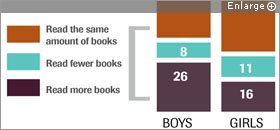
BRIC ARCHIVE

Note: Figures may not add up to 100 percent because of rounding.

SOURCE: Scholastic

E-books are particularly good when students are traveling or on the go, they told researchers, or when they don’t want their friends to know what they’re reading.

The survey for the New York City-based educational publisher was conducted online last fall. Questions were put to a nationally representative sample of 2,048 people, including children ages 6 to 17 and their parents.

No Batteries Required

But print books clearly still have a big place in children’s lives. Their responses showed that 80 percent of the books they read for fun are in print. They also prefer the printed form over the e-book for reading at bedtime or sharing with friends, the study found.

Fifty-eight percent said they will always want to read books printed on paper even if e-books are available. Two-thirds of the young people surveyed by Scholastic in 2010 gave the same response.

Asked about the benefits of e-books, children and parents most frequently cited the convenience of carrying all their books around in one place and obtaining books wherever they are. Among the e-book attributes they like the most are dictionaries, built-in note-taking and highlighting features, and skill-building activities.

Print books, on the other hand, got high marks from children and parents for not needing batteries and for the ease of seeing how much of a book has been read. Children, in particular, cited liking to hold a print book more than an electronic device. Parents cited liking to “get away from technology.”

Related Tags:

A version of this article appeared in the January 23, 2013 edition of Education Week as Children Still Prefer Print Books to E-Books

Events

This content is provided by our sponsor. It is not written by and does not necessarily reflect the views of Education Week's editorial staff.
Sponsor
Special Education Webinar
Integrating and Interpreting MTSS Data: How Districts Are Designing Systems That Identify Student Needs
Discover practical ways to organize MTSS data that enable timely, confident MTSS decisions, ensuring every student is seen and supported.
Content provided by Panorama Education
Artificial Intelligence Live Online Discussion A Seat at the Table: AI Could Be Your Thought Partner
How can educators prepare young people for an AI-powered workplace? Join our discussion on using AI as a cognitive companion.
Student Well-Being & Movement K-12 Essentials Forum How Schools Are Teaching Students Life Skills
Join this free virtual event to explore creative ways schools have found to seamlessly integrate teaching life skills into the school day.

EdWeek Top School Jobs

Teacher Jobs
Search over ten thousand teaching jobs nationwide — elementary, middle, high school and more.
View Jobs
Principal Jobs
Find hundreds of jobs for principals, assistant principals, and other school leadership roles.
View Jobs
Administrator Jobs
Over a thousand district-level jobs: superintendents, directors, more.
View Jobs
Support Staff Jobs
Search thousands of jobs, from paraprofessionals to counselors and more.
View Jobs

Read Next

Reading & Literacy Video What Happens When Middle and High Schoolers Still Struggle to Read?
When it comes to reading, teachers and experts alike say that many older students still struggle with the basics.
1 min read
Students attend Bow Memorial School in Bow, N.H. on Oct. 29, 2025. Bow Memorial School is a middle school that has developed a systematic approach to addressing foundational reading gaps in middle school students.
Sophie Park for Education Week
Reading & Literacy Opinion Yes, Small-Group Reading Instruction Works. But Use It Wisely
When is the best time to use the approach over whole-class literacy instruction?
Nell K. Duke & Claude Goldenberg
4 min read
Collage of different instruction types including, one-on-one, small group, and whole class instruction.
Getty Images + Education Week
Reading & Literacy How to Build a Reading Block: Two Teachers Share Their Approaches
Studies don't prescribe how best to knit together components of reading—leaving it up to teachers to devise.
7 min read
Students in Anjanette McNeely's class work on their letters during a reading block at Windridge Elementary School in Kaysville, Utah, on Dec. 4, 2025.
What's the best way to attend to all the elements of the 'science of reading' in a literacy block? Research doesn't specify a specific answer, but kindergarten teacher Anjanette McNeely has designed hers to incorporate foundational skills, content, and writing. McNeely's class works on their letters at Windridge Elementary School in Kaysville, Utah, on Dec. 4, 2025.
Niki Chan Wylie for Education Week
Reading & Literacy Many Teens Lack Basic Reading Skills. These Teachers Are Trying to Change That
Schools are building programs to provide sustained reading support to older students.
6 min read
Loralyn LaBombard, a reading specialist, reads “Among the Hidden” by Margaret Peterson Haddix with a group of students in a 7th grading reading class at Bow Memorial School in Bow, N.H., on Oct. 29, 2025.
Loralyn LaBombard, a reading specialist, reads <i>Among the Hidden</i> by Margaret Peterson Haddix with a group of students in a 7th grade reading class at Bow Memorial School in Bow, N.H., on Oct. 29, 2025. Nationally, experts say there is a lack of resources available to help middle and high school students learn basic reading skills.
Sophie Park for Education Week
