
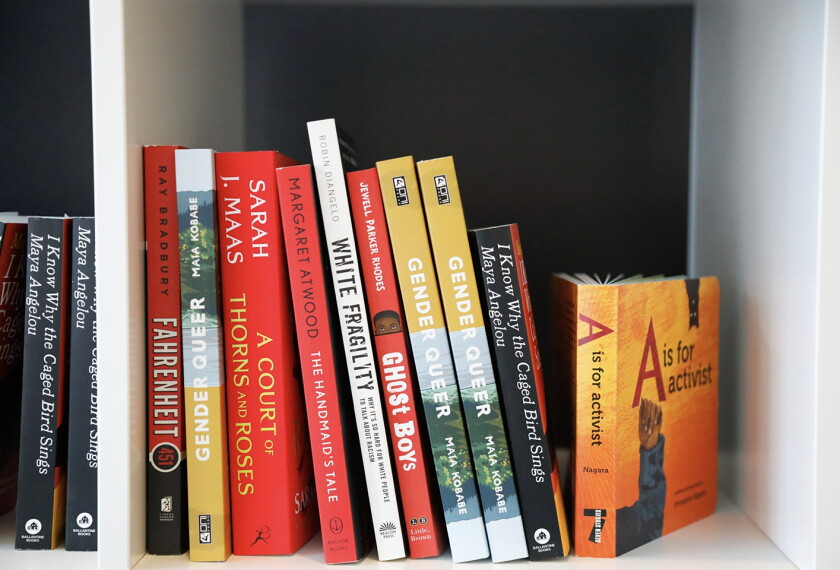
Book ban attempts nearly doubled in 2022, after a sharp increase in 2021, according to early numbers from the American Library Association.
Now, the number of books challenged or banned in public schools is the highest it has been in 20 years, since the association started tracking book bans.
More than 2,500 unique titles were targeted for censorship last year, marking a 38 percent increase from the 1,858 unique titles targeted in 2021. From 2000 to 2020, a few hundred books were challenged each year, according to ALA data. Challenges can include parents, community members, or teachers objecting to books in public meetings. They can also include silent challenges, where administrators remove books after phone calls or emails from parents.
Almost 60 percent of the book challenges involved school libraries or curricula, and about 40 percent targeted public libraries, according to the ALA numbers. Caught up in these challenges were 550 unique children’s titles and 1,604 young adult titles, making up 86 percent of all challenges throughout the year, ALA found.
More than 300 picture books for elementary school readers, with illustrations and sparse text, were banned, PEN America, a free speech advocacy organization that tracks book bans, found earlier this year.
Book challenges do not necessarily result in book bans. ALA records challenged books as those that an individual or organization wanted to be removed from schools or public libraries. Sometimes, the demand to remove books is disregarded, and sometimes the ALA does not know the outcome. That’s because the ALA’s office for intellectual freedom, which collects data from reports by librarians in the field and news stories published throughout the country, relies on anecdotal evidence they find as opposed to a national dataset.
Because many book challenges are not reported to the ALA or covered by the press, the 2022 data compiled by ALA represents only a snapshot of book censorship throughout the year, according to Deborah Caldwell-Stone, director of the ALA’s office for intellectual freedom. That means the number of books actually challenged in 2022 is expected to be larger than 2,571.
Since 2021, when book bans started escalating, the efforts to challenge and remove books have gotten more organized, according to Caldwell-Stone.
“We’re no longer dealing with an individual parent raising a concern about a book but groups pursuing a political agenda and leveraging power with elected officials, with school boards, library boards to erase the voices of marginalized persons from school libraries,” she said.
“When you take books that represent the lives and experiences, particularly of marginalized groups, like LGBTQ teens, off the shelf, they’re taking away a lifeline for them. Sometimes having those books on the shelf is life saving for them.”
More than 40 percent of banned and challenged books in 2021 are about LGBTQ topics, PEN America found. The percentage of challenged books on these topics in 2022 is still unknown.
The number of mass book challenges increased
The ALA found 1,269 challenges to books in 2022, nearly double that of 2021 when there were 729 challenges.
Of the overall number of books challenged, 90 percent were part of attempts to censor multiple titles. Among those, 40 percent were in cases involving 100 or more books.
“When you’re starting the challenge list of 100 books or more, then you’re not challenging a book because you’re concerned about what your child is reading,” Caldwell-Stone said.
“You’re challenging books because they don’t meet your approval, the group’s agenda on politics, race, gender identity, sexual orientation.”
Prior to 2021, book challenges predominantly involved individual objections to a single book, instead of an organized movement. The frequent use of lists of books compiled by conservative groups contributed significantly to the skyrocketing number of challenges and the frequency with which each title was challenged, according to the ALA.
Conservative parent groups, including Moms for Liberty, No Left Turn in Education, and MassResistance, as well as local Facebook groups, were responsible for at least half of all bans, PEN America found in a report last September.
The report identified at least 50 different groups involved in local and state-level efforts to ban books, some with hundreds of chapters, that had sprung up in 2021.
Brian Camenker, executive director of MassResistance, previously told EdWeek that he thought free speech groups such as PEN America and ALA are “on the wrong side of history.”
He said that most books parents are complaining about and trying to get banned contain inappropriate sexual material, and that no one should be advocating for “pornography” in school libraries.
The “pornography” argument is often used by groups and even politicians such as Florida’s Republican Gov. Ron DeSantis, who declare young adult books about sexuality and gender, and more specifically books about LGBTQ topics such as Flamer by Mike Curato and GenderQueer by Maia Kobabe, are inappropriate for children.
Parents have the right to decide what their child can and can’t read, Caldwell-Stone said. But to put pressure on schools and districts to remove books altogether so that no child can access them is playing into a political agenda, she said.
“I think that we’re observing a realization by a number of advocacy groups and political organizations that this could be a political wedge issue,” Caldwell-Stone said.
An example of this strategy was the fight over Toni Morrison’s Pulitzer Prize-winning book, Beloved, in Virginia. A parent who had raised issues about the book years ago resurfaced her argument in a campaign ad for Republican Gov. Glenn Youngkin, who leveraged school issues and the teaching of what he and other conservatives have labeled critical race theory in his successful 2021 campaign.
“We are an increasingly diverse society. And sometimes there’s fear around that, there are questions around that,” Caldwell-Stone said. “And I think that all that’s being leveraged by these advocacy groups to achieve their own ends, their own political agendas, and that schools and libraries are part of that.”


