
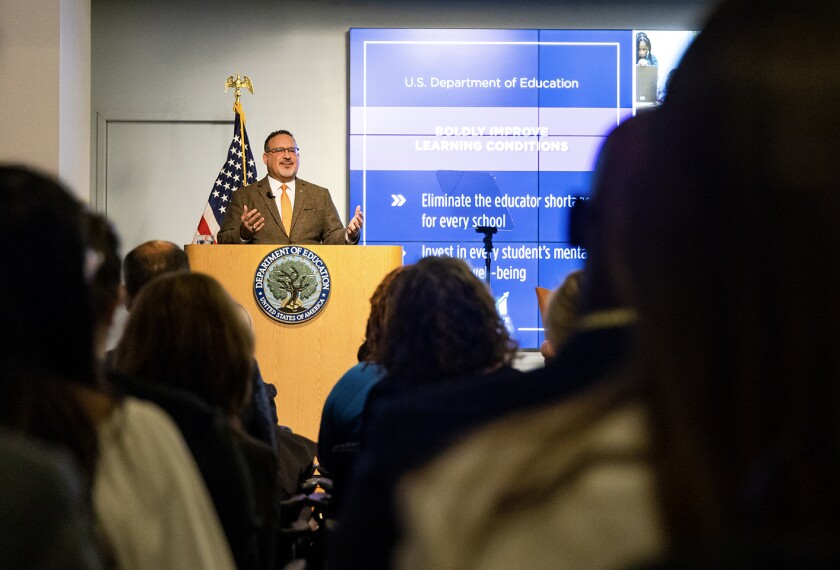
U.S. Secretary of Education Miguel Cardona called on state and local school leaders to focus their attention on creating more career and technical education programs, raising academic standards, and expanding mental health supports for students in a set of speeches Monday.
Cardona spoke in Washington at the legislative and policy conferences for the Council of Chief State School Officers, a nonprofit that provides a network for state superintendents and education commissioners, and the Council of the Great City Schools, a coalition of the nation’s 78 largest school districts. In both speeches, he called on education leaders to rework systems so they better support students’ academics, well-being, and life after graduation.
The education secretary’s speeches closely resembled his January address at the U.S. Department of Education’s headquarters, in which he laid out his 2023 priorities for the department and announced the “Raise the Bar: Lead the World” initiative, an effort to raise America’s rankings in educational achievement.
The key to doing that is to have state superintendents, education commissioners, and the leaders of the nation’s largest school districts prioritize student well-being, career pathways, bilingual education, and efforts to improve academic achievement, he said.
“Now is the time for systems in education that deliver on our nation’s potential and put us in the position to raise the bar and lead the world for years to come,” Cardona said during the CCSSO speech.
Cardona also used his speeches to address concerns about COVID-19 relief funding, as superintendents feel the pressure of looming spending deadlines and Republicans in Congress push for more scrutiny over how those funds are spent in their newfound majority in the U.S. House of Representatives.
Navigating oversight of COVID-19 relief funds
Cardona acknowledged the concerns about the Sept. 30, 2024, deadline to allocate COVID-19 relief funds in a conversation with Kelly Gonez, a board member of the Los Angeles Unified School District and chair of the Council of the Great City Schools, following his speech at the conference. (The Los Angeles Unified district is expected to be forced to close schools for three days this week due to a planned strike by school workers and teachers. That topic was not addressed.) But the education secretary did not indicate any new department plans to extend that deadline.
“There are some very valid reasons why there may be concerns about spending” COVID funds by the deadline, he said. “We’re listening to that.”
Local school districts and state leaders can help spread the message about the need for those funds by highlighting how they’ve used the money so far and how they plan to use it going forward, he said.
“It’s on us, all of us, to paint the picture,” Cardona said. “You’re the best cheerleaders for education funding.”
The education secretary also pointed to President Joe Biden’s proposed 2024 budget, which would raise education spending by 14 percent, as a win for schools.
A spotlight on mental health
Cardona also called on state and local school leaders to do what they can to curb the “youth mental health crisis.” He urged the crowd of state leaders at CCSSO to utilize $1 billion in funding to support school-based mental health programs allocated in the Bipartisan Safer Communities Act.
The law, which was passed in June, allocated funding to support student well-being in response to the mass shooting at Robb Elementary School in Uvalde, Texas, in which a gunman killed 19 students and two teachers. Only 15 states have set up grant competitions using that funding so far, Cardona said.
“We’ve got to do better,” he said. “Our students are in great need now. Let us support you through that work.”
The money from the Bipartisan Safer Communities Act can be used in a number of ways to support student well-being. Cardona offered examples, such as providing every student with a class period dedicated to mental health and well-being, as positive ways to use the funding. Cardona said state leaders can also use the funds to increase the number of social workers and other mental health professionals in schools and encouraged state and local school leaders to partner with their local health departments to achieve that.
Former governors weigh in
The chief state school officers council also used its legislative conference to honor former governors Jeb Bush of Florida and Bob Wise of West Virginia with its 2023 Distinguished Service Awards. Bush, a Republican known for his run for president in 2016, is now the chairman of ExcelinEd, an education policy think tank, and Wise, who is a Democrat, also served as president of All4Ed, an education advocacy organization.
Both former governors called for bipartisan partnerships and a focus on improving literacy skills to help students recover from the COVID-19 pandemic during Q&A sessions following the announcement of the awards.
“States need to build strategies as it relates to early childhood literacy,” Bush said. “I think it’s clear that embracing the science of reading is essential to begin that journey.”
Bush said literacy has “the greatest urgency apart from empowering parents.” The former governor would like to see states adopt K-3 reading strategies with transparency about students’ reading achievement and a curriculum that utilizes the science of reading.
“Is anybody marching in the streets for the fact that we have so many kids starting 4th grade that are illiterate?” Bush said. “Who’s angry about that? Who is marching in the streets for them? That should be the civil rights issue of our time. That should be the moral issue of our time.”
Wise encouraged the state education leaders to utilize COVID-19 relief funds to support student achievement and help raise reading and math performance.
“If we don’t do it now, if we don’t do it with the money we’ve got … then shame on us, and what have we done for a generation of our children?” Wise said. “This is our opportunity.”


