
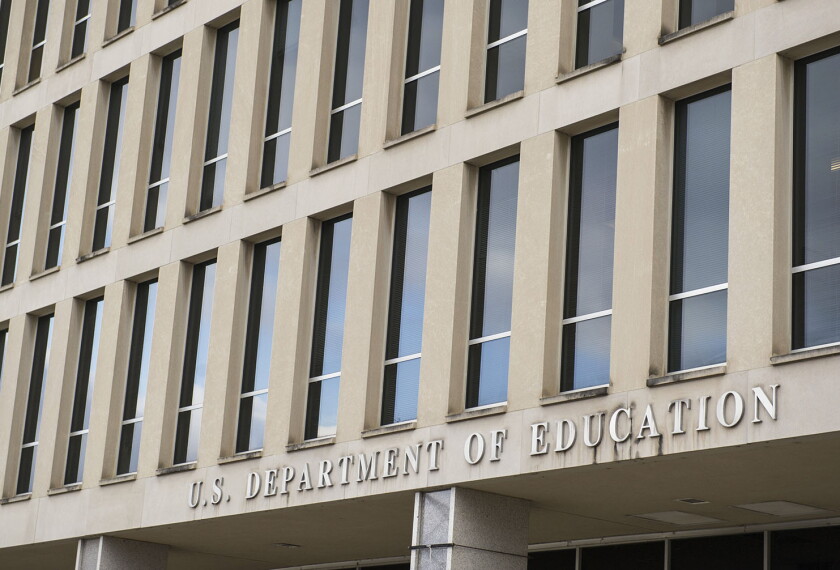
Updated: This article has been updated with the date of Linda McMahon’s confirmation hearing.
President Donald Trump continued his aggressive foray into education in the third week of his second term. He signed an executive order to bar transgender student-athletes from joining girls’ teams and the U.S. Department of Education swiftly began investigations into potential violations at schools and universities.
Meanwhile, the fallout from his attempted spending freeze continued, and his administration has been taking steps to prepare for the Education Department’s elimination.
Here’s a closer look at what Trump did in week three.
Trump’s effort to diminish the Education Department is well underway
It comes as no surprise that the president is considering how to close the Education Department. It was something he endeavored to do in his first term, though his push then didn’t pick up much steam. On the campaign trail, he joined the chorus of Republicans seeking to abolish it.
The president is weighing an executive order that would direct the secretary of education—he’s nominated a business mogul who served in his first administration, Linda McMahon—to look into how it could be done, and call on Congress to pass legislation to dot the I’s, according to reporting from the Wall Street Journal.
“I told Linda, ‘Linda, I hope you do a great job and put yourself out of a job.’ I want her to put herself out of a job,” Trump told reporters while signing executive orders in the Oval Office this week.
McMahon’s confirmation hearing before the Senate’s health, education, labor, and pensions committee will take place Feb. 13.
It would take congressional action to do away with the department, which has a budget of roughly $80 billion covering programs addressing prekindergarten through postsecondary education and oversees more than $1 trillion in student loans.
But there are things the president can do within the limitations of his power, and some of the work has seemingly already begun.
Read more about what Trump can and can’t do to eradicate the department.🔎
Members of Elon Musk’s Department of Government Efficiency team have been working out of the department, accessing sensitive information and feeding some into artificial intelligence tools, according to the Washington Post.
On Friday, the department denied entry to Democratic lawmakers, Axios reported. Other agencies under the scrutiny of DOGE have denied entry to Democratic lawmakers in recent weeks.
Employees described general uncertainty as they were being pressed to accept a “Fork in the Road” deferred resignation offer, the terms of which could be terminated early.
In addition, more than 75 staffers have been placed on administrative leave over the past three weeks as part of the department’s actions to align with the president’s first-day executive order to eliminate federal diversity, equity, and inclusion initiatives, according to the union that represents Education Department employees. Most of those placed on leave did not do any DEI work as part of their jobs, the union said. Some were identified for taking part in a DEI training during Trump’s first term.
The events have hurt morale, creating a sense of uncertainty, staff members who spoke to Education Week reported. And they’ve caused confusion about day-to-day work at the agency, with employees coming in to find colleagues and supervisors on leave.
Trump’s orders make it easier for the administration to remove career staffers by reclassifying those whose jobs include some form of policy work as political appointees. It appears to be far-reaching, touching staffers who are in any number of departments, employees said.

Though Trump can shrink the department, eliminating it requires congressional action. He would need virtually all Republicans in Congress to vote for it, as well as cooperation from some Democrats. A U.S. House of Representatives vote in 2023 to do just that failed, with 60 Republicans joining Democrats to defeat the effort.
In a letter this week to Acting Education Secretary Denise Carter, Democratic lawmakers from both chambers demanded details on the Trump administration’s recent actions at the Education Department.
“We will not stand by and allow the impact that dismantling the Department of Education would have on the nation’s students, parents, borrowers, educators, and communities,” they wrote. “Congress created the Department to ensure all students in America have equal access to a high-quality education and that their civil rights are protected no matter their zip code.”
On the other side of the aisle, the Republican chairman of the House’s education and workforce committee said this week he wouldn’t stand in the way of Trump’s efforts.
Read Education Week’s explainer on the U.S. Department of Education. 🔎
With Trump’s order on trans athletes, Education Department opens investigations
Trump continued his expansive effort to roll back the rights of transgender youth, signing an executive order Wednesday that threatened to pull back federal funds from schools and universities that allow transgender girls to compete on girls’ teams, and launch investigations into those that don’t comply.
The Education Department’s office for civil rights has already, in a rare public announcement, said it would investigate a gender-neutral bathroom at a Denver high school as a possible violation of Title IX, the landmark federal law prohibiting sex discrimination in schools. The agency also announced it was abandoning the Biden administration’s attempt to expand Title IX to cover discrimination based on gender identity and sexual orientation, instead reverting to the regulations from Trump’s first term.
After Trump’s executive order on athletes, the department said in a press release it would launch investigations into two universities and the association that oversees Massachusetts high school sports.
The OCR said it would investigate the Massachusetts Interscholastic Athletic Association, after a girls’ high school basketball team forfeited a game a year ago after an athlete on the opposing team reportedly injured three players. The athletic association’s handbook prohibits schools from excluding transgender girls from playing on teams that align with their gender identity. OCR is also investigating San Jose State University and University of Pennsylvania.
OCR is “reviewing athletic participation policies at a number of schools to evaluate their alignment” with Trump’s order, the department said.
Alongside the investigations, the NCAA, which has more than a thousand member schools, changed its participation policy to align with Trump’s executive order.
About half the states have passed legislation barring transgender women from playing on school athletic teams that don’t align with their sex at birth.
Despite the focus on transgender athletes, their numbers are small.
Roughly 3 percent of high school students identify as transgender, according to data from the U.S. Center for Disease Control and Prevention. They are less likely than their peers to participate in school sports. Nineteen percent of transgender and gender-expansive youth reported playing sports in the Human Rights Campaign’s 2022 Youth Survey, compared with nearly half of all high school-age youth.
A review of scientific research on transgender women athletes by E-Alliance, a Canadian organization that advocates for LGBTQ+ youth, found that any biomedical evidence of transgender women’s competitive advantage in elite sports was inconclusive. Meanwhile, the review found that there are more influential factors that affect athletic performance, including socioeconomics, nutrition, equipment, training opportunities, and coaching salaries.
Read more about Trump’s executive order on trans athletes. 🔎
Fallout from federal funding freeze continues, despite the administration walking it back
Trump’s funding freeze, which the president said was to align federal agencies’ spending with his barrage of executive orders meant to weed out DEI, continues to have ramifications even after it was halted by two judges.
Though Head Start operators were assured they were not included in the freeze, about 50 providers in 24 states, the District of Columbia, and Puerto Rico are still waiting for reimbursements they requested from the federal government as much as a week earlier, according to a nationwide survey of providers conducted Feb. 4 by the National Head Start Association.
Read more about how the freeze is affecting Head Start programs. 🔎
Education secretary will serve on anti-Christian bias task force
Under an executive order signed by Trump on Thursday, the secretary of education will serve on the “Task Force to Eradicate Anti-Christian Bias” along with other department heads.
The task force is charged with identifying any “anti-Christian bias” within the government, and drawing up three reports over the course of its two-year work. The task force will make recommendations for presidential and legislative action to “rectify past improper anti-Christian conduct, protect religious liberty, or otherwise fulfill the purpose and policy of this order.”
The task force comes at a time when Republicans leaders around the country have been testing the limits of the church-state divide by introducing religion into public school classrooms—whether through curriculum with Bible-infused lessons in Texas, requiring Ten Commandments displays in classrooms in Louisiana, or mandating that teachers include the Bible in lessons in Oklahoma.


