Blog

Your Education Road Map

Politics K-12

Politics K-12 kept watch on education policy and politics in the nation’s capital and in the states. This blog is no longer being updated, but you can continue to explore these issues on edweek.org by visiting our related topic pages: Federal, States.

Education Funding

See What the Huge COVID-19 Aid Deal Biden Has Signed Means for Education, in Two Charts

By Andrew Ujifusa — March 11, 2021 2 min read
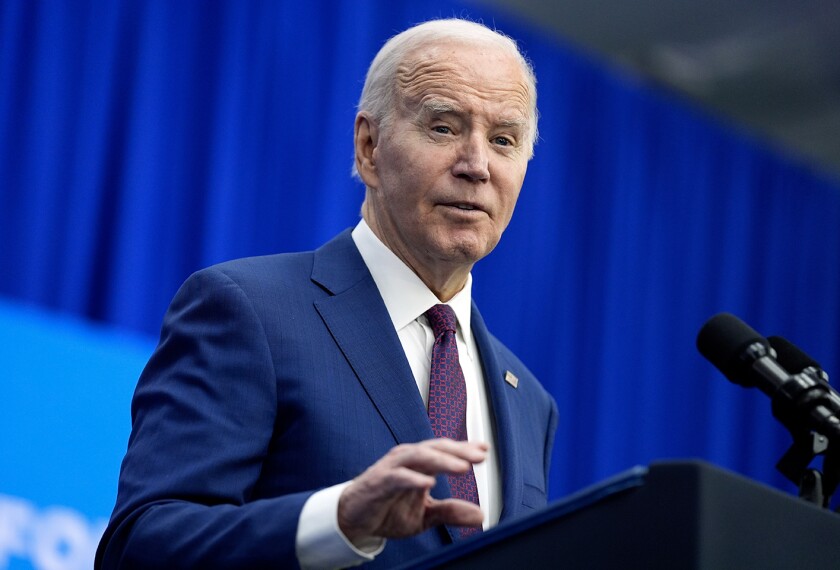
President Joe Biden signs the American Rescue Plan, a coronavirus relief package, in the Oval Office of the White House on March 11, 2021.
  • Save to favorites
  • Print

President Joe Biden has signed the $1.9 trillion American Rescue Plan, which will provide a fresh round of coronavirus relief for schools as an unprecedented infusion of federal aid for K-12 education continues.

The legislation includes approximately $129 billion to help students and educators deal with the various impacts of the pandemic; most of that money (about $123 billion) is part of a stabilization fund for elementary and secondary education that’s distributed through the federal Title I formula for disadvantaged students. Local school districts will receive at least 90 percent of that stabilization fund, but they must earmark one dollar out of every five for learning recovery programs.

The bill includes “maintenance of equity” provisions that in general are designed to prevent or minimize state and local cuts to schools serving relatively large shares of students from low-income households.

Through this and two previous COVID-19 relief bills enacted in March and December of last year, public schools have received approximately $195 billion in aid from the federal government. That’s nearly twice the $100 billion K-12 education received in the 2009 American Recovery and Reinvestment Act, commonly known as the stimulus, to counteract the effects of the Great Recession.

In partnership with the Learning Policy Institute, Education Week has created an interactive database about the American Relief Plan’s main education provisions. Using Congressional Research Service data, it provides estimated per-pupil funding figures by state, funding for local learning-recovery efforts by state, and other details.

See the database below.

“This historic legislation is about rebuilding the backbone of this country,” Biden said when he signed the legislation Thursday.

In a speech Thursday evening marking one year since the declaration of the coronavirus pandemic, Biden lamented “the loss of learning” and other effects COVID-19 has had on children.

Biden said that thanks to the American Rescue Plan, as well as his efforts to accelerate the vaccination of teachers and other school staff, “We can accelerate the massive nationwide effort to reopen our schools safely and meet my goal … of opening a majority of K-8 schools in my first 100 days in office. This is going to be the number one priority of my new secretary of education, Miguel Cardona.”

At the most basic level, the American Rescue Plan reflects Biden’s COVID-19 recovery blueprint, in which he called for $130 billion for K-12 education.

As the legislation worked its way through Congress, lawmakers included the mandatory support for learning recovery efforts, created dedicated funding streams for summer enrichment, after-school programs, private schools, and special education.

The bill also includes $350 billion for state, local, territorial and tribal governments, and $7 billion for the federal E-Rate program to provide students with internet service and internet-connected devices.

Supporters of the American Rescue Plan say it will support urgent K-12 priorities. But critics have questioned whether schools truly need additional federal aid.

A version of this news article first appeared in the Politics K-12 blog.
A version of this article appeared in the March 17, 2021 edition of Education Week as New COVID-19 Aid Headed for State, District Coffers

Events

This content is provided by our sponsor. It is not written by and does not necessarily reflect the views of Education Week's editorial staff.
Sponsor
Special Education Webinar
Integrating and Interpreting MTSS Data: How Districts Are Designing Systems That Identify Student Needs
Discover practical ways to organize MTSS data that enable timely, confident MTSS decisions, ensuring every student is seen and supported.
Content provided by Panorama Education
Artificial Intelligence Live Online Discussion A Seat at the Table: AI Could Be Your Thought Partner
How can educators prepare young people for an AI-powered workplace? Join our discussion on using AI as a cognitive companion.
Student Well-Being & Movement K-12 Essentials Forum How Schools Are Teaching Students Life Skills
Join this free virtual event to explore creative ways schools have found to seamlessly integrate teaching life skills into the school day.

EdWeek Top School Jobs

Teacher Jobs
Search over ten thousand teaching jobs nationwide — elementary, middle, high school and more.
View Jobs
Principal Jobs
Find hundreds of jobs for principals, assistant principals, and other school leadership roles.
View Jobs
Administrator Jobs
Over a thousand district-level jobs: superintendents, directors, more.
View Jobs
Support Staff Jobs
Search thousands of jobs, from paraprofessionals to counselors and more.
View Jobs

Read Next

Education Funding Rebuking Trump, Congress Moves to Maintain Most Federal Education Funding
Funding for key programs like Title I and IDEA are on track to remain level year over year.
8 min read
Photo collage of U.S. Capitol building and currency.
iStock
Education Funding In Trump's First Year, At Least $12 Billion in School Funding Disruptions
The administration's cuts to schools came through the Education Department and other agencies.
9 min read
Education Funding Schools Brace for Mid-Year Cuts as 'Big, Beautiful Bill' Changes Begin
State decisions on incorporating federal tax cuts into their own tax codes could strain school budgets.
7 min read
President Donald Trump signs his signature bill of tax breaks and spending cuts at the White House on July 4, 2025, in Washington.
President Donald Trump signs his signature bill of tax breaks and spending cuts, the One Big Beautiful Bill Act, at the White House on July 4, 2025, in Washington. States are considering whether to incorporate the tax changes into their own tax codes, which will results in lower state revenue collections that could strain school budgets.
Evan Vucci/AP
Education Funding Educator Layoffs Loom as Canceled Community Schools Grants Remain in Limbo
Three legal challenges and bipartisan backlash have followed the Trump administration's funding cuts.
5 min read
Stephon Thompson, an administrator at Stevenson Elementary School, directs students through the doors at the beginning of the school day in Southfield, Mich., on Feb. 28, 2024.
Stephon Thompson directs students through the doors at the beginning of the school day at Stevenson Elementary School in Southfield, Mich., on Feb. 28, 2024. The school has added on-site social services in recent years as a community school. The Trump administration has recently discontinued 19 federal grants that help schools become local service hubs for students and their families.
Samuel Trotter for Education Week