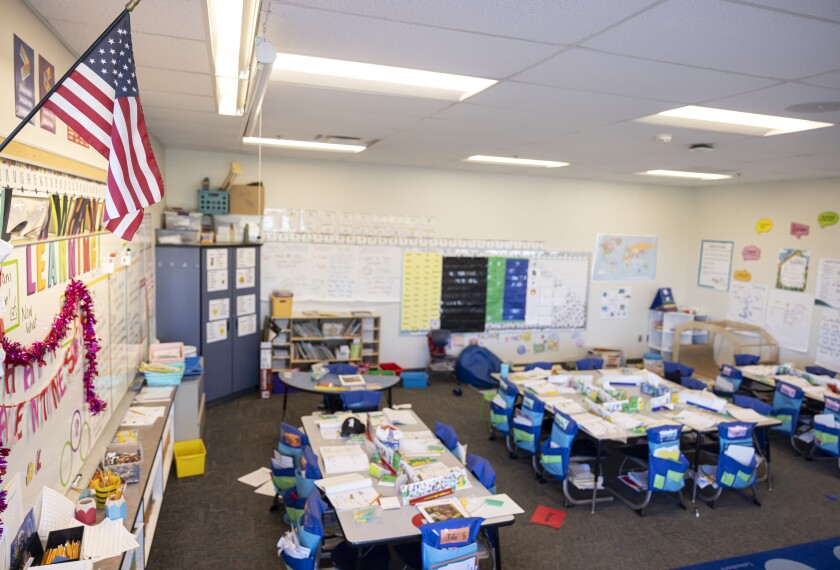
Funding for Head Start and a host of other child-related programs would hold steady under President Bush’s proposed fiscal 2007 budget plan for agencies outside the Department of Education.
The administration termed the flat funding prudent, but critics labeled the president’s plan for Head Start, which would receive $6.8 billion next fiscal year under Mr. Bush’s plan, a de facto budget cut. Head Start and Early Head Start, which the Department of Health and Human Services oversees, provide services to about 917,000 disadvantaged preschool children.
“When there are fewer resources available, someone has to decide that it is better to do one thing rather than another, or to put more resources toward one goal instead of another,” Health and Human Services Secretary Michael O. Leavitt said in a statement last week. “Our budget reflects the areas that have the highest payoff potential.”
But the National Head Start Association, an Alexandria, Va.-based group that represents Head Start teachers and parents, says flat funding would result in the loss of 19,000 spots for children in the budget year that begins Oct. 1.
And Adele Robinson, the director of public policy and communications for the Washington-based National Association for the Education of Young Children, said high-quality, stable child care is the linchpin of other budget priorities, such as economic development.
“We are very concerned that the rhetoric of the value of young children does not match the budget priorities,” she said.
Head Start is among the largest of the education- and youth-related programs that are handled by federal agencies outside the Education Department. Highlights of the president’s fiscal 2007 budget proposals for other such programs follow.
Department of Agriculture
President Bush’s proposed budget for the Department of Agriculture contains $13.9 billion for child-nutrition programs, including the federal school lunch, breakfast, and summer food programs. The proposed funding represents an increase of $700 million or 5 percent, over projections for fiscal 2006 and includes $300 million to cover unanticipated hikes in participation or meal-reimbursement rates. The budget would pay for more than 5 billion reimbursable school lunches in fiscal 2007, an increase of 1.3 percent from 2006.
The budget also reintroduces a previously unsuccessful proposed change to the federal food-stamp program that could make some children ineligible for free school lunches. The change targets families who are “categorically eligible” for food stamps because they receive non-cash benefits through the Temporary Assistance for Needy Families program. Eligibility for food stamps allows children in those families to receive free lunch, even though in some cases, the families may have incomes that exceed the school lunch program’s regular rules. Mr. Bush’s 2006 budget contained a similar proposal, but Congress rejected it.
Agriculture Department spokeswoman Jean Daniel said the department has an obligation to make sure that children who receive free lunches meet the program’s income requirements.
The Food Research and Action Center, a Washington-based advocacy group opposed to the change, estimates that about 40,000 children could be affected if it is enacted.
Department of Health and Human Services
In addition to holding down the lid on Head Start funding, the proposed HHS budget would continue to fund the Child Care and Development Block Grant program, which provides child-care assistance to low-income families, at its fiscal 2006 appropriation of $2.1 billion. The budget plan would also increase spending on community-based sexual-abstinence education, from $113 million to $141 million, or 25 percent, and support the Helping America’s Youth Initiative, a $50 million program that would award grants to faith-based and community organizations that provide services to disadvantaged youths and families. Priority would be given to organizations serving areas with significant gang activity.
Department of the Interior
The Department of the Interior’s Bureau of Indian Affairs oversees 170 schools that serve nearly 46,000 students, or about 7 percent of all American Indian children attending elementary and secondary school nationwide. The proposed budget would fund the BIA school program at $536 million, an increase of $14 million, or about 3 percent, from the fiscal 2006 budget. During the 2004-05 school year, only 30 percent of BIA-run schools made adequate yearly progress under the federal No Child Left Behind Act. The proposed budget for fiscal 2007 includes funding to restructure the office of Indian Education Programs and establish leadership offices that would be accountable for monitoring and helping BIA schools achieve AYP targets.
Department of State
The president also requested $26.7 million in the State Department budget to pay for the National Security Language Initiative, more than six times the $4.3 million set aside for the initiative in fiscal 2006. The program’s goal is to expand the number of teachers and students in the United States who master languages considered critical to national security. The president’s budget proposals for the Departments of Defense and Education also include money for the initiative, including $35 million in Education Department spending.
The State Department funding would support several educational and exchange programs. For example, the initiative would extend a summer-long high school exchange program for American students in critical-need languages to a full academic year. The Fulbright Foreign Language Teaching Assistant Program, which brings teachers to the United States to study and teach in their native languages, would also grow.
Arts and Humanities Endowments
The National Endowment for the Arts and the National Endowment for the Humanities would both see level funding under the proposed budget. The proposed NEH budget, which totals about $141 million, would pay for programs such as Landmarks of American History and Culture, a series of one-week workshops for teachers and community college instructors at historical sites.
The arts endowment would receive $124 million for programs such as its Poetry Out Loud event, which encourages high school students to memorize and perform great poems, and Shakespeare for a New Generation, which brings professional theater productions of William Shakespeare’s plays to high schools and middle schools.
National Science Foundation
The National Science Foundation, which runs several K-12 education programs, would see its overall budget climb to $6 billion, an increase of 8 percent from fiscal 2006. As part of his American Competitiveness Initiative to improve mathematics and science education, President Bush has proposed doubling funding for the independent Arlington, Va.-based federal agency over the next decade.
The education component of the NSF budget would increase by 2.5 percent, to $816 million.
But funding for the Math and Science Partnership program, which has seen many of its duties shifted to the Department of Education during the Bush administration, would fall by 27 percent, to $46 million—enough to continue existing programs but not to pay for new ones, according to a budget document. The partnerships promote teacher training in math and science, among other efforts. Critics of Mr. Bush’s proposed cut, including members of Congress from both parties, have resisted decreasing the NSF’s partnership funding.