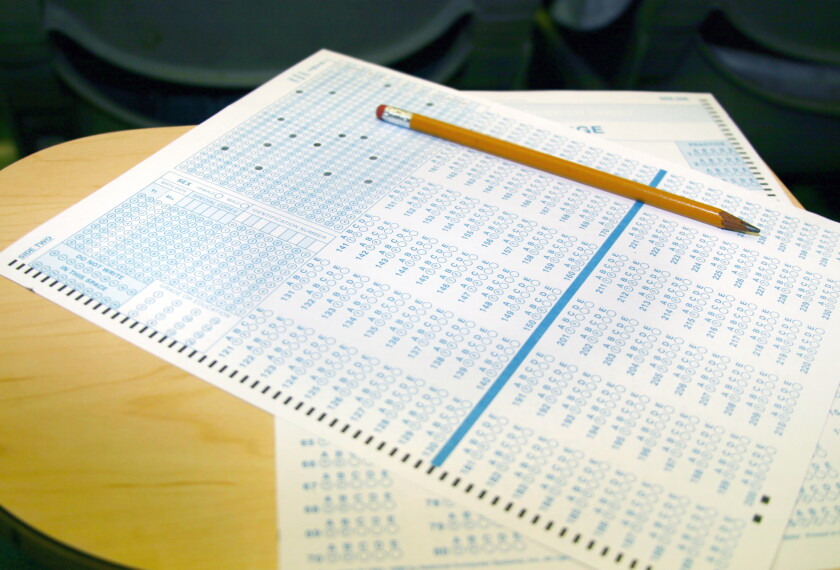
The clock is ticking loudly in Massachusetts, where educators are racing to prepare students for what they say are the most challenging tests public schools have ever administered in the state.
The tests--the Massachusetts Comprehensive Assessment System, or mcas--are a cornerstone of the state’s multibillion-dollar education reform law. They will be given next month for the first time to 4th, 8th, and 10th graders, including special education, bilingual, vocational, and charter school students.
Like many states ushering in tough new assessments, harried school officials in the Bay State are using words like “frenzy” and “fevered” to describe their efforts to get teachers, students, and parents ready.
“We’ve been spending almost all our time getting people to understand what the tests are and what they’re not,” said acting state Superintendent Frank Haydu III.
Mr. Haydu, a businessman who helped write the $2.7 billion Education Reform Act of 1993, stressed that while “people shouldn’t panic,” they should do what they can to take the mystery out of the exams. He said the test questions are culled “100 percent” from the learning standards contained in the state’s new curriculum frameworks.
Those frameworks, which describe in detail what students should know and be able to do in each subject for the grade groupings pre-K-4, 5-8, 9-10, and 11-12, have been issued in the past two school years, and are intended for teachers to incorporate into their curricula. (“With Vote Set, Mass. Board Still at Odds Over History Standards,” June 11, 1996.)
High Anxiety
MCAS will offer a mixture of multiple-choice and essay questions designed by the state education department and the Dover, N.H.-based Advanced Systems. This year, students will be tested in English, mathematics, science, and technology.
Social studies questions will be asked, but not included in this year’s scores, which will be released in November. A history and social science test will be added in 1999, and a foreign-language component will be added later.
State officials have not yet set any penalties for low test scores. But by the 2000-2001 school year, 10th graders will be required to pass the 10th grade assessments to graduate from high school.
Intense preparation has spared many school districts from pretest panic. In the Worcester district, for example, where more than half of the ethnically diverse, 24,000-student enrollment qualifies for free or reduced-priced lunches, educators have spent the past year working to incorporate the state standards into their lesson plans.
“Thousands of teachers and administrators have been in on this,” said James A. Caradonio, Worcester’s deputy superintendent. The Worcester schools have been singled out by the state for their exemplary MCAS preparation program, which includes everything from teacher workshops and parent meetings to study halls. The school system even has its own MCAS cable television show, called the Homework Hotline, a low-budget call-in program explaining concepts behind the exam and awarding prizes to students who phone the show with correct answers to sample test questions.
“Change is never easy. But we trust this test,” Mr. Caradonio said. “And our preparation has pushed us ahead of the curve.”
But for many Massachusetts educators, a single year of preparation is not enough to quell anxieties about low test scores. The state provided guidelines for English, math, and science to schools less than a year ago, and history guidelines were distributed in December.
“There’s a lot of preparation going on now, but most of it’s pretty late for this round,” said Susan E. Szachowicz, the head of the social science department at 3,500-student Brockton, Mass., High School. “And I wonder how we’ll have time to revamp our program [for next year], since the scores won’t be released until November.”
Ms. Szachowicz, who worked on a state school board-appointed committee to draft the social science frameworks, says she has faith in education reform and its accompanying frameworks and assessments, but is not unaware of the political ramifications of low scores.
“No matter what you tell people, a lot is riding on these scores--school pride, community pride,” she said. “Passing the bar is a political nightmare.”
Low Expectations
Test scores will be grouped in four categories: “failing,” “needs improvement,” “proficient,” and “advanced.” The education department has not yet determined what scores fall into those categories or what score merits a passing grade on the exams.
Scores are expected to be low. Expectations are so low, in fact, that lawmakers, including acting Gov. Paul Cellucci, have been crisscrossing the state to warn constituents and level expectations.
“Some districts are not going to do well,” Gov. Cellucci, a Republican, warned in a March 27 speech. “It’s going to take us a long time to get back on top.”
In February, the state released an informational video and brochure explaining the assessments. Ample details, including sample test questions and study guides, are also available on the education department’s extensive World Wide Web site at www.doe.mass.edu.2
Despite such efforts, Steven E. Gorrie, the head of the 83,000-member Massachusetts Teachers Association, the state’s largest teachers’ union and an affiliate of the National Education Association, said that educators still fear low scores followed by an inevitable rush to judgment.
“Education reform evolves over time, not overnight. And this test is only the first go-around,” he said. “The state has raised the bar. And it’s not too high as long as people understand it takes more than one try to get there. I hope everyone is on the same page.”