
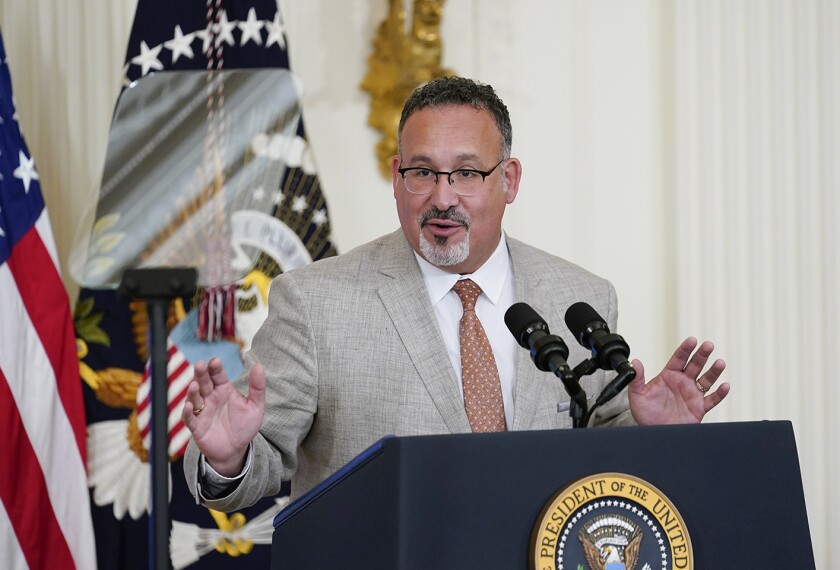
U.S. Secretary of Education Miguel Cardona defended the Biden administration’s stance on a range of education issues during a House appropriations committee hearing Tuesday, including tightening regulations on federal funding for charter schools, scrutinizing pandemic relief aid spending, and expanding the Title I aid program for high-needs students.
Cardona appeared on Capitol Hill to support President Biden’s recently released $88 billion federal budget proposal for the U.S. Department of Education, which includes substantial increases in funding for high-need schools, mental health support for students, and students with disabilities.
But newly proposed regulations for charter schools drew more attention from lawmakers than any of those initiatives.
The Biden administration last month announced proposed regulations that would require charter schools seeking federal funding to demonstrate widespread community interest in the program with the help of a survey and data showing overenrollment in local public schools.
The proposal would also require private charter providers to partner with at least one local public school district on developing curriculum, professional development opportunities, behavioral interventions, or practices to help struggling students. For-profit operators would be barred from the federal grant program, which totals $440 million in Biden’s proposed education budget.
That issue sparked the closest thing to fireworks during a cordial hearing largely free of tension—a far cry from the bickering when Cardona’s predecessor Betsy DeVos appeared before Congress, and from the heated debates with Cardona last year over history curricula and in-person learning.
Cardona on Thursday said the department wants to prevent charter schools from opening in places with low demand, only to close a year or two later and leave students in the lurch. Citing examples of charter schools he strongly supports, he dismissed accusations that the administration wants to defund charter education as “misinformation” and “myths.”
“I think the proposals are reasonable, and what they ask for is greater accountability, transparency and fiscal responsibility,” he said.
Eighteen Republican governors earlier this month urged the Biden administration against implementing these changes. Advocates like the National Alliance for Public Charter Schools also oppose it.
Critics of the proposed regulations say they would give the federal government and districts too much power to veto charter concepts they don’t like; prevent charter schools from opening in high-need areas where districts are facing declining enrollment; and squeeze the ability of private providers to offer families an alternative to public schools.
During Thursday’s hearing, several Republican lawmakers argued the proposed policies will constrain innovation and place an unfair administrative burden on prospective charter operators.
“You may be an advocate for high-quality charter schools, I take you at your word on that,” U.S. Rep. John Moolenaar, R-Mich., told Cardona. “But what you’re doing by this new rule is discouraging people to take the risk to jump in.”
Moolenaar and Rep. Tim Cole, R-Okla., urged Cardona to extend the public comment period on the proposed regulation changes and hold off on implementing any changes until after the current fiscal year. But Cardona said the department has already begun reviewing the feedback it received.
From ‘culture wars’ to budget details
The hearing also touched on contentious fights over state-level Republican efforts to stigmatize classroom discussions of race and sexuality.
Rep. Lois Frankel, D-Fla., asked Cardona how the federal government will fight those new laws, including in her home state of Florida, where a district recently canceled a workshop on the civil rights movement, fearing backlash, she said.
Cardona said the office for civil rights will conduct investigations in cases where students’ rights appear to be violated. Schools shouldn’t be dragged into the “culture wars,” he said.
“It’s really important as an educator and as a father that our students are engaged and proactively introduced to the beautiful diversity that has made this country the most amazing experiment in the world,” he said. “That includes our history, even parts we’re not proud of.”
A few other highlights from the hearing:
- Rep. Rose DeLauro, D-Conn., the committee chair, said she’ll be holding a separate hearing on the issue of teacher shortages, which have drawn increased attention as the pandemic has exacerbated widespread staffing challenges. The federal budget proposal includes $350 million to improve K-12 staff recruitment and retention.
- Cole said he hopes to see the department ensure that the proposal to expand Title I funds for high-need students from $17 billion this year to $37 billion next year will be accompanied by efforts to hold schools accountable for using those funds to drive academic achievement. Cardona said Deputy Secretary of Education Cindy Marten has been working on sharing with districts strong principles for spending those funds wisely.
- Cardona repeatedly emphasized the importance of addressing mental health in schools, and added that the proposal to invest $1 billion in school counselors and social workers would also benefit parents and families who might need those services for themselves. The topic of mental health ramifications from the pandemic came up in conversation this week during lunch with Ashish K. Jha, the recently hired White House Coronavirus Response Coordinator.
- Rep. Ben Cline, R-Va., argued that the American Rescue Plan contributed to inflation and presented a list of school districts that have spent millions of dollars in pandemic relief funds on synthetic turf fields, a weight room expansion, drainage on a football field, and two outdoor tracks. Cardona said the department has worked in recent months to strengthen tracking data to see how districts are using the funds, but he said the majority of spending he’s observed is going toward important priorities like academic recovery, staffing, and building maintenance.


