Law & Courts

Federal Judge Dismisses Challenge to Transgender-Inclusive Athletics Policy in Connecticut

By Mark Walsh — April 26, 2021 3 min read
In this Thursday, Feb. 7, 2019 photo, Bloomfield High School transgender athlete Terry Miller, second from left, wins the final of the 55-meter dash over transgender athlete Andraya Yearwood, left, and other runners in the Connecticut girls Class S indoor track meet at Hillhouse High School in New Haven, Conn. In the track-and-field community in Connecticut, the dominance of Miller and Yearwood has stirred resentment among some competitors and their families.
  • Save to favorites
  • Print

A federal district judge has dismissed a high-profile challenge to a policy in Connecticut of allowing transgender females to participate in girls scholastic sports.

U.S. District Judge Robert H. Chatigny of Hartford, Conn., ruled Sunday that the case was moot because two prominent transgender track athletes, Andraya Yearwood and Terry Miller, had graduated and the cisgender female athletes who objected to the transgender-inclusive policy of the Connecticut Interscholastic Athletics Association are unlikely to have to compete against other transgender girls before they graduate.

“I conclude that the request to enjoin enforcement of the CIAC policy has become moot due to the graduation of Yearwood and Miller, whose participation in girls’ track provided the impetus for this action,” the judge said his April 25 opinion in Soule v. Connecticut Association of Schools.

Chatigny said “there is no indication” that two cisgender female track athletes who are the challengers still in school, Alanna Smith and Ashley Nicoletti, will encounter competition by a transgender student in a CIAC-sponsored event next season.

The CIAC adopted its transgender participation policy in 2013 to defer to a student’s own gender identity and a school district’s determination of the student’s eligibility based on the student’s gender identity in school records and everyday school life.

In 2019, the participation of Yearwood and Miller in girls’ track competitions, in which they won or finished second in several events, prompted complaints from several parents and cisgender female athletes, who sued the CIAC and a number of Connecticut school districts in February 2020.

The challengers argue that the CIAC policy put them at a competitive disadvantage and violated Title IX of the Education Amendments of 1972, which bars sex discrimination in federally funded educational programs.

Around the same time, the challengers had filed a complaint with the U.S. Department of Education’s office for civil rights, and that office under President Donald Trump’s administration last year issued a letter declaring that the CIAC policy violated Title IX. In February, the OCR under President Joe Biden’s administration withdrew that letter.

Meanwhile, the COVID-19 pandemic soon shut down 2020 track and field competitions, and some of the challengers graduated, as did the two transgender athletes.

Chatigny said that the cisgender girls could file a new claim for relief if additional transgender girls became participants in girls track. The judge denied the challengers’ request to remove Yearwood and Miller from the CIAC’s athletic records and move the challengers up in the order of finish of the races, which the challengers contend would be relevant in their efforts to get college scholarships or jobs.

The judge also denied money damages to the challengers under Title IX.

The ruling is a victory for the CIAC and its member schools, and for Yearwood and Miller, who intervened in the case with the aid of the American Civil Liberties Union. But the dismissal of the case on mootness grounds means the judge did not reach the larger Title IX questions that have bubbled up across the country amid a larger debate over the participation of female transgender athletes in girls’ sports.

While the challengers said Title IX was on their side because transgender-inclusive policies harmed “biologically female” athletes, those on the other side contend Title IX requires schools to permit transgender girls to participate in sports consistent with their gender identity.

Chatigny said in a footnote to his opinion that the issue of transgender females participating in girls’ and women’s athletics “implicates opposing interests that are not easily reconciled.”

He cited an article that appeared in the Duke Journal of Gender Law & Policy in 2020 by Doriane Lambelet Coleman, Michael J. Joyner, and Donna Lopiano titled “Re-affirming the Value of the Sports Exception to Title IX’s General Non-Discrimination Rule.”

That paper argues that “whether one is trans or not, if one is in sport and cares about sex equality,” the physical phenomenon of male puberty “is undeniably relevant.”

That paper is one piece of a larger discussion in which even some longtime Title IX advocates have raised questions about allowing all transgender females to participate in girls’ and women’s sports, including this April 15 article in The Washington Post.

Events

This content is provided by our sponsor. It is not written by and does not necessarily reflect the views of Education Week's editorial staff.
Sponsor
Artificial Intelligence Webinar
AI in Schools: What 1,000 Districts Reveal About Readiness and Risk
Move beyond “ban vs. embrace” with real-world AI data and practical guidance for a balanced, responsible district policy.
Content provided by Securly
This content is provided by our sponsor. It is not written by and does not necessarily reflect the views of Education Week's editorial staff.
Sponsor
Recruitment & Retention Webinar
K-12 Lens 2026: What New Staffing Data Reveals About District Operations
Explore national survey findings and hear how districts are navigating staffing changes that affect daily operations, workload, and planning.
Content provided by Frontline Education
Education Funding Webinar Congress Approved Next Year’s Federal School Funding. What’s Next?
Congress passed the budget, but uncertainty remains. Experts explain what districts should expect from federal education policy next.

EdWeek Top School Jobs

Teacher Jobs
Search over ten thousand teaching jobs nationwide — elementary, middle, high school and more.
View Jobs
Principal Jobs
Find hundreds of jobs for principals, assistant principals, and other school leadership roles.
View Jobs
Administrator Jobs
Over a thousand district-level jobs: superintendents, directors, more.
View Jobs
Support Staff Jobs
Search thousands of jobs, from paraprofessionals to counselors and more.
View Jobs

Read Next

Law & Courts Supreme Court’s Gender Identity Ruling Leaves Schools Seeking Clarity
Advocates say they would welcome more from the Supreme Court on gender-notification policies.
7 min read
The Supreme Court is photographed, Friday, Feb. 27, 2026, in Washington.
The Supreme Court is photographed, Friday, Feb. 27, 2026, in Washington. The high court recently ruled that California policies that sometimes limit or discourage schools from disclosing information to parents about children’s gender transitions and expressions at school likely violate parents’ constitutional rights
Rahmat Gul/AP
Law & Courts Supreme Court Backs Parents in School Gender Disclosure Fight
The Supreme Court restored an injunction blocking California policies on student gender transitions
8 min read
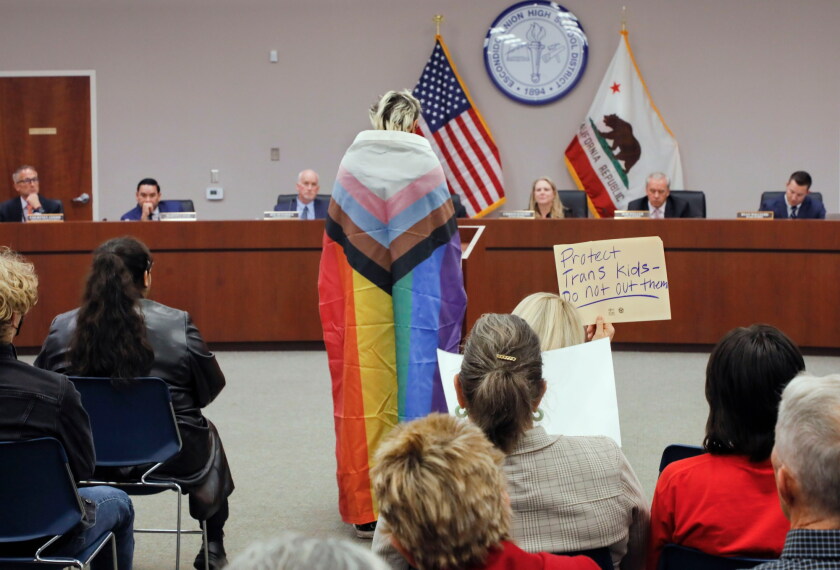
Teacher’s aide Amelia Mester, wrapped in a Pride flag, urges Escondido Union High School District not to have employees notify parents if they believe a student may be transgender in November 2025. A policy on the issue in the city’s elementary school district is the subject of a federal class-action lawsuit in which a judge just sided against the district.
Teacher’s aide Amelia Mester, wrapped in a Pride flag, urges Escondido Union High School District not to have employees notify parents if they believe a student may be transgender at a meeting in November 2025. Two parents and two teachers from the district sued in 2023, challenging California state guidance concerning student gender transitions and parental notification. The U.S. Supreme Court has now reinstated a lower-court decision overturning those state policies.
Charlie Neuman for The San Diego Union-Tribune/TNS
Law & Courts Appeals Court Allows Louisiana Ten Commandments Displays to Proceed
The court said it was premature to rule on the constitutionality of La. Ten Commandments displays.
3 min read
Students work under Ten Commandments and Bill of Rights posters on display in a classroom at Lehman High School in Kyle, Texas, Thursday, Oct. 16, 2025.
Students work under Ten Commandments and Bill of Rights posters on display in a classroom at Lehman High School in Kyle, Texas, Oct. 16, 2025. A federal appeals court has lifted a lower-court injunction blocking a Louisiana law that requires Ten Commandments displays, clearing the way for the law to take effect.
Eric Gay/AP
Law & Courts Social Media Companies Face Legal Reckoning Over Mental Health Harms to Children
Some of the biggest players from Meta to TikTok are getting a chance to make their case in courtrooms around the country.
6 min read
Social Media Kids Trial 26050035983057
Meta CEO Mark Zuckerberg leaves court after testifying in a landmark trial over whether social media platforms deliberately addict and harm children, on Feb. 18, 2026, in Los Angeles.
AP Photo/Damian Dovarganes
