
Federal education funding for K-12 is rising compared with where it was two years ago—but there are disparities in terms of which states are reaping the most benefits. And federal aid to disadvantaged students is actually on course to decline in several states over the first two years of the Trump administration.
Those are two main takeaways from the most recent statistics put out by the U.S. Department of Education about changes in funding over the past two years.
The Education Department’s budget has increased by a small degree since President Donald Trump and Secretary of Education Betsy DeVos assumed office, even though the Trump team has sought to slash the agency’s budget two years running. Congress has pointedly ignored the administration’s push.
To gauge the state-by-state federal funding environment, Education Week examined changes in state-by-state funding between fiscal 2017, the last budget Congress passed and President Barack Obama signed before Trump took office, and the fiscal 2019 spending that Trump approved about two months ago.
State Highlights
In addition to the total state-by-state spending on elementary and secondary education, the analysis also breaks out the changes for Title I grants to districts, which are earmarked for disadvantaged students and represent the single largest pot of federal K-12 cash. (The fiscal 2019 numbers are estimates at this point but give a good idea of where the numbers are heading.)
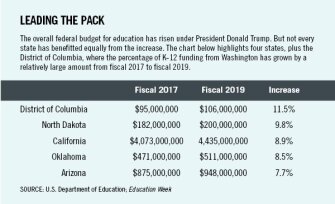
- One winner over the past two years: California. The state with the largest public school enrollment is slated to get a Title I funding bump of more than 9 percent, from just over $1.8 billion in fiscal 2017 to a little over $2 billion in fiscal 2019. Total federal spending on California schools is estimated to increase 8.9 percent, from about $4.1 billion to roughly $4.4 billion.
- Another big winner? Oklahoma, where Title I spending is due to jump from $169 million to $190 million, an increase of more than 12 percent. That’s the single-largest percentage increase of any state examined. It’s also noteworthy given the high-profile political fight in the Sooner State over state spending on public education that’s had a profound impact on schools and lawmakers. Overall spending on Oklahoma schools is expected to rise by about 8.5 percent from fiscal 2017 to fiscal 2019.
- Who’s losing out? Kansas. Education funding in the Sunflower State is due to decline from $333 million to $327 million from fiscal 2017 to fiscal 2019. The state has been embroiled in school finance wars for years. Kansas is the only state where total elementary and secondary funding from the federal government is slated to dip from fiscal 2017 to fiscal 2019.
- Another region that’s losing out, albeit from a narrower perspective, is New England. Connecticut, Massachusetts, New Hampshire, and Rhode Island are all estimated to receive less Title I money in fiscal 2019 than in fiscal 2017, although their aid didn’t decline by much. (Connecticut is due for the largest drop by percentage, or 4.4 percent.) And farther south, the department estimates that Georgia will receive a $3 million dip in Title I funding, although that’s just a tiny fraction of its fiscal 2017 Title I allocation of $540 million. One more Title I “loser”? DeVos’ home state of Michigan, where Title I aid is expected to decline by 3.9 percent down to $485 million.
- Other than the Golden State, the West Coast is seeing its Title I funding slip. Oregon and Washington are on track to get less Title I district aid for disadvantaged students than they did two years ago. The same is true for Utah. Farther west than all those? Hawaii is on course for an 8.2 percent dip in Title I, the largest Education Week saw for any state.
Just because Congress decided to save a program from the Trump budget axe doesn’t mean that there aren’t changes afoot in funding for individual states.
- West Virginia and Wisconsin, just to pick two states, are each due to lose roughly $2 million in funding for their Supporting Effective Instruction grants—better known as Title II, a program the teachers’ unions among others desperately fought to save as Trump sought to eliminate them. That’s a decline of 11.6 percent and 5.6 percent for West Virginia and Wisconsin, respectively.
- For individual programs across states, there tended to be relatively large increases in funding for homeless children and youths, special education, and career and technical education.
- Puerto Rico is also worth highlighting. Its federal funding setup is different from its state counterparts, but the department estimates the island’s Title I aid will be $391 million in fiscal 2019, a decline of 4.2 percent, and its total elementary and secondary aid will total $650 million, a 1.9 percent dip. The U.S. territory has been losing students for many years, a trend that accelerated after Hurricane Maria last year. But those shrinking statistics might be a tough pill to swallow for Puerto Rico since it’s still deep in recovery mode from the storm.
The Title I formula is remarkably complex. In fact, it’s really four formulas in one. Congress considered tinkering with it three years ago, not long before the Every Student Succeeds Act passed, but ultimately abandoned the effort. The formula depends on a variety of factors, student population and demographics among them. In fact, there’s a some evidence that Title I money is not particularly well-targeted.
Also keep this in mind: Federal education funding tends to make up roughly 10 percent of total spending on public schools, so relatively short-term changes in Beltway aid tend not to have the same impact on any individual state as changes agreed to by its lawmakers or local district decisionmakers.


