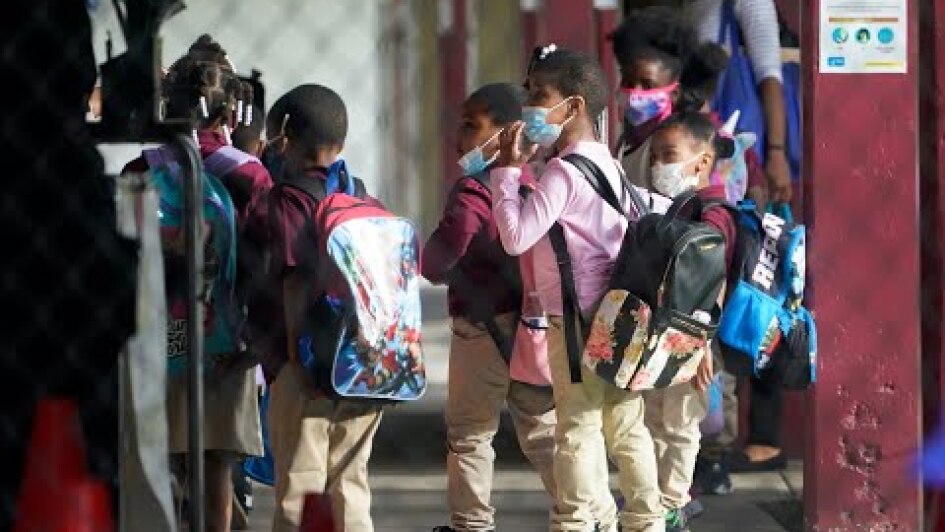
With proper precautions, it will be possible for U.S. schools to conduct in-person learning during the COVID-19 pandemic, the Centers for Disease Control and Prevention said in new, long-awaited recommendations released Friday that stressed the importance of getting schools reopened.
But most schools are in areas with such significant community spread of the virus that they likely won’t be able to have all students on campus full-time, the recommendations say. Instead, they may have to operate under hybrid arrangements of remote and in-person learning to allow for social distancing in classrooms and hallways.
“I want to underscore that the safest way to open schools is to ensure that there is as little disease as possible in the community,” CDC Director Rochelle Walenksy said in a press call to announce the new guidance Friday. “Thus, enabling schools to open and remain open is a shared responsibility.”
I want to underscore that the safest way to open schools is to ensure that there is as little disease as possible in the community. Thus, enabling schools to open and remain open is a shared responsibility.
Walensky also emphasized that schools will have to work with their communities to put reopening plans into place.
“I want to be clear,” she said. “With the release of this operational strategy, CDC is not mandating that schools reopen. CDC is simply providing schools with a long-needed road map for how to do so safely under different levels of disease in the community.”
The recommendations are a core part of President Joe Biden’s plan to reopen “a majority of K-8 schools” for in-person instruction within the first 100 days of his administration. The White House has faced some criticism after some critics said Press Secretary Jen Psaki seemed to lower the bar this week, clarifying that a school would be considered “open” if it offered students at least one day a week of face-to-face learning.
There is not yet federal data on how many schools are operating in-person, but one analysis found that in December, 68 percent of districts offered at least some level of in-person instruction.
Whether the new guidance provides the clarity, credibility, and political will schools need to open and operate safely will be a key test. It’s ultimately up to local school districts, often working under state directives, to decide when and how to reopen. And superintendents have said they face many practical barriers to operating schools during the crisis.
The new CDC guidelines stress that “long-standing systemic health and social inequities have put many racial and ethnic minority groups at increased risk of getting sick and dying from COVID-19.” And they note that being out of school has exacerbated educational equity concerns for students in those groups and students from low-income homes, who may lack access to reliable internet necessary for remote learning. But, in some districts, students from those groups are also less likely to return when in-person classes are available to them.
Local health metrics are the key to reopening
The document uses health metrics to detail risk of COVID-19 transmission in schools. It sets recommended thresholds for when schools are safe to open in-person with all students or to operate in a hybrid of in-person and remote learning, with key mitigation strategies depending on level of spread in the community. Among those strategies: grouping students in cohorts or “pods” to limit interactions in the school building.
The guidance recommends that schools in the two highest-risk categories—labeled “orange” and “red"—operate under hybrid learning models or with limited attendance, requiring six feet of social distancing between students. High schools and middle schools in the highest risk group should remain in virtual learning unless they have few cases and can “strictly implement mitigation strategies,” like routine surveillance testing of students and staff, the guidance says.
Schools are in the orange zone if their county has reported more than 50 new cases of COVID-19 per 100,000 people in the past seven days, or if more than 8 percent of tests conducted during that time come back positive, the recommendations say. Schools are in the red zone if their county’s case rate exceeds 100 cases per 100,000 people or if it has a test positivity rate that exceeds 10 percent, the guidance says.
Nationwide, there have been 30.4 average daily new cases of COVID-19 per 100,000 people in the last seven days, federal data show. Fewer than 5 percent of counties fall into the lowest-risk level defined by the guidance, Walensky said, and about 90 percent of counties are considered high-risk.
The new federal guidelines clash with mandates in place in some states. Iowa will soon join Arkansas, Florida, and Texas in requiring schools to offer on-site instruction to all students five days a week, even as they see high rates of the virus in many areas.
The recommendations rely on five key mitigation strategies, versions of which were included in previous recommendations the CDC issued under the Trump administration. Because the coronavirus is an airborne illness, schools should prioritize the first two, Walensky said: “universal and correct use of masks” and social distancing of at least six feet. The other three strategies detailed in the guidance are hand-washing and “respiratory etiquette,” maintaining clean facilities, and implementing strategies for careful contact tracing and isolation of potentially exposed students, teachers, and staff.
The guidance lists vaccinations for teachers and staff and broad surveillance testing of students and adults as additional strategies, but places less emphasis on them than the other practices. Separately, Biden has ordered the creation of a national testing board that will draft recommendations for schools, and he’s pushed for funding for broader testing efforts.
As the country nears a full year since most states issued broad closure orders in response to the COVID-19 pandemic, it may be difficult for school administrators to change their communities’ perception of risk or comfort with various mitigation strategies. Dated heating and air conditioning systems and crowded classrooms can make social distancing and proper ventilation difficult, they’ve said.
Alongside new guidance, the CDC released a summary of existing research on COVID-19 in schools. Among the findings:
- Schools that strictly follow core strategies (i.e., proper mask use, physical distancing, hand-washing and hygiene etiquette, cleaning, and contact tracing with quarantine) had the same or often lower infection risk than their communities overall, even when community infection rates were high.
- Middle and high school students are more likely than younger students to catch and transmit the coronavirus, and administrators should consider moving upper grades to remote learning sooner than lower grades.
- Close-contact and indoor sports, as well as activities that involve shouting or singing, cause students to breathe heavily near each other, significantly raising their risk of passing along COVID-19.
Daniel Bittman, the superintendent of the Elk River School District in Minnesota, which is currently phasing its 13,000 students back in to in-person instruction, welcomed the new guidance as a unified source of advice for school districts and their communities.
“It’s helpful to have very clear recommendations on things like testing, hand-washing, face covering, and the importance of layering various mitigation strategies, coming from what we consider to be a trustworthy source,” he said. “We are already doing 90 percent of those things. But this provides some level of consistency and clarity and a common language for everyone to use.”
But Bittman is also concerned that if his district can’t implement every single strategy outlined by the CDC, some of his staff and community members might worry that they won’t be safe in schools.
“To say that school districts must keep six feet of space for social distancing, we can’t do that effectively and consistently, especially on buses and in hallways and cafeterias,” he said. “It could create some alarm, because it’s not necessarily practical.”
Schools also face challenges with adequate staffing due to teacher quarantines and a drop in applications for substitute teaching. Some teachers have expressed concerns about emerging, more contagious variants of the virus. And local teachers’ unions in cities like Chicago have raised concerns about accommodations for employees with medically vulnerable family members and whether or not teachers should be vaccinated before returning to the classroom.
Political pushback over teacher vaccinations
Walensky sparked some pushback last week when she said that vaccinating teachers is not “a prerequisite” for school reopenings. The new guidance backs up her statement, saying that teachers should be prioritized for early vaccines but that they can safely return to classrooms with appropriate precautions before they are inoculated.
“The decision to go back to in-person instruction is not one that any of us take lightly,” Walensky said. “Believe me, I know.”
As a presidential candidate, Biden spoke frequently of “listening to the science,” and he accused former President Donald Trump of letting politics drive his administration’s response.
Under the Trump administration, the CDC issued guidance for schools on a range of issues, including basic precautions like hand-washing, virus testing, and quarantines for infected or exposed students and staff.
But some school leaders said the recommendations were inconsistent and lacked clear metrics to guide their decisions. For example, a color-coded chart detailed community risk levels, but it did not tell schools how to respond to that risk. The agency also changed its position on universal symptom screenings, and the non-partisan Government Accountability Office faulted the Trump administration for contradictory messaging to schools.
In addition to more guidance for schools, Biden has ordered additional federal data on how they are operating during the pandemic. And he’s asked Congress to pass a COVID-19 relief bill that includes $130 billion in additional K-12 relief aid.
Walensky said Friday that the White House had been briefed on the new guidance, but did not review or craft her remarks to reporters participating in the press call.
Alongside the guidance, the U.S. Department of Education released the first part of a “handbook” of successful mitigation practices and community feedback strategies for schools. It promised further releases would highlight best practices in areas like equity and supporting students’ mental health.
Education groups that have long pushed for clearer federal guidance praised the CDC release Friday. But some district leaders told Education Week the guidance didn’t contain any new or surprising recommendations.
Alberto Carvalho, the superintendent of the Miami-Dade school district, said he welcomed their affirmation of what his district, which reopened fully to all students in October, is already doing. About 47 percent of the district’s 350,000 students are now attending school in person full-time, while 53 percent opted to remain in remote mode.
“Rather than being an enlightening document, I felt it to be validating of the practices we’ve had in place,” Carvalho said.
Gary Gonzales, the superintendent of the South Whittier schools, a K-8 district near Los Angeles that serves primarily low-income Latino families, said some families in his district will have a hard time trusting that it’s safe to return, and the new guidance probably won’t change that.
“The die was cast” when Trump downplayed the seriousness of the virus, he said, and parents then saw, in their own community, how deadly it was. “Now they don’t trust leadership in the form of a local superintendent, or a state leader, or a federal leader. Trust has been eroded that way.”
The importance of community spread
Research has suggested most students and staff with COVID-19 become infected outside of the school, so community spread can drive both campus outbreaks and staff absences that can force a school to close.
“If our communities are decimated by COVID-19, it’s impractical to say you’re going to be able to run a school properly. Teachers, students, caregivers, bus drivers all are part of a community, and the local health department may be overwhelmed if the community rates are too high,” said Ibukun Akinboyo, assistant professor of pediatrics in the Division of Pediatric Infectious Diseases at the Duke School of Medicine and a medical director of pediatric infection prevention at Duke University Medical Center.
But Akinboyo, speaking before the release of the guidelines, warned administrators that data on spread rates often can be incomplete or out of date in areas with limited testing or slow reporting, and community infection risk guidelines like those offered by some states and the CDC need to be considered in the context of a community’s larger health picture.
For example, a community infection rate of 15 in 100,000 may be considered low risk on average, but that risk calculation changes if the school has a high percentage of teachers in vulnerable groups or very limited support from the local health department.
Walensky stressed Friday that “layered mitigation strategies” will help keep schools safe.
“Most school outbreaks are the result of breaches in mask wearing and relaxed mitigation,” she said.





