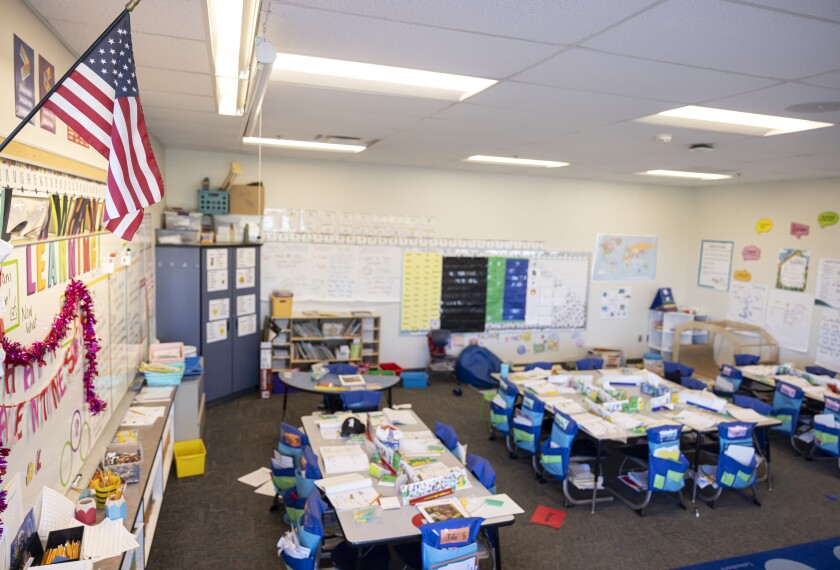
American students’ global competitiveness is at risk as divisive efforts take hold across the United States to ban books, restrict curriculum, and penalize teachers for talking about race, gender identity, and sexuality, Education Secretary Miguel Cardona said.
This week, Cardona joined education ministers and teachers’ union leaders from 22 countries here at the International Summit on the Teaching Profession. Delegates focused on elevating and enhancing the teaching profession, leveraging the potential for technology to improve education, and educating for global and cultural competence and civic engagement.
When asked how laws that limit classroom discussions about race, gender identity, and sexuality—which have taken effect in 18 states and are under consideration in several more—affect American schools’ ability to prepare students to be globally and culturally competent, Cardona said such policies are holding students back from excelling compared with their peers around the globe.
“Here in the United States, it’s a small minority of people, but they want to focus their attention and their leadership on divisive culture wars, which is the opposite of what we’re seeing [at this summit],” Cardona said in an interview with Education Week. “It goes to show how that doesn’t belong in education.”
Instead, the education secretary thinks American schools should focus on preparing students to be globally competitive and to excel internationally. Specifically, he wants to see more schools emphasize multilingualism, as 78 percent of Americans only speak English, according to the U.S. Census, and expand career learning opportunities.
“Shouldn’t that be a goal for us in this country to help our students compete with students from [other] countries?” Cardona said. “To be able to not only understand another language but to be able to have the understanding that different doesn’t mean bad. If anything, it’s an asset.”
Cultural competency was just one of the many topics discussed at the three-day summit that also featured a speech from First Lady Jill Biden. Cardona said the lessons learned in the summit will help with his initiative Raise the Bar: Lead the World, an effort to make American schools internationally competitive.
“The students of the United States, just like the young people of your nations, are the greatest resource we have,” Biden said during her address. “They will lead us into the future and reimagine what our planet can do. That’s why, like so many of you, we are committed to making sure education works for all students.”

Raising teacher pay is not enough to keep teachers
During a press conference on April 27, the last day of the summit, Cardona said he would like to see the Education Department double down on efforts to recruit and retain teachers, and attract new people to the profession.
The U.S. isn’t alone in experiencing difficulty in filling teaching positions, said Andreas Schleicher, director of education and skills and a special adviser on education policy at the Organisation for Economic Co-operation and Development, an international policy organization and one of the cohosts of the event. Countries across the world are struggling to recruit people to the profession, and the challenges aren’t always tied to pay.
For example, Germany, Schleicher’s home country, pays teachers the highest out of the 22 countries participating in the international summit but still faces major shortages. And Finland, where teachers are paid below the average for the countries participating in the summit, there are far more applicants than teaching positions available, according to OECD. In 2021, the U.S. had one of the lowest ratios of average teacher pay to the earnings of similarly educated professionals, according to OECD.
Across the globe, UNESCO estimates 69 million teachers are needed to attain universal basic education, with the largest deficit in sub-Saharan Africa.
“In the United States, you should probably pay your teachers better, but that is not enough to offer people an intellectually rewarding career,” Schleicher said during a news conference at the event.
In addition to efforts to raise teacher pay, Cardona said he plans to focus on increasing teacher voice in policy conversations; improving teacher working conditions by helping schools find more times for breaks and professional development; and hiring support staff like mental health counselors, school nurses, and paraprofessionals.
He’d also like to increase recruitment efforts at teacher preparation programs to help set up more teachers for success, and expand teacher mentorship programs.
“Teachers, once they get into the parking lot, they’re on,” Cardona said in an interview. “They have students in front of them the whole day. Maybe they’ll get half an hour for lunch where they have to make calls and hit the copy machine. ... So, how do we build in the teacher day time for professional learning, time for reflection, and time to observe another teacher?”
Artificial intelligence like ChatGPT is raising all kinds of questions
Throughout the summit, leaders placed a special focus on the emergence of artificial intelligence.
Research has shown that American teachers have a mixed view of AI technologies like ChatGPT.
In a recent Walton Family Foundation survey conducted by the polling and research firm Impact Research, 51 percent of teachers said they have used the tool, 40 percent said they use it weekly, and 10 percent said they use it every day. However, in an EdWeek Research Center survey conducted this month, 47 percent of educators said they feel that AI will have a somewhat negative or very negative impact on teaching and learning.
Cardona compared the recent advances in AI to the introduction of the internet in the late 1990s and early 2000s.
“We talked about the opportunity we have with artificial intelligence to learn from what happened when the internet came without any guardrails,” Cardona said at the press conference. “Think back not too long ago to when social media got to our students and we were scratching our heads trying to figure it out and now we have a mental health crisis.”
The education secretary said he’d like U.S. schools to avoid making the same mistakes and figure out how to use AI to help in the classroom.
“We have an opportunity to embrace artificial intelligence and what it means for education,” he said.
Looking to other countries for guidance
Cardona pointed to a few strategies and programs in other countries that impressed him throughout the conference.
For example, in Australia, education ministers committed to a National Teacher Workforce Action Plan in October 2022. The $217 million initiative aims to address teacher shortages by drawing more people into the profession, strengthening initial teacher education, keeping the teachers the country already has, elevating the teacher profession’s status, and better understanding workforce needs.
The education secretary was also impressed with Finland, where education leaders have focused on improving teacher respect, resulting in more people entering the profession. He also pointed to Ukraine, which has worked to get students back in schools as the war with Russia continues.
The delegations from each country left the summit with a set of actions to improve their education systems.
The U.S. delegation, including the Education Department staff and representatives from the American Federation of Teachers, the National Education Association, and the Council of Chief State School Officers, identified four actions to take over the next year: collaborating to ensure student well-being and academic success; promoting schools as community centers that offer a range of services on top of academics; strengthening support for educators and improve teacher preparation and leadership to grow and retain the workforce; and modernizing education so all students have access to high-quality career pathways, and teachers, students, and families can use technology to further learning.
“It is clear that we all recognize how critical high quality educators are for our children,” Cardona said in a speech closing out the summit. “And it is our children who benefit the most when we reimagine how we recruit and retain educators and when we give them the respect and support they deserve.”