

For 20 high school football seasons, Mac Hardy’s phone rang every Friday afternoon before a home game. It was his boss, the chief of police in Hoover, Ala., asking the same question.
“Are you ready for tonight?”
Hardy was the school resource officer at Hoover High School, in a suburb of Birmingham, where football games routinely drew 10,000 people and big faceoffs attracted crowds of 15,000. There were often fights, but never a shooting—“by the grace of God,” he said.
He attributes much of that good fortune to conversations that happened months before the first kickoff, in which school and local public safety officials worked through what could go wrong on a Friday night and settled on who would handle what.
Not every high school has had the same good fortune.
Gunfire has wounded or killed someone at 43 high school football games in the United States since 2018, according to Education Week’s school shooting tracker, most recently last Friday night in Bakersfield, Calif., where a 17-year-old boy was killed at Independence High School’s season opener. A 15-year-old has been arrested, and police have said it was a gang-related shooting that followed an argument.
Those shootings, in total, have claimed 17 lives and injured 71. They represent 17% of all shootings included in EdWeek’s tracker, and account for 11% of related deaths and 16% of shooting-related injuries.
The annual count of football game-related shootings barely moves: four one season, eight another—swings small enough to be chance. One year stands apart, however: In 2020, when districts called off games, capped attendance, or closed their stands entirely, the number fell to one.
Football game shootings often have their roots in personal disputes
Education Week began its tracker in 2018 and logs only incidents in which someone other than the shooter is struck, so the 43 recorded shootings at football games don’t represent all gun violence tied to those events. Games where shots were fired but nobody was hurt and shootings that happened nearby during football games, but off school property, stay out of the data.
“We tend not to see the more random mass shootings at the athletic events,” said Ken Trump, president of National School Safety and Security Services, who has tracked incidents at school athletic events for two decades and serves as an expert witness in school security litigation.
What turns up instead are disputes between people who already knew each other, and fights that escalate until someone produces a weapon. Trump ticks off where they tend to start: parking lots, restrooms, concession stands, the admissions line. Places where people bunch together.
Hardy, now the director of operations for the National Association of School Resource Officers, described the same problem from the gate. “You have people coming in, hundreds and thousands of people coming in that you have no clue who they are, what they’re doing, what they’re capable of.”
Schools should plan out security well ahead of football season
Asked what they would recommend districts do to enhance security before the first home game, five school safety specialists interviewed for this story converged on something that costs nothing.
“I would have to say the planning, the careful planning with emergency response personnel, with before- and after-school providers, athletic directors,” said Amanda Nickerson, a professor and director of the Dr. Jean M. Alberti Center for Bullying Abuse Prevention at the University at Buffalo.
Stacey Hall, executive director of the National Center for Spectator Sports Safety and Security at the University of Southern Mississippi, recommends a tabletop exercise before the season opens, walking a team of safety officials through security scenarios while there is still time to close any gaps it reveals.
Stoddard suggests copying others’ homework. His district’s four-tier event safety plan is published online, and he says officials from other districts ask for it regularly. “Beg, borrow, and plead,” he said.
Hardy, speaking in mid-August, put the timing plainly. “It’s late right now in the ball game, because we’re in the fourth quarter.”
There are limitations to hardware-based safety solutions
Schools’ most visible response to security threats at football games in recent years has been screening at the entrance. But safety specialists warn against overreliance on metal detectors, and they say they’ve seen schools use them in a way that undermines safety.
Start with the machines’ sensitivity setting. Turn it up and the line slows.
“What often happens is they change the sensitivity settings on them to get people through faster,” at the risk of missing what the machine was bought to find, Trump said.
Hardy supports using detectors and calls turning down their sensitivity the wrong fix for a backup at the admissions gate. What he recommends instead is a plan for the moment the machine goes off: Anyone who sets it off should step out of line and move to a separate station, where an officer runs a handheld wand over them and the main line keeps moving.
Most alarms from metal detectors have ordinary explanations: an artificial knee, a belt buckle, the steel shank in a boot. That second check should be the responsibility of law enforcement rather than a volunteer, Hardy said, because a civilian who asks to see someone’s waistband has no way to handle what might turn up.
“Metal detectors are not a cure-all,” he said. “It is a tool that we use to help secure the facility.”
Another consideration is that metal detectors and screening add to time at the gate, which leaves people standing together longer on the unscreened side of the stadium.
Rich Pauole, the director of student activities for the Charles County, Md., schools, said moving ticket sales online was the best change his district has made to reduce risk at sporting events.
“It keeps the line moving. It keeps people not on top of each other in high-congested areas,” he said. The change also freed up a deputy who used to spend the night guarding a cash box.
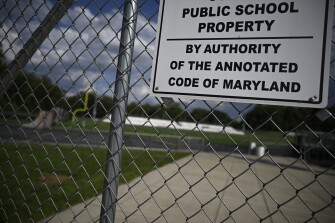
Added fencing is another security measure schools have taken.
But, “what would stop somebody from walking to a secluded place in that fence and throwing something over?” said Jason Stoddard, Charles County’s director of school safety and security.
Trump warns that hardware can become security theater.
In Charles County, safety has to do with rules—and sticking to them
Stoddard rejects that phrase for his own district, but points to a wide variety of measures Charles County has taken to reduce risk at football games that stretch far beyond metal detectors.
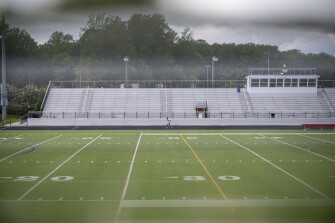
Most of the district’s safety toolkit is rules. Ticket sales stop at halftime. Nobody who leaves mid-game reenters without paying admission again. Bags, backpacks, coolers, and outside food are barred at every game. At games with additional security measures, students show ID or arrive with a parent, and the online-ticketing system caps capacity. Kickoff has also moved from 7 p.m. to 6 p.m. so games finish in daylight.
The reentry prohibition has a specific purpose, Pauole said, which is keeping people from drifting between the stands and the parking lot all night. Home- and visiting-team fans are seated apart. Law enforcement are posted at concession stands, bathrooms, entrances, and student sections of the stadium, and they tell people to keep moving rather than settle in one place.
Trump has a name for the alternative, which lacks deliberate postings for the adults in charge of safety: “cop clump,” adults gathered in a group talking while the ground goes uncovered.
An ambulance and a defibrillator are present at every game. Visiting schools are asked to send an administrator, Stoddard said, because that person recognizes families and students from their school in the crowd.
Nobody works these jobs as a volunteer. The staff are paid; most work multiple games a season; and the athletic director briefs the ticket takers, concession workers, and bleacher staff before the gates open. Everyone is expected to watch the crowd.
“Even if you’re working as the front ticket taker, we’re asking you to make sure that you’re paying attention to what’s going on around you,” Stoddard said.
Everyone is on high alert for people gathering together.
“When you see a group starting to congregate,” Pauole said, “you’ve got to break that group up, whether it’s a good thing or a bad thing.”
Online ticketing, parking lot cameras, and a paid event staff cost money (Charles County received a federal Homeland Security grant to pay for the cameras). But schools can adopt much of the same approach at little cost.
“It’s not your right to enter a school event,” Hardy said. A spectator who will not take off their coat or leave a bag behind can be turned away.
Stoddard stresses the importance of well-developed rules, but also sticking to them.
“If you have rules and you’re not willing to enforce them, they’re not rules at all,” he said. “They’re just mere suggestions.”
Pauole, too, would rather overpolice the small stuff.
“There’s no substitute for safety,” he said.

If shots are fired
Hardy had roughly 25 officers inside the stadium on a big night, and all had one assignment. “Their responsibility was going directly to the threat and stopping that threat,” he said.
Moving 10,000 people through the ticket lines and the stadium falls to everyone else, which works only if the assignments are clear and determined in advance.
The announcer had a binder, and he could flip to a page of prewritten safety-related lines: how to exit the row, which stairwell to use, and a warning to stay off the field, which was never a way out.
“He can’t have it by memory,” Hardy said. “It’s got to be in writing. It’s got to be in front of him.”
Nickerson, from the University of Buffalo, adds two no-cost steps to the announcer’s protocol.
First, use terminology everyone will understand in an emergency—rather than “shelter in place,” for example, “stay where you are and take cover” is more universally understood.
“We don’t want some places to say ‘code red’ and others to say ‘lockdown,’” she said.
Second, point out the exits at the start of the event, before anyone needs them.
If gunfire erupts, clearing the stadium can be the wrong call, Stoddard said.
If the shooting happened in the parking lot, police might want spectators held in the stands rather than routed through a crime scene. Decisions are made jointly, he said, with school officials, police, fire, and EMS operating in a unified command. The athletic director on site speaks for the school system.
“You’re going to have people panic. There’s just no way around that,” Hardy, the former Hoover school resource officer, said.
Stoddard expects most people to stop listening once they are in fight or flight mode.
But Nickerson, who is also a member of the Regional Gun Violence Research Consortium, a coalition of researchers, stresses the importance of clear instructions during a safety emergency.
“There’s actually some research on emergencies and crowds that say that panic is not the best descriptor,” she said. People help each other. They “look for cues for what to do.” By that account, a crowd is waiting for instructions.
These events stay rare. No safety specialist interviewed suggested calling off Friday night football games.
At the same time, no safety measure on the list will prevent every tragedy.
“Our job in anything that we do for school security is risk reduction, not risk elimination,” Stoddard said. “There’s no way to reduce all risk. It is impossible.”


