
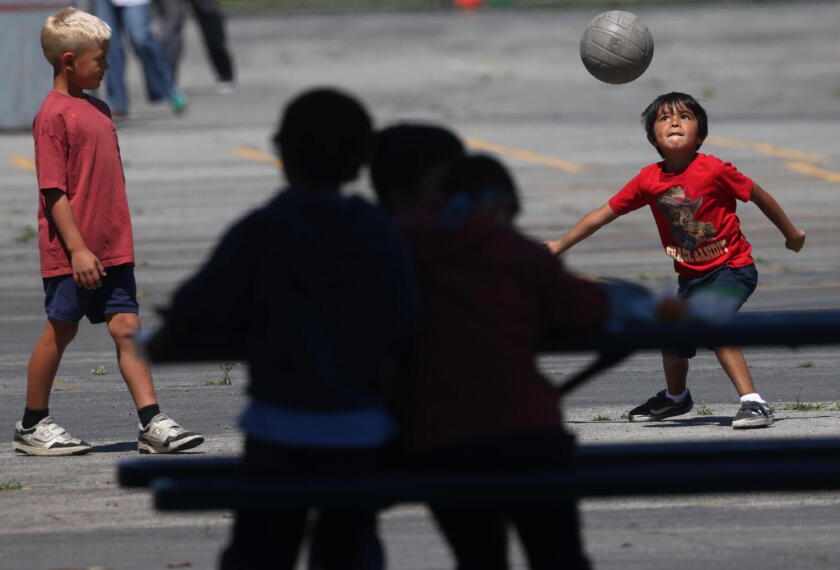
While more than 100 years of research support the importance of recess for students, the fact remains that many schools do not have a restorative break in their daily schedule.
Earlier this year, the American Academy of Pediatrics released new guidance on recess titled “The Crucial Role of Recess in School,” the group’s first update to its recess recommendations in nearly 13 years.
The report recommends that students get a minimum of 20 minutes of recess per day. “School and district policies should emphasize the crucial role of recess breaks for the whole child and protect the time allocated for recess to ensure all students’ right to a safe, quality recess experience every day,” the lead authors write.

But according to an EdWeek Research Center survey conducted between September and November of 2025, many students are not receiving that amount of recess.
Thirty-four percent of the 464 teachers surveyed said their students never have recess, while 40% said students get recess once a day. A different question asked how long recess lasts for students—55% said 15-20 minutes, 29% said 21-30 minutes, and 15% said less than 15 minutes.
The report shows there are many benefits to recess, including academic and social-emotional ones. New evidence shows that kids benefit from pauses in between learning—this allows their brains to retain information. Recess provides an allocated time for peer-to-peer engagement, which helps students of all ages develop skills like cooperation, communication, and leadership, said the report.
Still, education experts say recess is often overlooked. Kathy Hirsh-Pasek, a professor of psychology and neuroscience at Temple University and a senior fellow at the Brookings Institution, said when people talk about recess, they focus too much on the time needed for recess.
“It’s not about, ‘do I need this amount of time or that amount of time?’ ” she said. “It’s about a concept of how we educate human beings, and when you put it in that larger perspective, recess pops out, not as an elective, but something that has to be taken seriously.”
Hirsh-Pasek and Karyn Allee, an associate professor of elementary education at Mercer University, published a Brookings Institution piece last month addressing how the United States lags other nations in terms of how often and how long students have recess.
For example, in Finland, students get 75 minutes of recess per day, with a 15-minute break after every lesson and in Shanghai, elementary lessons are limited to 35 minutes with a break right after.
“The world’s highest-performing school systems did not sacrifice recess in pursuit of test scores—they built their days around breaks,” the commentary read.
In a conversation with Education Week, Allee and Hirsh-Pasek discussed the benefits of recess and what’s standing in the way of making it a reality for all U.S. schools.
This interview has been edited for length and clarity.

What’s the history of recess in the education system?
Allee: Post-World War II, especially with the baby boom, communities were growing rapidly. It was a sign of community wealth and prestige to have schools that had strong, wonderful playgrounds.
This idea of recess was modeled after adult workers needing a break from the factory or farm work. It was accepted as something kids needed as well, as part of their day.
That really shifted with the impetus of the school improvement legislation, particularly the No Child Left Behind Act in 2001.
We really only tested reading and math at that point. Children who are perceived as behind or at risk received more intervention in reading and math, specifically to the exclusion of other subjects. That escalated over the years to where recess became less of a priority, because it was seen as extra and unnecessary.
What are misconceptions about recess?
Allee: One of them is that recess and physical education can substitute for each other. P.E. has specific learning standards—there are targeted learning objectives.
Hirsh-Pasek: Some consider recess to be frivolous, discretionary, and unnecessary. The minute you put it in that particular bin, it’s easy to cut. From the research and science angle, recess should be obligatory. In countries with students that perform well on the tests that the United States cares about, there are more mandated recesses, approximately 10 minutes for every hour.
What are the benefits of recess?
Allee: The act of moving has positive effects on the brain. It helps with focus, retention of learning, and improves working memory and behavior in classrooms. Recess is also correlated with better attendance and arriving on time to school. There are also social-emotional and linguistic benefits to being able to engage in conversation during recess.
Hirsh-Pasek: What are businesses looking for today? No. 1 is collaboration. Are kids more collaborative in recess than they are in a classroom? Yes.
Are kids more communicative at recess than they are in a classroom? Yes. In recess, students are learning to communicate. For example, if a student sits on a swing, the other student can’t have it for five minutes.
Are they learning critical thinking? Yes. They’re solving problems constantly on the playground, some of them social or academic. Games on the playground can be about executive function skills, like Simon Says.
And finally, and very importantly, students learn to build confidence. It’s a safe area in which to fail, and nobody’s grading them.

What gets in the way of schools prioritizing recess?
Allee: Schools and teachers are so micromanaged right now. Even those regular brain breaks, if you’re feeling pressure as a teacher, that’s the first thing that’s going to go. A five-minute brain break is not bad; it’s good, but it’s not compensatory, such as 30 minutes or 45 minutes of recess, where you’re just playing and socializing, sitting, or resting.
In Georgia, the law dictates that all elementary children should have 20 minutes of recess, unless there’s a really good reason to take it away. So, the legislation doesn’t really do much to enforce the policy.
Additionally, there’s a prevalent thought that teachers can withhold recess as punishment for those kids who are most behind or poorly behaved. But usually, those are the kids who need recess the most. Many times, what we’re doing is the opposite of science, but it is unfortunately baked into our culture.
Is there a right way to do recess?
Allee: Structured recess is somewhat antithetical to the concept of recess, because generally we think of recess as free play. But there are groups, like Playworks, that have some structured recess games, and it’s meant to build social-emotional skills.
In general, students need time and space. We have kids who don’t know how to be bored. We have kindergartners who are going through dopamine withdrawal because they’re expected to sit and attend a class without a device, and they can’t do it. Teachers are having behavioral crises in classrooms because kids don’t know what to do without their tablet.
How accessible is recess for all students?
Allee: Recess can raise an equity issue because, with its decline, we haven’t funded safe spaces for children to play freely. There are many schools that don’t have high-quality, safe places to play, and some children do not have the opportunity for free play at home.
Students do need safe spaces. The Harvard Center on the Developing Child has a working group that wrote on the intersection of climate change and early childhood, specifically environmental risk factors occurring in the spaces where children play. For example, in some schools and neighborhoods, there isn’t shade, grass, or a safe place to play, which is an infrastructure issue.
But you don’t need the best, shiniest climbing structure to be able to have recess. Students can get creative with what’s available, but they do need time and space, and it needs to be safe.


