
Equity & Diversity

UCLA Weighs Shift in Admissions Policy

By Alyson Klein — September 19, 2006 1 min read
  • Save to favorites
  • Print

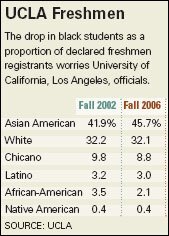
The University of California, Los Angeles, is considering revamping its admissions policy, partly in response to concern over the shrinking number of African-American students enrolling in its freshman class.
UCLA Freshmen

Only 96 African-Americans—or 2 percent of the incoming freshman class—have said they plan to enroll in the university this fall, the lowest number and proportion since 1973.

Currently, one admissions reviewer considers an applicant’s academics, while another examines other factors, including “life challenges” such as the quality of the student’s high school. The proposed process would allow two reviewers to consider a student’s entire application to get a more holistic view.

The recent numbers for African-American admissions “heightened the need to take a hard look at our admissions process to make sure it is fair,” said Adrienne Lavine, an engineering professor and immediate past chairwoman of UCLA’s faculty senate.

The proposed policy has been agreed upon by one faculty committee, but still needs final approval from at least one other faculty panel, Ms. Lavine said.

California’s public colleges are barred from considering race in admissions decisions, under Proposition 209, a voter initiative approved in 1996. The proposed UCLA policy would not violate the law, said Ward Connerly, a leading proponent of the initiative. But the proposed policy shift might not benefit black students in the long run, he said.

“It’s going to be very clear that UCLA is reacting to pressure,” Mr. Connerly said, arguing that if UCLA admitted some black students under “a softer standard,” it would “marginalize” all African-American students.

A version of this article appeared in the September 20, 2006 edition of Education Week

Events

This content is provided by our sponsor. It is not written by and does not necessarily reflect the views of Education Week's editorial staff.
Sponsor
Special Education Webinar
Integrating and Interpreting MTSS Data: How Districts Are Designing Systems That Identify Student Needs
Discover practical ways to organize MTSS data that enable timely, confident MTSS decisions, ensuring every student is seen and supported.
Content provided by Panorama Education
Artificial Intelligence Live Online Discussion A Seat at the Table: AI Could Be Your Thought Partner
How can educators prepare young people for an AI-powered workplace? Join our discussion on using AI as a cognitive companion.
Student Well-Being & Movement K-12 Essentials Forum How Schools Are Teaching Students Life Skills
Join this free virtual event to explore creative ways schools have found to seamlessly integrate teaching life skills into the school day.

EdWeek Top School Jobs

Teacher Jobs
Search over ten thousand teaching jobs nationwide — elementary, middle, high school and more.
View Jobs
Principal Jobs
Find hundreds of jobs for principals, assistant principals, and other school leadership roles.
View Jobs
Administrator Jobs
Over a thousand district-level jobs: superintendents, directors, more.
View Jobs
Support Staff Jobs
Search thousands of jobs, from paraprofessionals to counselors and more.
View Jobs

Read Next

Equity & Diversity Opinion Culturally Responsive Teaching Is a 'Journey of Discovery.' Here Are Tips to Guide You
How teachers can tap into the many factors that contribute to students' cultural identity, according to educators.
12 min read
Conceptual illustration of classroom conversations and fragmented education elements coming together to form a cohesive picture of a book of classroom knowledge.
Sonia Pulido for Education Week
Equity & Diversity Q&A Student Dress Codes Can Send the Wrong Message. How to Get Them Right
Recommendations include a climate survey for students and reevaluating subjective language in dress code policies.
6 min read
In this Sept. 7, 2018 photo, a student at Grant High School in Portland, Ore., waits for a ride after school. Portland Public Schools relaxed its dress code in 2016 after student complaints that the rules unfairly targeted female students and sexualized their fashion choices.
In this Sept. 7, 2018 photo, a student at Grant High School in Portland, Ore., waits for a ride after school. Portland Public Schools relaxed its dress code in 2016 after student complaints that the rules unfairly targeted female students and sexualized their fashion choices. A new brief has nine recommendations to make dress codes more inclusive in schools.
Gillian Flaccus/AP
Equity & Diversity Opinion It’s Time for Courageous Education Leaders to Defend Equity. Here’s How
Here’s how K-12 education leaders can create enduring equitable school systems.
Dwight E. Rhodes
5 min read
A person leaves into the unknown as people watch from inside.
Nanzeeba Ibnat/iStock + Education Week
Equity & Diversity Trump Sues California Over Law Letting Trans Athletes Compete in K-12 Sports
The Justice Department filed the lawsuit after California on Wednesday refused to repeal its state law.
Lia Russell, The Sacramento Bee
5 min read
AB Hernandez, a transgender student at Jurupa Valley High School, competes in the high jump at the California high school track-and-field championships in Clovis, Calif., May 31, 2025.
Jae C. Hong/AP
