A study on reading instruction in two Wisconsin districts suggests that a widely used skills-based program may not be effective in raising the achievement of children in urban schools.
Conducted by researchers at the University of Wisconsin-Milwaukee, the study found that pupils in the local public schools who were taught with SRA Direct Instruction did not show as much growth on a standardized test in reading as students taught with a less scripted program.
“I think this suggests that [Direct Instruction] should be selectively used,” said Randall J. Ryder, the lead researcher for the study, which followed students from 1st through 3rd grade. “The surprising thing is that for students in urban schools, this kind of structure doesn’t necessarily benefit them.”
The findings were quickly disputed by advocates of Direct Instruction, who questioned the researchers’ methodology and analysis of the data.
Siegfried Engelmann, a professor of education at the University of Oregon, whose research led to the creation of the instructional approach, contended that the study was poorly designed and compared students who were not academically matched. He also maintained that teachers in the Direct Instruction classrooms did not follow the program’s procedures.
Methodology Questioned
“This study is technically so bad it never should have been published,” Mr. Engelmann charged. “There are all kinds of studies that show otherwise.”
Mr. Engelmann referred to a study conducted in Houston several years ago with some 10,000 pupils that showed significant gains in achievement among youngsters in Direct Instruction classrooms (“Studies Cite Learning Gains in Direct Instruction Schools,” April 17, 2002).
Pupils in two Wisconsin districts who received Direct Instruction had lower scores on a reading-achievement test than those taught with a less scripted instructional method. The children’s actual gains were measured against what researchers had predicted the pupils’ improvement would be throughout the school year.
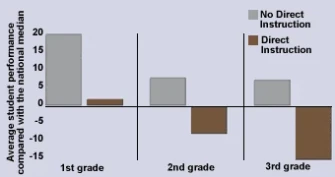
SOURCE: Results of Direct Instruction Reading Program Evaluation Longitudinal Results: First Through Third Grade, Randall J. Ryder, Jen Sekulski, and Anna Silberg, University of Wisconsin-Milwaukee, 2003.
By contrast, he said, the Wisconsin study began following about 200 1st graders each from the Milwaukee public schools and the nearby suburban Franklin school district in the 2000-01 school year. The number of pupils in each cohort varied considerably from year to year because of attrition.
The researchers also were left with incomplete data when the Franklin district decided to discontinue using Direct Instruction beyond the 1st grade. There also was an imbalance in the proportion of pupils from each district instructed in the two methods. The urban district was more heavily weighted toward Direct Instruction, while more of the suburban students were taught using a program published by Houghton Mifflin that combines basic-reading skills and authentic literature.
Mr. Ryder acknowledged that teachers in all the classrooms tended to use supplemental materials to better meet individual students’ needs, but he said they adhered to the basic tenets of the respective programs. Moreover, he maintained, the study was carefully designed to take into account the differences between children.
Mr. Ryder, a professor of reading education, explained that his conclusions might vary from those of previous studies as a result of differences in how the test scores were analyzed. Previous studies, he said, have tended to determine students’ progress by comparing scores on a standardized test at the beginning and the end of each school year.
After testing students’ initial skills in word reading and comprehension, Mr. Ryder and his University of Wisconsin colleagues, Jen L. Sekulski and Anna Silberg, used a complex analysis to project what improvement would be expected by the end of the school year. The children’s scores on a follow-up test were compared with what their expected growth had been.
Overall, Mr. Ryder said, the students in the Direct Instruction classrooms scored significantly lower on the measure than the comparison group.
Reading First Approval
The study was requested in 1999 by Wisconsin state Rep. Gregg Underheim. The Republican legislator was interested in exploring the potential benefits of Direct Instruction to schools statewide.
State education officials contracted the $340,000 study out to the University of Wisconsin. Mr. Ryder took over the project when the original researcher left.
The Direct Instruction program is one of several that districts participating in the federal Reading First program can choose. It is currently being used in at least 10 Milwaukee schools that hold grants under the program, according to Stephanie J. Petska, the director of special education for the state education department.
The Houghton Mifflin program has been among the programs recommended by some states to districts trying to satisfy the requirements of Reading First grants.
Mr. Ryder said he was scheduled to present his findings at the annual conference of the American Educational Research Association, to be held in San Diego in April.


