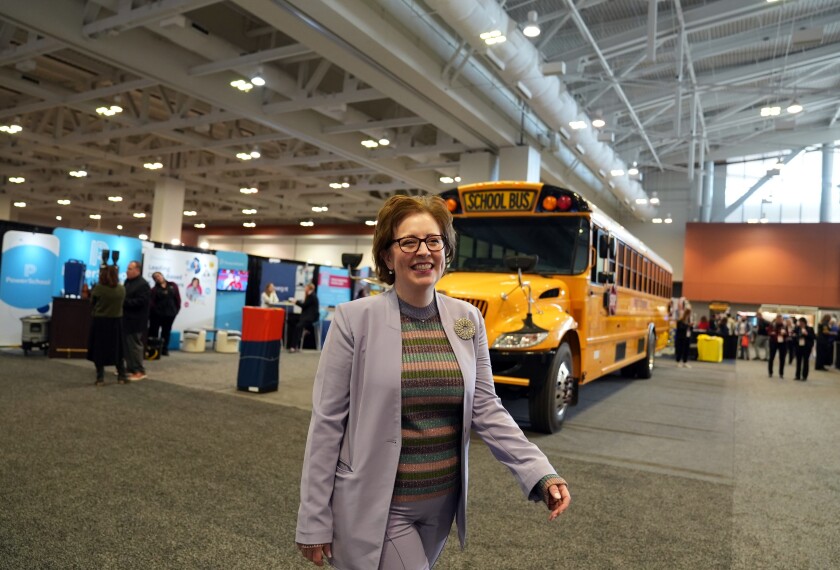
Margaret Spellings, President Bush’s nominee to become the next secretary of education, vowed last week to listen carefully to the concerns of those dealing with the No Child Left Behind Act at the state and local levels and to take a “workable and sensible” approach to carrying out the controversial law, the signature education achievement of Mr. Bush’s first term.
During her Jan. 6 confirmation hearing before the Senate education committee, she also pledged to bring a “spirit of bipartisanship” to her job if she wins Senate backing, which was all but certain. Later that day, in fact, the committee unanimously approved her nomination during a brief meeting just off the Senate floor.
No floor consideration was scheduled as of late last week, though the Senate was expected to take fairly quick action on the nomination.
Ms. Spellings, 47, also reiterated President Bush’s desire to “build on the policy foundation” of the No Child Left Behind law with a greater focus on high schools.
“From parent to policymaker, I have seen public education from many angles, and often been in the other person’s shoes,” Ms. Spellings told the committee in her opening remarks. She won praise from both Republicans and Democrats at the hearing of the Senate Health, Education, Labor, and Pensions Committee.
“I am confident you will do a good job,” said Republican Sen. Michael B. Enzi of Wyoming, noting her experience in education at the local, state, and national levels.
“I don’t think anyone has a better understanding of the president’s position on [education matters],” added Mr. Enzi, who last week became the committee’s new chairman. He replaced Sen. Judd Gregg, R-N.H., who has relinquished the top slot in favor of chairing the Budget Committee.
“We’ve had our differences, but I believe she’s an inspired choice to be secretary of education at this critical moment in our nation’s history,” said Sen. Edward M. Kennedy of Massachusetts, the committee’s ranking Democrat. “I look forward very much to working with her in the years ahead.”
‘Tipping the Boat’
Before joining the White House in 2001 as the president’s domestic-policy adviser, Ms. Spellings served as Mr. Bush’s education adviser when he was the governor of Texas. Before that, she was the top lobbyist for the Texas Association of School Boards. (“Spellings Would Bring Acumen, Pragmatism to Secretary’s Position,” Nov. 24, 2004.)
If confirmed, she would become the eighth U.S. secretary of education.
She would succeed Secretary of Education Rod Paige, who offered his letter of resignation to President Bush in November. The president named Ms. Spellings as his choice on Nov. 17. The department has several other key vacancies in leadership positions, including the No. 2 slot. Deputy Secretary of Education Eugene W. Hickok announced in December his intention to leave the department.
In her opening remarks, Ms. Spellings made clear that she intended to build on the recent record of bipartisanship in Washington when it comes to education policy.
“The recent enactment of the Individuals with Disabilities Education Act, as well as No Child Left Behind, are proof that education is an area where we can truly come together,” she said. “Do we agree on everything? Of course we don’t, and we won’t. But if confirmed, I pledge to do all I can on behalf of the president to work with you to continue the spirit of bipartisanship.”
Ms. Spellings also touched on some of the continuing debate around the No Child Left Behind Act, an ambitious revision of the Elementary and Secondary Education Act that holds states and school districts accountable for improving student achievement.
She emphasized that she would pay close attention to challenges in the law’s implementation. “We must listen to states and localities, to parents and reformers, about their experience with the act,” she said. “We must stay true to the sound principles of leaving no child behind, but we in the administration must engage with those closest to children to embed these principles in a sensible and workable way.”
That message seemed to be especially welcomed by committee members.
“We’ve been at the forefront of the debate on No Child Left Behind,” said Sen. Orrin G. Hatch, R-Utah, who just rejoined the education committee at the start of this Congress. “I believe we were the first state to make moves toward possibly opting out, and I didn’t want to see us do that.”
Utah ultimately backed down in early 2004 from earlier talk of declining the federal aid. Instead, the state legislature passed a measure that said Utah shouldn’t spend any of its own money to comply with the federal law. (“Utah House Softens Stand on Federal Education Law,” Feb. 18, 2004.)
Sen. Hatch asked Ms. Spellings: “How do you anticipate addressing the concerns that have been raised about the No Child Left Behind Act, like in my home state of Utah?”
The secretary-designate, without offering any specific areas for new flexibility, reiterated her commitment to listening to concerns about the law, adding that “none of us want to tip the boat over, if you will, with these, you know, horror-story type of examples.”
Sen. Enzi asked Ms. Spellings to explain the rationale for President Bush’s proposal—issued during the presidential campaign—to expand the No Child Left Behind Act’s testing requirements with two more years at the high school level. Now, the law only requires that high schools test students one time.
“What gets measured gets done,” Ms. Spellings said. “The assessment and data systems that we’ve put in place in No Child Left Behind … [are] really working to improve education.”
She added: “Certainly, it will be a little bit more complicated because of different types of offerings, the way high school is organized, but I do think that same philosophy can apply: that measurement, sound data, more information, both for educators, students, and parents, is useful to improvement in the system.”