School & District Management Report Roundup

Scientists Track Poverty’s Links to Cognition

By Linda Jacobson — January 06, 2009 1 min read
  • Save to favorites
  • Print

The brains of children who are living in poverty function differently from those of children living in better circumstances, according to a study by researchers at the University of California, Berkeley.

The research shows that the prefrontal cortex—the part of the brain that is active in problem-solving, reasoning, and creativity—responds differently in normal 9- and 10-year-olds who differ only by their socioeconomic status.

The study involved 26 children. Half of them were from poor families, and half were from high-income households.

Measuring electrical activity in the brain with an electroencephalograph, the researchers found response levels were lower in the brains of the children from low-income families when they were viewing a series of pictures of triangles that were then mixed with other images, such as a puppy or Mickey Mouse.

The researchers compared the brain activity at that point with that of people who have had a part of the prefrontal cortex damaged by a stroke.

“It’s not just that these kids are poor and more likely to have health problems, but they might actually not be getting full brain development from the stressful and relatively impoverished environment associated with low socioeconomic status: fewer books, less reading, fewer games, fewer visits to museums,” Robert Knight, the director of the university’s Helen Wills Neuroscience Institute, said in a press release.

Work is under way at the university to reverse the brain differences by developing games that improve this area of brain function.

The study has been accepted for publication in the August issue of the Journal of Cognitive Neuroscience.
Related Tags:

A version of this article appeared in the January 07, 2009 edition of Education Week

Events

This content is provided by our sponsor. It is not written by and does not necessarily reflect the views of Education Week's editorial staff.
Sponsor
Special Education Webinar
Integrating and Interpreting MTSS Data: How Districts Are Designing Systems That Identify Student Needs
Discover practical ways to organize MTSS data that enable timely, confident MTSS decisions, ensuring every student is seen and supported.
Content provided by Panorama Education
Artificial Intelligence Live Online Discussion A Seat at the Table: AI Could Be Your Thought Partner
How can educators prepare young people for an AI-powered workplace? Join our discussion on using AI as a cognitive companion.
Student Well-Being & Movement K-12 Essentials Forum How Schools Are Teaching Students Life Skills
Join this free virtual event to explore creative ways schools have found to seamlessly integrate teaching life skills into the school day.

EdWeek Top School Jobs

Teacher Jobs
Search over ten thousand teaching jobs nationwide — elementary, middle, high school and more.
View Jobs
Principal Jobs
Find hundreds of jobs for principals, assistant principals, and other school leadership roles.
View Jobs
Administrator Jobs
Over a thousand district-level jobs: superintendents, directors, more.
View Jobs
Support Staff Jobs
Search thousands of jobs, from paraprofessionals to counselors and more.
View Jobs

Read Next

School & District Management How 4 Superintendents Are Bracing for Federal Funding Uncertainty Under Trump
Superintendent of the Year finalists discussed how they're preparing for potential cuts.
3 min read
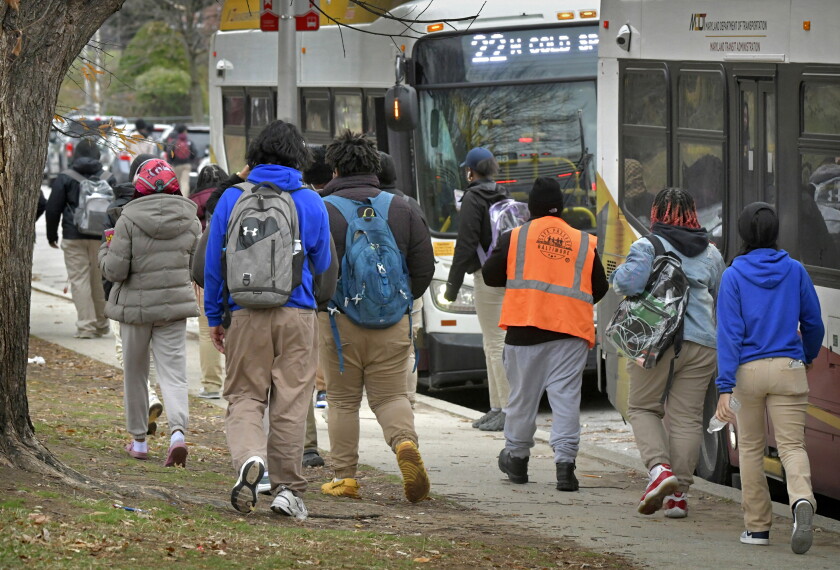
Students at Merganthaler Vocational-Technical High School board MTA buses at the end of the school day on Dec. 13, 2024 , in Baltimore. federally funded programs allows students to access resources they might otherwise not get—like tutoring and after-school programs, according to Baltimore Superintendent Sonja Santelises.
Students at Merganthaler Vocational-Technical High School board buses at the end of the school day on Dec. 13, 2024 , in Baltimore. Federally funded programs in the city's schools allow students access to services they might otherwise not get, such as tutoring and after-school programs, Baltimore Superintendent Sonja Santelises said at a recent panel discussion of the finalists for AASA's Superintendent of the Year award.
Amy Davis/Baltimore Sun/TNS
School & District Management Q&A Why This Leader Is Willing to Risk Losing His Job to Support Immigrant Students
This small Vermont district defies backlash to support immigrant families.
6 min read
A Somali flag, right, flies alongside the United States and Vermont flags outside the Winooski School District building, Wednesday, Dec. 10, 2025, in Winooski, Vt.
A Somali flag, right, flies alongside the United States and Vermont flags outside the Winooski School District building, Wednesday, Dec. 10, 2025, in Winooski, Vt. The district's effort to show support for Somali students drew intense backlash.
Amanda Swinhart/AP
School & District Management How These 3 States Are Building a Principal Pipeline
Principal apprenticeship programs aim to remove barriers to school leadership.
5 min read
Principal and apprentice having a conversation in school courtyard.
E+
School & District Management Opinion 4 Practical Steps Leaders Can Take to Support Student Learning
When it comes to best practice for data-driven instruction, teachers will take clues from leaders.
3 min read
Screenshot 2025 12 18 at 8.01.20 AM
Canva
