
Student Well-Being & Movement

Schools Have Been Hit Hard by the Opioid Epidemic. How One Program Is Trying to Help

By Sarah Schwartz — March 07, 2023 2 min read
Person being helped from a pill bottle by a healthcare provider
  • Save to favorites
  • Print

As schools continue to confront the devastation of the opioid epidemic, educators and health experts put the topic front and center at the SXSW EDU conference in Austin during a panel discussion about partnerships between school districts and health organizations.

In Texas, where the panelists all work, deaths from the powerful synthetic opioid fentanyl have continued to rise, increasing 89 percent from 2020 to 2021.

The vast majority of these deaths are in adults, and school-age children and teens only make up a “small sliver of the overall problem,” said Darrien Skinner, a prevention specialist with the Texas Targeted Opioid Response program at Texas Health and Human Services Commission, during the March 7 panel discussion.

Still, he said, schools are an ideal place to focus on prevention and harm reduction, he said: “What can we do to help our educators and help our youth so that they don’t have such a large risk of overdose later in life?”

The Texas Targeted Opioid Response program, or TTOR, is a public health initiative by the state designed to provide prevention, treatment, and recovery services. Some of its work is done through schools.

Texas isn’t the only state to involve schools in prevention efforts. Several districts across the country have started to stock naloxone, a drug that can temporarily reduce the effects of life-threatening overdoses.

Lisa Cleveland, a professor at the University of Texas Health Science Center at San Antonio School of Nursing, said that demand from schools for naloxone has increased rapidly over the past few years.

Data from the state show that there were 15 school-based requests for naloxone through TTOR in 2019. That number jumped to 342 by 2022. Also in 2022, elementary, middle, or high school educators made up the program’s largest cohort for naloxone trainings. “This is an enormous shift,” Cleveland said.

“I’m really encouraged that schools are wanting to have naloxone, to have it on their campuses. I think that’s a huge step forward,” Cleveland continued. But she sees it as part of a larger strategy that requires more prevention, earlier.

“It’s about arming our students, our faculty, the community in general, about the dangers of fentanyl, and how to protect themselves,” she said.

Texas’ program also includes providing opportunities for prescription drug disposal. The goal of these programs is to remove unused opioid medications from homes, where children may gain access to them.

The state has partnered with the Texas Education Agency to provide drug disposal packets that students can take home, said Douglas Thornton, associate professor of pharmaceutical health outcomes and policy at the University of Houston College of Pharmacy. As of January, the initiative had reached 41 districts.

Research on the effects of these programs is mixed. Several studies have found that when hospitals give out disposal bags to patients, they are more likely to dispose of any leftover drugs properly.

But other research suggests that the total number of drugs returned through public health initiatives, like drop boxes and take-back events, is likely a very small percentage of the total unused opioids in an area.

Events

This content is provided by our sponsor. It is not written by and does not necessarily reflect the views of Education Week's editorial staff.
Sponsor
Artificial Intelligence Webinar
Managing AI in Schools: Practical Strategies for Districts
How should districts govern AI in schools? Learn practical strategies for policies, safety, transparency, and responsible adoption.
Content provided by Lightspeed Systems
This content is provided by our sponsor. It is not written by and does not necessarily reflect the views of Education Week's editorial staff.
Sponsor
Reading & Literacy Webinar
Two Jobs, One Classroom: Strengthening Decoding While Teaching Grade-Level Text
Discover practical, research-informed practices that drive real reading growth without sacrificing grade-level learning.
Content provided by EPS Learning
Jobs Virtual Career Fair for Teachers and K-12 Staff
Find teaching jobs and K-12 education jubs at the EdWeek Top School Jobs virtual career fair.

EdWeek Top School Jobs

Teacher Jobs
Search over ten thousand teaching jobs nationwide — elementary, middle, high school and more.
View Jobs
Principal Jobs
Find hundreds of jobs for principals, assistant principals, and other school leadership roles.
View Jobs
Administrator Jobs
Over a thousand district-level jobs: superintendents, directors, more.
View Jobs
Support Staff Jobs
Search thousands of jobs, from paraprofessionals to counselors and more.
View Jobs

Read Next

Student Well-Being & Movement Millions of Students Attend Schools Near Toxic Sites, a New Study Shows
The study explores schools' proximity to hazardous sites and students' exposure to pollutants.
4 min read
The Fifth Ward Elementary School and residential neighborhoods sit near the Denka Performance Elastomer Plant, back, in Reserve, La., Friday, Sept. 23, 2022. Less than a half mile away from the elementary school, the plant makes synthetic rubber, emitting chloroprene, listed as a carcinogen in California, and a likely one by the Environmental Protection Agency.
The Fifth Ward Elementary School and nearby residential neighborhoods in Reserve, La., pictured here on Sept. 23, 2022, sit near a synthetic rubber plant that has emitted chloroprene, which California lists as a carcinogen. New research finds thousands of schools are located within a quarter mile of such environmental hazard sites.
Gerald Herbert/AP
Student Well-Being & Movement 3 Driving Questions to Create a Sense of Belonging in Schools
Students who feel they belong in their school are more likely to show up and learn.
5 min read
MVCS 1981
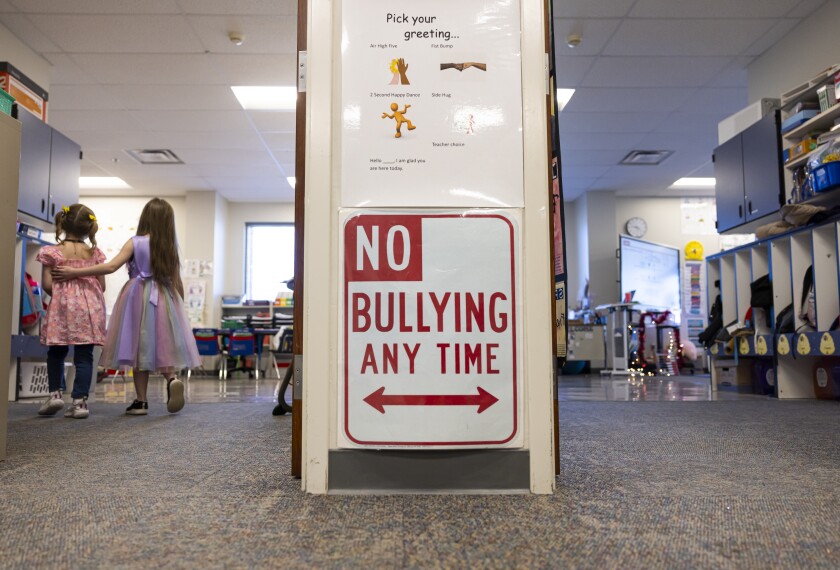
A sign discouraging bullying is seen as two students walk into a classroom at a school in Colorado Springs, Colo., on Feb. 12, 2026. Experts say creating a sense of belonging in school can help curb problems like bullying.
Kevin Mohatt for Education Week
Student Well-Being & Movement Opinion Why a Good School Needs Both Coaches and Referees
If teachers are forced into being referees, they can't fill that role properly or coach well, either.
6 min read
The United States Capitol building as a bookcase filled with red, white, and blue policy books in a Washington DC landscape.
Luca D'Urbino for Education Week
Student Well-Being & Movement Q&A Cellphones: The 'Most Formidable Adversary' Schools Have Ever Faced
The Spokane schools in Washington paired cellphone restrictions with expanded extracurricular activities.
5 min read
Students at Glover Middle School in Spokane, Wash. make bookmarks and snowflakes during Falcon Time on Dec. 3, 2025.
Students at Glover Middle School in Spokane, Wash. make bookmarks and snowflakes during Falcon Time on Dec. 3, 2025. The district has sought to encourage students to spend less time on devices.
Kaylee Domzalski/Education Week
