
It’s hard to change a deep culture that favors physically disciplining students at school, but it is happening.
Nationwide, the practice is on a steady decline, from more than 300,000 students in 2000 to more than 109,000 in 2013-14 nationwide.
That mirrors shrinking support for physical punishment in general: The Annie E. Casey Foundation’s Child Trends annual study finds the percentage of adults who believe that sometimes children need a “good, hard spanking” for discipline shrunk from 84 percent for men and 82 percent for women in 1985, to 76 percent for men and 65 percent for women in 2014.
And even when parents believe they should physically discipline their own children, they are less sanguine about having school officials do so. For example, while more than 60 percent of parents in the South, where corporal punishment tends to be more common in schools, believed in spanking their own children, only 35 percent approved of corporal punishment in schools, according to a 2002 ABC News poll.
“The culture we’ve found is a dichotomy,” said Kimberly Jones Merchant, a managing attorney and the director of educational opportunities for the Mississippi Center for Justice, which represents disadvantaged students in that state.
While many parents believe their children should be paddled for acting up, she said, there is also a belief that “there’s a line that should be drawn” when a stranger at school is doing the paddling. “It’s been difficult on a state level to try to change the policy because there are a whole slew of parents who not only support it but want it.”
The center was part of the unsuccessful push to ban corporal punishment in Mississippi last year. Marilyn Young, a former Mississippi state school board member and a former board member and educator in Tunica County schools, said media coverage of the nearby Memphis, Tenn., public schools’ decision to ban corporal punishment made it harder to pass the statewide ban in 2015. Nearly all of Tunica’s poor, mostly rural school district is black, as were all of the more than 160 students who experienced corporal punishment in the district in 2013-14.
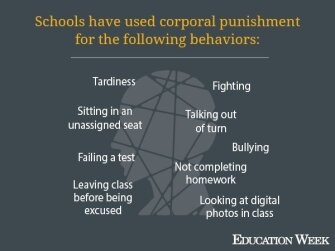
“A lot of people thought all hell broke loose (after Memphis’ ban),” Young said. “It just puts this image in your mind that students are going to be totally out of control if they can’t get a whipping.”
Tiered Response
Instead of an outright ban, critics of corporal punishment in Mississippi and beyond have focused on baby steps. The state law allows districts to decide whether or not to use corporal punishment, and only 11 of Mississippi’s 148 school districts explicitly ban corporal punishment, according to Merchant’s analysis, but many are trying to reduce administrators’ use of the practice.
“Some of the administrators, it’s finally dawning on them that [corporal punishment] doesn’t work and they need to find an alternative,” Young said.
In 2013-14, federal civil rights data show that out of more than 25,000 students who received corporal punishment in Mississippi, the Grenada, Miss., school district accounted for more than 400 of them. While its high school did not use corporal punishment, its K-3, 4-5, and middle schools did. In the lower schools, black students received corporal punishment at double the rate of white students. In Grenada Elementary School, for example, 10 percent of white students received physical discipline, compared to 23 percent of black students.
Grenada “recognized the high number of office discipline referrals, leading the district to take a closer look at our discipline policy,” said David Daigneault, the district’s superintendent. The then-4,300-student school system decided to implement positive behavior intervention and supports, or PBIS, a tiered framework for dealing with student misbehavior. Grenada isn’t alone: A 2015 study of public attitudes toward corporal punishment in the International Journal for Cross-Disciplinary Subjects in Education likewise found a “generational change” of educators and parents moving away from physical discipline and towards PBIS and similar methods.
Grenada has developed behavior plans for each of its students and added more punishments involving loss of privileges, such as missing music, art, library, or computer time, in addition to missing recess. Corporal punishment can be used now only after the student has already received “counseling, parent conferences, and other forms of discipline” without effect, though there is still no districtwide limit on what implement can be used or to what extent. The district also began allowing parents to opt their students out of physical punishment.
Before implementing the new discipline system, Daigneault said, 255 out of 1,546 students at Grenada Elementary, the district’s K-3 school, received corporal punishment in 2013-14. By 2014-15, after implementation, that number fell to 108 students, and then to 61 students in 2015-16.
The Tunica district similarly has limited corporal punishment on its own, but “it took us about five years—trainings at the board level for two years, talking about how can we cut our system of referrals down … and it is still a constant struggle,” Young said. “We have board members vote to get rid of it, and then the next board members vote to bring it back.”


