Opinion
School Climate & Safety Opinion

What It Takes to Lead a School After a Shooting

A principal’s guide for healing from a schoolwide tragedy
By Warman Hall — November 27, 2018 4 min read
BRIC ARCHIVE
  • Save to favorites
  • Print

Last December 7th, Aztec High School experienced a horrible and tragic event when a young man who had attended our school more than five years earlier walked on our campus and took the lives of Casey Jordan Marquez and Francisco “Paco” Fernandez. The active shooter event lasted a little more than seven minutes; the shooter took his own life seconds before the police arrived on scene. Our heroic local police department responded to our call for help within four minutes and emergency responders from all corners of San Juan County, N.M., assisted with the subsequent release of lockdown, campus evacuation, and reunification with families.

In the subsequent year, our local sheriff’s department and the FBI have conducted investigations looking at the crime from numerous angles. From these investigations, and from our shared perspective, the leaders in our district have learned much about what carried us through that day.
BRIC ARCHIVE

For instance, we know that the shooter planned a far worse death count. Casey and Paco innocently surprised the gunman as he was preparing to carry out his plan; those first shots alerted staff to secure classrooms and signal a campuswide lockdown. Following lockdown training and radio communication prevented the gunman’s attempt to enter two classrooms.

In short, our staff was heroic. And while our fidelity to protocol was not perfect, training and communication saved lives that day. Even an imperfect recall of training is better than not having trained at all. I don’t think that I’ll ever look at even the most routine safety training with a lax perspective again.

About This Package

In this special Commentary package, current and former school leaders share insights from how they managed and recovered from some of the most difficult—and often unexpected—circumstances of their careers.

This special section is supported by a grant from The Wallace Foundation. Education Week retained sole editorial control over the content of this package; the opinions expressed are the authors’ own, however.

Read more from the package.

As I write this essay, our student leadership, staff, and I are in the middle of planning how the school will structure the one-year anniversary of our tragedy. We will never forget the precious lives lost that day or the heroic response from our community. As a whole, the kids have been resilient and inspiring in the way they have begun to use their collective voice to call for unity and mutual support as a way through our ongoing recovery. From a principal’s personal perspective, I have far more advice to share on what has gotten me through the past 12 months of community rebuilding than I would ever be able to say about that day a year ago.

I have learned that after a tragedy, a principal needs to be prepared to deal with a wide variety of opinions and perspectives on how the school should respond and change in the wake of what has happened.

How does one lead a school when strong voices and weak voices in the community all need to be heard long before a plan is put into place? How does one deal with the reality that some decisions are not going to be left to the site leadership alone? How does a leader deal with his or her own self-doubt while seeking to listen to and empower others who are just as traumatized by events? Three very personal lessons come to mind that I can share with my professional peers.

Lesson one: Remember that you’re not in it alone. Delegating power and releasing control are traits that principals often should nurture. The daily perspectives we deal with are already numerous and most principals I’ve met are pretty good at leading as coalition-builders. After a school tragedy, it is natural that the building principal is someone that people want to check in with about big decisions on the school’s response. Make sure to regularly connect with others in your sphere of influence and chain of command to hear crucial perspectives for when your input is requested or your leadership needed.

Lesson two: Work to keep the kids front and center. Support a clear structure for listening to the kids’ wants and needs as decisions are being made, and be prepared to incorporate student voices that feel left out. Just like the adults in our communities, the kids with the strongest voices are likely to be the first to surface and advocate. And, like a good teacher who structures a solid classroom discussion on a contentious topic, a principal needs to formalize the discussion and encourage various participants to listen to one another so that even the quiet voices have an opportunity to be heard.

Lesson three: Reconnect with the reasons why you do this job. Self-doubt can definitely creep in as day-to-day decisionmaking and school management demands attention long before a leader has adequately had time to address his or her own mental wellness. Accepting help from mental-health professionals is just as important for the leader as it is for everyone else after a tragedy.

On a purely personal level, I’ve come to understand the need to stay in tune with my spiritual core so that I can continue in a profession that I believe is my life calling. In the book of Philippians, the Apostle Paul reminds us that we can do all things through Him who strengthens us. Reconnecting with the “why” in what I do has been very important to me. If that divine grace was good enough for a great man of faith like Paul, then it is certainly good enough for me.

< Previous
What It Takes to Be a 'Crisis Principal' in a Hurricane

Next >
What It Takes to Make a 4-Day School Week Work

Coverage of leadership, summer learning, social and emotional learning, arts learning, and afterschool is supported in part by a grant from The Wallace Foundation, at www.wallacefoundation.org. Education Week retains sole editorial control over the content of this coverage.
A version of this article appeared in the November 28, 2018 edition of Education Week as What Comes After a Tragedy

Events

This content is provided by our sponsor. It is not written by and does not necessarily reflect the views of Education Week's editorial staff.
Sponsor
Classroom Technology Webinar
Better Tools, Not More: What Educators Say About Teaching and Technology
Optimism is up. AI use is rising. Coherence is the next challenge. Hear what the 2026 Educator Confidence Report reveals about the field.
Content provided by HMH
This content is provided by our sponsor. It is not written by and does not necessarily reflect the views of Education Week's editorial staff.
Sponsor
Student Achievement Webinar
The Relationship Advantage for Attendance, Engagement, and Achievement
Relationship-building goes beyond back-to-school. Get practical ideas from district leaders and educators to strengthen student connections.
School & District Management Webinar EdMarketer Quick Hit: Build Campaigns That Engage K-12 Leaders
We’ll share what’s resonating with Education Week’s K-12 audience based on user behavior across platforms and other proprietary data.

EdWeek Top School Jobs

Teacher Jobs
Search over ten thousand teaching jobs nationwide — elementary, middle, high school and more.
View Jobs
Principal Jobs
Find hundreds of jobs for principals, assistant principals, and other school leadership roles.
View Jobs
Administrator Jobs
Over a thousand district-level jobs: superintendents, directors, more.
View Jobs
Support Staff Jobs
Search thousands of jobs, from paraprofessionals to counselors and more.
View Jobs

Read Next

School Climate & Safety A Shooting Strikes an Elementary School. Some Doubt Policy Change Will Follow
Tragedies like the one in Bend, Ore., draw public outcry, but typically not swift change on school safety.
5 min read
Children place flowers at a makeshift memorial outside Silver Rail Elementary in Bend, Ore., Friday, Oct. 16, 2026, a day after a deadly shooting.
Children place flowers at a makeshift memorial outside Silver Rail Elementary in Bend, Ore., Friday, Oct. 16, 2026, a day after a deadly shooting. The child victims, ages 5, 8, and 11, include the youngest person killed in a school shooting since Education Week began<a href="https://www.edweek.org/leadership/school-shootings-this-year-how-many-and-where/2026/01" target="_blank" link-data="{&quot;cms.site.owner&quot;:{&quot;_ref&quot;:&quot;00000173-0561-d1f0-a17f-adef4bee0000&quot;,&quot;_type&quot;:&quot;ae3387cc-b875-31b7-b82d-63fd8d758c20&quot;},&quot;cms.content.publishDate&quot;:1792177418426,&quot;cms.content.publishUser&quot;:{&quot;_ref&quot;:&quot;00000180-d7b2-d193-a1b2-dfbba3aa0001&quot;,&quot;_type&quot;:&quot;6aa69ae1-35be-30dc-87e9-410da9e1cdcc&quot;},&quot;cms.content.updateDate&quot;:1792177418426,&quot;cms.content.updateUser&quot;:{&quot;_ref&quot;:&quot;00000180-d7b2-d193-a1b2-dfbba3aa0001&quot;,&quot;_type&quot;:&quot;6aa69ae1-35be-30dc-87e9-410da9e1cdcc&quot;},&quot;link&quot;:{&quot;disableUtmTracking&quot;:false,&quot;target&quot;:&quot;NEW&quot;,&quot;attributes&quot;:[],&quot;url&quot;:&quot;https://www.edweek.org/leadership/school-shootings-this-year-how-many-and-where/2026/01&quot;,&quot;_id&quot;:&quot;000001a1-4619-d1d1-a3f3-f77b151b0000&quot;,&quot;_type&quot;:&quot;ff658216-e70f-39d0-b660-bdfe57a5599a&quot;},&quot;linkText&quot;:&quot; tracking these incidents&quot;,&quot;theme.brightspot-theme-default.:core:enhancement:Enhancement.hbs.enhancementAlignment&quot;:null,&quot;theme.brightspot-theme-default.:core:link:Link.hbs._template&quot;:null,&quot;theme.brightspot-theme-default.:core:link:Link.hbs.type&quot;:null,&quot;theme.brightspot-theme-default.:core:link:Link.hbs._preset&quot;:null,&quot;theme.brightspot-theme-default.:core:enhancement:Enhancement.hbs._preset&quot;:null,&quot;_id&quot;:&quot;000001a1-4619-d1d1-a3f3-f77b14b10001&quot;,&quot;_type&quot;:&quot;809caec9-30e2-3666-8b71-b32ddbffc288&quot;}"> </a>tracking those incidents eight years ago.
Joe Kline/AP
School Climate & Safety Three Children and Teacher Killed in Oregon Elementary School Shooting
Authorities in Bend, Ore., said the attacker gained entry by shooting through locked doors.
2 min read
Police tape is placed outside Silver Rail Elementary school following a shooting, on Oct. 15, 2026 in Bend, Ore.
Police tape is placed outside Silver Rail Elementary School following a shooting, on Oct. 15, 2026 in Bend, Ore. Authorities said an attacker shot through locked school doors to enter the building.
Joe Kline/AP
School Climate & Safety 4 Ways AI Data Centers Can Affect Schools
From health to productivity and finances, data centers could pose risks for students and schools.
3 min read
Carroll
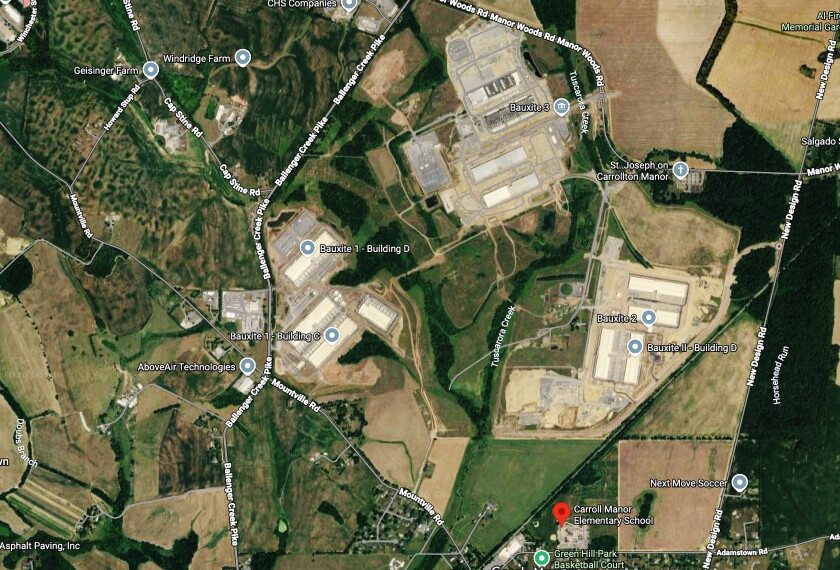
The Quantum Frederick Data Center Campus near the Carroll Manor Elementary School.
Map data ©2026 Google, Imagery ©2026
School Climate & Safety For Students Walking to School, the Route Can Be Deadly. What Can Make It Safer?
School districts, including New York City, have rolled out a number of strategies to reduce risks.
5 min read
A student leaving Greenspun Junior High School in Henderson, Nev., enters a car in the travel lane of Valle Verde Drive on Sept. 14, 2022. Pedestrian fatalities near schools are most likely to occur in the early morning and early evening hours, federal data show.
Rachel Aston/Las Vegas Review-Journal via TNS