Albert Einstein defined insanity as doing the same thing over and over again and expecting a different result.
The truth of this statement has never been more obvious than it is right now in education. Our schools maintain century-old structures and keep doing the same things over and over again, expecting different outcomes.
Decades of efforts to reform schooling have focused on tinkering around the edges. These attempts include increasing testing, tightening accountability measures, providing more carrots, and creating bigger, harsher sticks. Yet despite huge investments in time, effort, and money, these efforts haven’t worked.

What we have failed to recognize is that there have been substantial shifts in what is expected of schools and schooling. But there has been little, if any, change in how schools are structured to account for those shifts.
Consider any company that existed 100 years ago. Now think about what it would mean if that company operated the same way today that it did 100 years ago. It’s insane to consider that they would even be in business! Yet that’s what has happened to our schools. They operate and are structured in the same way that they always have—yet we still expect different results.
So let’s ask ourselves a few questions:
- What if we transformed schools by implementing what the public wants and what we know about high-performing organizations?
- What if we let those who know teaching and learning best (teachers!) call the shots about issues and conditions impacting student learning?
- What if we created structures that empowered highly trained professionals to own their work and the subsequent outcomes?
The answer? A dramatic transformation in how schools are structured and operated. What we need are teacher-powered schools and teams.
Teacher-powered schools, also called teacher-led schools, are inspired by students and led by teachers. The public overwhelmingly supports the idea that teachers can—and should—have the authority to make decisions impacting whole-school success. When teachers have autonomy, the schools they create demonstrate the characteristics of high-performing organizations.
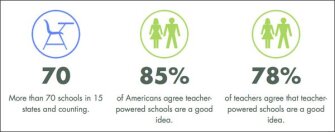
These schools put decisionmaking in the hands of those who know students best: teachers. And when teachers are able to make important management and learning decisions while being held accountable for student results, they embrace the opportunity to take responsibility for student learning. Teachers in teacher-led schools take on higher levels of accountability because they are collectively responsible for student outcomes.
So: Are you a teacher who is ready to call the shots? Or, are you an administrator who wants to shift your school to become more teacher-powered?
Here are seven steps to get started:
1. Start a study group to learn more about teacher-powered schools.
There are a growing number of resources for you and your team. You could start a book study of Trusting Teachers with School Success: What Happens When Teachers Call the Shots, which analyzes several teacher-powered schools across the country, or An Improbable School: Transforming How Teachers Teach and Students Learn, a profile of Wildlands, a teacher-powered school in Wisconsin. Your study group could also work together to study Steps to Creating a Teacher-Powered School, a free online guide with over 200 resources for teacher teams who are designing or managing teacher-powered schools.
2. Connect with other educators who are interested in teacher-powered schools.
There are thousands of teachers and administrators who are interested in learning more about teacher-powered schools. Find your tribe both in person and virtually! For in-person connections, seek out friends or colleagues who have said, “If I could start a school, I would…” To make connections with teachers all over the country, join the teacher-powered schools lab in the Center for Teaching Quality’s virtual network, the Collaboratory.
3. Research and connect with existing teacher-powered schools.
There are more than 70 teacher-led schools operating in the United States. These include charter schools and district schools; elementary, middle, and high schools; rural, urban and suburban schools; and more. One of the best ways to learn the details about how teacher-powered schools operate is to connect with them. Here are links to a few:
- Chrysalis Charter School (Calif.)
- Wildlands School (Wisc.)
- Denver Green School (Colo.)
- Social Justice Humanitas Academy (Calif.)
- Reiche Elementary School (Maine)
Many teacher-powered schools have fishbowl environments and happily welcome visitors into their classrooms. If you live near a school and want to visit, call or email to determine an appropriate time—and bring a list of questions!
4. Form a design team and begin creating the vision of your future teacher-powered school.
Teacher-powered schools or teams are, by definition, collaborative. There is a fundamental belief associated with this movement that the collective is more effective and powerful than any individual. To that end, identify at least a few colleagues with whom you can work to begin to design the vision of your team. Consider using these discussion guides that were created based on the experiences of teachers from eight teacher-powered schools. These guides offer tips and discussion questions for your team to consider as you engage in the design process.
5. Investigate your local and state school board policies.
Whether you are trying to start a new school, transition an existing school’s model, or shift teams within a school, your design team will need to know and understand the policies that govern the shifts you are trying to make.
For new schools, your team will need to determine the process for approving and starting new schools in your district (if such a process exists). This may include learning about the processes for creating either a district or charter school. If your team is attempting to transition an existing school or teams within a school, your team will need to learn about policies that govern how schools are run, who runs them, and who can make what decisions. Your team may also need to investigate the process for securing local or state waivers to meet these requirements.
6. Connect with your local association and school board members.
Once your team is familiar with the policy landscape, it’s a good strategy to connect with people who can support your team’s efforts.
- Local Association: A good starting point for building a coalition of support for your team is your local teachers association. Not only can they help your team further navigate the policy landscape, they can also help identify areas within the collective bargaining agreement where there may be issues that need to be addressed with your team.
- School Board Members: In most cases, new schools or new structures within currently existing schools will need the support and approval of school board members. Building relationships with school board members, and learning what their priorities are, will help you design a school that aligns with district priorities and continue to build your coalition of support.
7. Attend the National Teacher-Powered Schools Conference.
The best way to learn how to design and operate a teacher-powered school is to connect with others who are also engaged in this work. The National Teacher-Powered Schools Conference, which will be held November 6-7, 2015, in Minneapolis, will bring together teachers from across the country who are at different stages of designing, launching, operating, and improving their teacher-powered schools. This event will help your team accelerate their vision to reality!
It’s time to stop doing the same things over and over again, expecting different results. It’s time to move toward the true transformation of schools and leverage the talent of those who know teaching and learning best.
It’s time for teacher-powered schools and teams!



