Opinion
Student Well-Being & Movement Letter to the Editor

Teach Executive Function

February 11, 2020 1 min read
  • Save to favorites
  • Print

To the Editor:

I enjoyed the article about math anxiety (“The Myth Fueling Math Anxiety,” Big Ideas special report, Jan. 8, 2020). As a neuroscientist who specializes in how the core skills of executive function promote rigorous math learning, it is particularly gratifying to see EdWeek cover this topic.

In the last paragraph, the article says, “There aren’t ‘math people’ and ‘non-math people,’ only those who work through the challenging lesson and those who surrender too soon.” The ability to do this is a great example of executive function at work.

Executive functions are like the air traffic control system of the mind: They give us agency over our thoughts, attention, emotions, and behavior. They allow us to control our learning and our lives, and maybe even supercharge math learning. Every student is a powerful learner. In fact, we don’t need to teach students to learn. They’re wired for it.

Inside each student lies the foundations to learn and master anything. But somehow this message isn’t taught to young learners, particularly in math for girls, students of color, and students from low-income communities. The world bombards them with subtle (and not-so-subtle) messages about what society thinks they aren’t capable of achieving. This can hijack their executive functions and leave them less available to learn math, which can start a negative spiral that may become internalized as a part of their identity, and shape who they believe they are.

Every child should know their innate abilities, to know how to use them to take control of their learning, and to have every opportunity to learn anything, including rigorous math. Why? Because all students have powerful minds that deserve to be challenged and given opportunities to learn rigorous math. And because success in math is critical to many factors for success in young adulthood.

Melina Uncapher

Neuroscience Professor

University of California, San Francisco

EF+Math Program Director

NewSchools Venture Fund

Oakland, Calif.

Related Tags:

A version of this article appeared in the February 12, 2020 edition of Education Week as Teach Executive Function

Events

This content is provided by our sponsor. It is not written by and does not necessarily reflect the views of Education Week's editorial staff.
Sponsor
Artificial Intelligence Webinar
Managing AI in Schools: Practical Strategies for Districts
How should districts govern AI in schools? Learn practical strategies for policies, safety, transparency, as well as responsible adoption.
Content provided by Lightspeed Systems
This content is provided by our sponsor. It is not written by and does not necessarily reflect the views of Education Week's editorial staff.
Sponsor
Reading & Literacy Webinar
Unlocking Success for Struggling Adolescent Readers
The Science of Reading transformed K-3 literacy. Now it's time to extend that focus to students in grades 6 through 12.
Content provided by STARI
Jobs Virtual Career Fair for Teachers and K-12 Staff
Find teaching jobs and K-12 education jubs at the EdWeek Top School Jobs virtual career fair.

EdWeek Top School Jobs

Teacher Jobs
Search over ten thousand teaching jobs nationwide — elementary, middle, high school and more.
View Jobs
Principal Jobs
Find hundreds of jobs for principals, assistant principals, and other school leadership roles.
View Jobs
Administrator Jobs
Over a thousand district-level jobs: superintendents, directors, more.
View Jobs
Support Staff Jobs
Search thousands of jobs, from paraprofessionals to counselors and more.
View Jobs

Read Next

Student Well-Being & Movement Millions of Students Attend Schools Near Toxic Sites, a New Study Shows
The study explores schools' proximity to hazardous sites and students' exposure to pollutants.
4 min read
The Fifth Ward Elementary School and residential neighborhoods sit near the Denka Performance Elastomer Plant, back, in Reserve, La., Friday, Sept. 23, 2022. Less than a half mile away from the elementary school, the plant makes synthetic rubber, emitting chloroprene, listed as a carcinogen in California, and a likely one by the Environmental Protection Agency.
The Fifth Ward Elementary School and nearby residential neighborhoods in Reserve, La., pictured here on Sept. 23, 2022, sit near a synthetic rubber plant that has emitted chloroprene, which California lists as a carcinogen. New research finds thousands of schools are located within a quarter mile of such environmental hazard sites.
Gerald Herbert/AP
Student Well-Being & Movement 3 Driving Questions to Create a Sense of Belonging in Schools
Students who feel they belong in their school are more likely to show up and learn.
5 min read
MVCS 1981
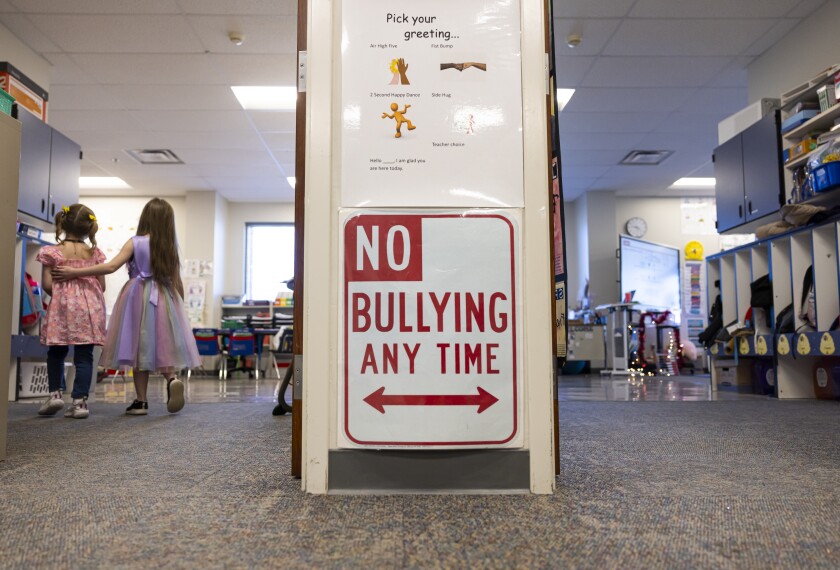
A sign discouraging bullying is seen as two students walk into a classroom at a school in Colorado Springs, Colo., on Feb. 12, 2026. Experts say creating a sense of belonging in school can help curb problems like bullying.
Kevin Mohatt for Education Week
Student Well-Being & Movement Opinion Why a Good School Needs Both Coaches and Referees
If teachers are forced into being referees, they can't fill that role properly or coach well, either.
6 min read
The United States Capitol building as a bookcase filled with red, white, and blue policy books in a Washington DC landscape.
Luca D'Urbino for Education Week
Student Well-Being & Movement Q&A Cellphones: The 'Most Formidable Adversary' Schools Have Ever Faced
The Spokane schools in Washington paired cellphone restrictions with expanded extracurricular activities.
5 min read
Students at Glover Middle School in Spokane, Wash. make bookmarks and snowflakes during Falcon Time on Dec. 3, 2025.
Students at Glover Middle School in Spokane, Wash. make bookmarks and snowflakes during Falcon Time on Dec. 3, 2025. The district has sought to encourage students to spend less time on devices.
Kaylee Domzalski/Education Week