Opinion Blog

Ask a Psychologist

Helping Students Thrive Now

Angela Duckworth and other behavioral-science experts offer advice to teachers based on scientific research. Read more from this blog.

Student Well-Being & Movement Opinion

How to Help Students Make Decisions They Won’t Later Regret

Young people often tend to prioritize fun over studying
By Hal Hershfield — July 26, 2023 1 min read
How do I help students make decisions they won't later regret?
  • Save to favorites
  • Print

How do I help students make decisions they won’t later regret?

Try to help them make a stronger connection with their future self. Here’s something I wrote about the topic for Character Lab as a Tip of the Week:

During my first year of college, the headliner at the annual “Spring Fling” concert was LL Cool J. I knew enough of his hits—and enough of my friends were going—that I didn’t want to miss out on a weekend of fun.

The only issue? I had an Intro Spanish final exam on Monday morning and I was woefully unprepared. As you might have guessed, I didn’t hunker down and study. I enjoyed the show alongside my classmates and ended up with a barely passing grade and a poor grasp of basic Spanish.

Who hasn’t experienced a similar dilemma?

Part of the problem is that we often lack a strong emotional connection to our future selves: They can even seem like strangers to us. That’s why we have a hard time choosing to do something to benefit the future self—say, studying for an exam—when there’s a more fun option right in front of us. And the consequences for this disconnect are real: Research finds that young adults who lack a sense of closeness with their future selves perform worse in their classes in subsequent semesters.

So how can you help young people make better decisions now that they won’t regret later? Telling kids that their actions today will have consequences tomorrow may not be effective if they don’t have a strong bond between their current and future selves. Instead, ask them to imagine stepping into the shoes of their future self to see the world through those eyes. Thinking about tomorrow more vividly may lead them to choose more wisely today.

Don’t assume that kids think beyond the present.

Do ask young people how they think they’ll feel about a decision in the future. Talk to them, without judgment, about both their current and future feelings. A concert might provide rich memories for their future selves, but if they always prioritize fun over sacrifice, they’ll surely be worse off in the long run.

Related Tags:

The opinions expressed in Ask a Psychologist: Helping Students Thrive Now are strictly those of the author(s) and do not reflect the opinions or endorsement of Editorial Projects in Education, or any of its publications.

Events

This content is provided by our sponsor. It is not written by and does not necessarily reflect the views of Education Week's editorial staff.
Sponsor
Artificial Intelligence Webinar
Managing AI in Schools: Practical Strategies for Districts
How should districts govern AI in schools? Learn practical strategies for policies, safety, transparency, as well as responsible adoption.
Content provided by Lightspeed Systems
This content is provided by our sponsor. It is not written by and does not necessarily reflect the views of Education Week's editorial staff.
Sponsor
Reading & Literacy Webinar
Unlocking Success for Struggling Adolescent Readers
The Science of Reading transformed K-3 literacy. Now it's time to extend that focus to students in grades 6 through 12.
Content provided by STARI
Jobs Virtual Career Fair for Teachers and K-12 Staff
Find teaching jobs and K-12 education jubs at the EdWeek Top School Jobs virtual career fair.

EdWeek Top School Jobs

Teacher Jobs
Search over ten thousand teaching jobs nationwide — elementary, middle, high school and more.
View Jobs
Principal Jobs
Find hundreds of jobs for principals, assistant principals, and other school leadership roles.
View Jobs
Administrator Jobs
Over a thousand district-level jobs: superintendents, directors, more.
View Jobs
Support Staff Jobs
Search thousands of jobs, from paraprofessionals to counselors and more.
View Jobs

Read Next

Student Well-Being & Movement Millions of Students Attend Schools Near Toxic Sites, a New Study Shows
The study explores schools' proximity to hazardous sites and students' exposure to pollutants.
4 min read
The Fifth Ward Elementary School and residential neighborhoods sit near the Denka Performance Elastomer Plant, back, in Reserve, La., Friday, Sept. 23, 2022. Less than a half mile away from the elementary school, the plant makes synthetic rubber, emitting chloroprene, listed as a carcinogen in California, and a likely one by the Environmental Protection Agency.
The Fifth Ward Elementary School and nearby residential neighborhoods in Reserve, La., pictured here on Sept. 23, 2022, sit near a synthetic rubber plant that has emitted chloroprene, which California lists as a carcinogen. New research finds thousands of schools are located within a quarter mile of such environmental hazard sites.
Gerald Herbert/AP
Student Well-Being & Movement 3 Driving Questions to Create a Sense of Belonging in Schools
Students who feel they belong in their school are more likely to show up and learn.
5 min read
MVCS 1981
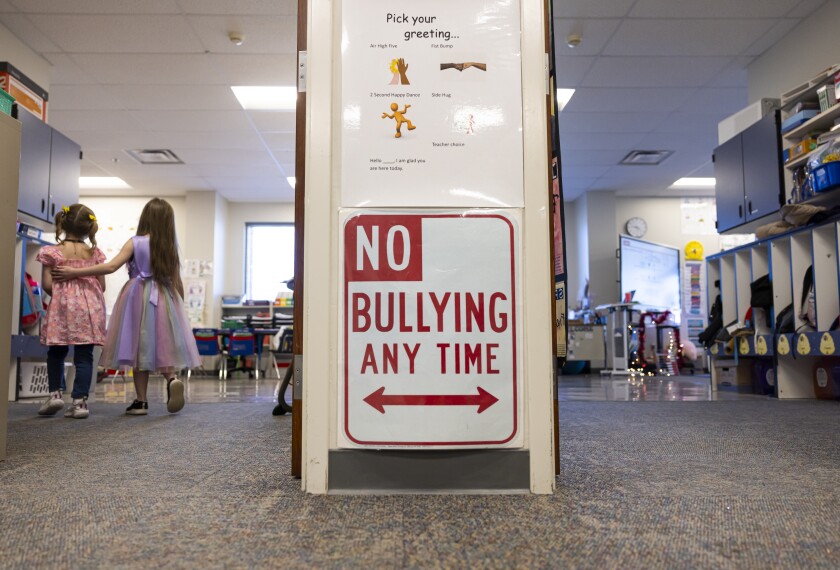
A sign discouraging bullying is seen as two students walk into a classroom at a school in Colorado Springs, Colo., on Feb. 12, 2026. Experts say creating a sense of belonging in school can help curb problems like bullying.
Kevin Mohatt for Education Week
Student Well-Being & Movement Opinion Why a Good School Needs Both Coaches and Referees
If teachers are forced into being referees, they can't fill that role properly or coach well, either.
6 min read
The United States Capitol building as a bookcase filled with red, white, and blue policy books in a Washington DC landscape.
Luca D'Urbino for Education Week
Student Well-Being & Movement Q&A Cellphones: The 'Most Formidable Adversary' Schools Have Ever Faced
The Spokane schools in Washington paired cellphone restrictions with expanded extracurricular activities.
5 min read
Students at Glover Middle School in Spokane, Wash. make bookmarks and snowflakes during Falcon Time on Dec. 3, 2025.
Students at Glover Middle School in Spokane, Wash. make bookmarks and snowflakes during Falcon Time on Dec. 3, 2025. The district has sought to encourage students to spend less time on devices.
Kaylee Domzalski/Education Week
