

Arne Duncan, President-elect Barack Obama’s choice to serve as secretary of education, coasted through his confirmation hearing today on a wave of bipartisan support from the Senate education committee.
“Mr. Duncan, there is no question that schools across America can benefit from the same kind of fresh thinking that you have brought to Chicago public schools,” said Sen. Tom Harkin, D-Iowa, who presided over the hearing because Sen. Edward M. Kennedy, D-Mass., the committee’s chairman, was unavailable. “You have very impressive credentials and experience.”
Sen. Lamar Alexander of Tennessee, who served as secretary of education under President George H.W. Bush and is considered one of the chamber’s leading GOP voices on K-12 policy, also had kind words for Mr. Duncan.
“President-elect Obama has made several distinguished cabinet appointments, but in my view of it all, you’re the best,” Sen. Alexander said.
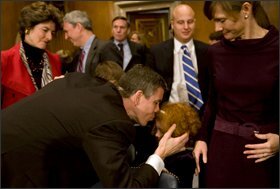
Mr. Duncan’s testimony, January 13, 2009.
As the schools chief in Chicago since 2001, Mr. Duncan, 44, has implemented somewhat controversial policies, including closing low-performing schools, expanding charter schools, and offering alternative pay to teachers, while working in collaboration with unions.
He didn’t provide a detailed prescription for reworking the No Child Left Behind Act, the main federal K-12 school law, but he stressed a commitment to accountability.
“At the K-12 level, we want to continue to dramatically raise standards and improve teacher quality,” Mr. Duncan said. “We must do dramatically better. We must continue to innovate. We must build upon what works and we must stop doing what doesn’t work.”
Sen. Alexander asked Mr. Duncan about his support for charter schools and the federal Teacher Incentive Fund, which provides grants to school districts for alternative-pay programs. The fund has been criticized by the 3.2 million-member National Education Association, in part for diverting resources away from other federal teacher professional-development programs.
Mr. Duncan called the Teacher Incentive Fund “one of the best things” that Secretary of Education Margaret Spellings has done and said that he would like to expand it. But he emphasized that Chicago implemented its grant in collaboration with its teachers’ union.
The nominee said he has “been a strong supporter of charter schools.” Although he expanded charter schools in Chicago, he said the district was selective about who it allowed to open such schools, but then gave those who were chosen flexibility.
“This has not been ‘let a thousand flowers bloom,’ ” Mr. Duncan said. But “once we approve a group, we give them significant autonomy,” he added.
A Review of Programs
Sen. Michael B. Enzi of Wyoming, the top Republican on the Senate Health, Education, Labor and Pensions Committee, also lauded Mr. Duncan’s record, but said he would continue to remind Mr. Duncan about the challenges facing rural schools. And he said he hoped Mr. Duncan would help the committee continue its record of bipartisan cooperation.
“Education has always been a bipartisan issue and we need to keep it that way,” Sen. Enzi said.
Even conservative Republicans who have advocated for significantly scaling back the federal role in education gave Mr. Duncan a warm reception. Sen. Tom Coburn of Oklahoma, who has been critical of the No Child Left Behind Act’s intrusion on an area he thinks is best reserved for the states, said he had a good conversation with Mr. Duncan before the hearing.
Sen. Coburn asked whether Mr. Duncan planned to conduct a thorough review of every program in the Department of Education to make sure that each one was effective. Mr. Duncan agreed that he would work with staff members in targeting scarce resources to the programs that work best.
And Sen. Coburn asked whether Mr. Duncan would consider examining a provision in the NCLB law that requires special education teachers to be highly qualified in the subjects they teach. He said Oklahoma was at risk of losing some of its best teachers because of the requirement. Mr. Duncan said he would study the teacher provision.
In response to questions from other senators, Mr. Duncan said he would support increased funding for students in special education, and that he favors allowing students in special education and English-language learners to use alternative assessments under the No Child Left Behind Act. He also expressed support for early childhood education, saying he hoped to get closer to the goal of universal pre-kindergarten.
Tutoring Stint’s Impact
Sen. Harkin asked Mr. Duncan for his views on Teach for America, the New York City-based nonprofit organization that places recent college graduates in high-need schools. The organization receives a small federal grant, and has bipartisan support in Congress.

But it has been criticized by some in the education community, including Linda Darling-Hammond, an education adviser to the Obama transition team, for sending teachers into classrooms who are not as well-prepared as those who go through traditional teacher education programs.
Mr. Duncan lauded the organization, saying that it has helped attract talented people into the field of education.
“I’m a huge fan of Wendy’s,” Mr. Duncan said, referring to Wendy Kopp, the organization’s founder and chief executive officer. He said he hoped the federal government would be able to help support “a new generation of education entrepreneurs,” including Ms. Kopp and Jon Schnur, the founder of New Leaders for New Schools, a New York City-based nonprofit that helps train principals to work in needy schools.
In his opening statement, Mr. Duncan said the federal government must encourage schools to set high expectations for all children and continually challenge the status quo. He said participating in a tutoring program his mother ran for disadvantaged students on the South Side of Chicago when he was a young boy had been one of the most significant experiences influencing his views on education. He mentioned some students in the program who went on to careers in medicine, in Hollywood, and in business.
“What I saw, literally from the time I was born was that, despite the challenges in the community … our young people can be very successful,” Mr. Duncan said. “That was a formative experience.”
He said his parents “did this work every day simply because this work was so important and because this work is bigger than all of us,” and that he would continue their commitment in his new role.


