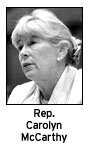
There’s something about Rep. Carolyn McCarthy that makes this group of 150 or so middle school students sit on the edge of their seats, watching and listening intently.
|
“It’s amazing in a nonprofit environment how money still talks,” said James W. Knapp, the finance director for the 45,000-student district. No, she certainly didn’t plan to become a politician, she replies candidly to one student’s question. With a rare poise, she explains that the seeds of her political career were planted on Dec. 7, 1993, just a few miles away from this suburban Long Island school. That day, a lone gunman boarded a commuter train and began shooting, leaving Ms. McCarthy’s husband dead and her son permanently disabled.
|
The shootings and her ensuing activism not only helped propel her into a congressional seat in 1996, but made her one of the most recognizable members of the House’s freshman class.
The incident also focused the unlikely candidate on education, which she believes is the key to reducing violence. Today, Ms. McCarthy spends every available Monday and Friday visiting schools in her congressional district, where she talks to students about gun control and conveys a personal message of hope and perseverance.
“Sometimes, things happen in our lives and we have to react,” she tells the group of students gathered in the auditorium of Woodmere Middle School here last month. “My cause is gun violence, and I’ve always taken it to the point that education can cut down on gun violence in this country.”
In Washington, the 54-year-old Democrat often speaks of lessons gleaned from her visits with students, as well as her life experiences as a licensed practical nurse, mother, and student with learning disabilities. She is also well-known on Capitol Hill for her colorful suits and the large, bright bows she wears in her blond hair.
And, while Rep. McCarthy’s critics contend she is a one-issue candidate who is naive about navigating the political process, her fans seem to relish her gentle, down-to-earth approach.
‘Can-Do’ Spirit
At a recent hearing where the New York congresswoman testified on the need for more special education funding, a Democratic colleague, Rep. Lynn Woolsey of California, praised her “can-do attitude.”
Ms. McCarthy’s path to Congress certainly offers a primer in “can-do” spirit. It began when, after a year-and-a-half helping her son defy doctors’ predictions that he would never walk or talk again, she became a local activist for gun-control laws and education issues.
And when then-Rep. Daniel Frisa, the incumbent in this predominantly Republican, suburban district voted against a gun-control measure in Congress, she decided to challenge him for his seat in 1996. Her campaign attracted national media coverage.
Today, the native New Yorker is a local celebrity. Woodmere Principal Claudette Tableman said of the school’s 751 students, “the kids will be talking about this for the rest of the year.”
“I’m so impressed that she visits schools,” she added.
Ms. McCarthy, meanwhile, remains modest and surprisingly frank.
On her recent visit, she tells the students at Woodmere Middle School that she had a “huge learning curve” when she arrived in Congress and still studies about three hours a night to familiarize herself with legislation. “It’s not a fun job, but it’s an opportunity to try to make a difference in some people’s lives,” she said.
During an interview in the principal’s cramped office, Ms. McCarthy is well-spoken and seemingly at ease with her rising fame. She said she enjoys her school visits because students are responsive and rarely get the respect they deserve from adults.
“I come to schools because I feel that if I’m going to be making policy, it’s important for me to be in schools,” she said. “Everything we do in Washington affects these schools.”
She has joined with her Republican colleagues on the House Education and the Workforce Committee to press for more money to defray districts’ special education costs. Her other education-related causes include lobbying for school construction funds and higher-education spending.
An Average Citizen
Despite a recent spate of fatal school shootings that have made national headlines, Ms. McCarthy points out that the vast majority of public schools are safe and that most students are not violent.
Barbara Hohlt, who chairs New Yorkers Against Gun Violence, a local advocacy group, said Ms. McCarthy’s work in schools has effectively raised the profile of gun-violence issues among students and their parents.
“The fact that she is an average citizen who has gotten involved in this issue makes people really think about it,” Ms. Hohlt said.
Ms. McCarthy is expected to keep her seat in this November’s elections, although her Republican challenger, Gregory R. Becker, is a well-known state assemblyman whose family has been active in area politics for several generations. In an interview, he said he is not intimidated by his opponent’s national name recognition.
“I am not running against anyone. I am running for a congressional seat in the fourth district,” Mr. Becker said. A strong school choice proponent, he supports publicly funded vouchers for private and religious schools, something Ms. McCarthy opposes.
Provided she wins re-election, Ms. McCarthy will continue to visit the 33 school districts she represents. “I don’t see myself as an important woman. I just see myself as someone going to work each day,” she said.


