
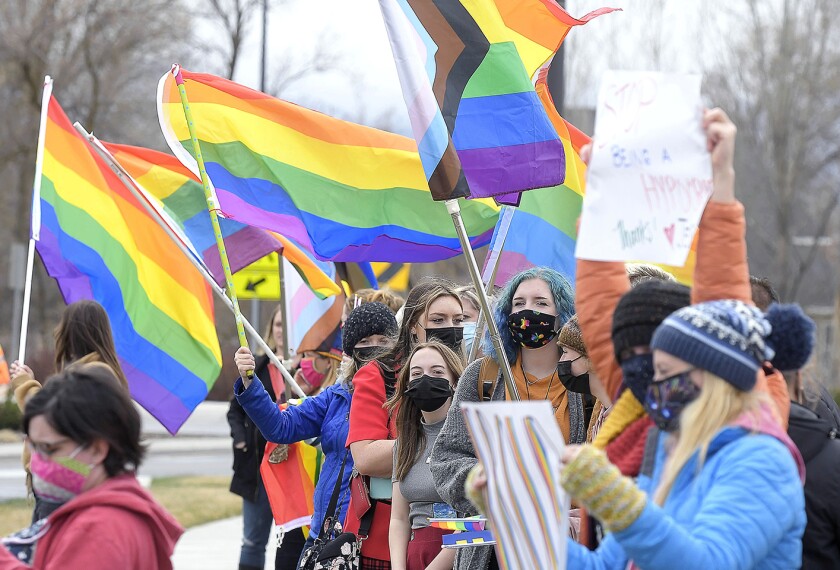
LGBTQ students would be explicitly protected from sex-based discrimination under a proposed revision of federal Title IX rules released Thursday. But the rules stop short of addressing the most controversial issue now under debate—whether the law protects transgender students’ ability to participate in sports consistent with their gender identity.
The Biden administration will go through a separate rulemaking process to settle that question, the U.S. Department of Education announced.
The department released the proposed revisions to Title IX on the 50th anniversary of the legislation that banned sex discrimination in schools, colleges, and universities. In a call with reporters, U.S. Secretary of Education Miguel Cardona said the rules aim to “give full effect to the law’s reach and to deliver on its promise to protect all students from sex-based harassment and discrimination.”
“Let’s be clear, every student has something to offer our country,” Cardona said. “Every student deserves to learn free from discrimination or harassment regardless of their sex, sexual orientation, or gender identity.”
Among the highest-profile changes, the proposed rules would for the first time broaden the definitions of sex discrimination and harassment to include sexual orientation and gender identity—following the lead of the U.S. Supreme Court’s decision in Bostock v. Clayton County, Ga., which established that sex discrimination includes sexual orientation and gender identity in federal employment law. They also make it clear that schools cannot “prevent a student from participating in a [school’s] education program or activity consistent with their gender identity.”
The proposal marks a defining moment for LGBTQ students, especially transgender and nonbinary students, who have found themselves at the center of debates over how schools should govern restroom access, sports participation, book content, and discussions of gender identity and sexuality.
“Together we must seize this opportunity to better protect LGBTQ youth who face bullying and harassment, experience higher rates of anxiety, depression, suicide, and too often grow up feeling like they don’t belong,” Cardona said. “Today, we send a loud message to these students, and all of our students: You belong in our schools. You have worthy dreams and incredible talents. You deserve the opportunity to shine authentically and unapologetically.”
LGBTQ advocates say the proposed rules not only allow for further protection for LGBTQ youth, but also affirm their experiences and identities.
“Just having such a clear and explicit statement of inclusion is extremely powerful, particularly in a time when we’re hearing a lot of statements of exclusion from other sources,” said Elana Redfield, federal policy director for the Williams Institute, a University of California Los Angeles research center dedicated to LGBTQ issues.
What about transgender youth participation in sports?
The Education Department has still to tackle the fiercely controversial issue of transgender students’ participation in athletics. Eighteen states have passed laws preventing transgender students from participating in sports that align with their gender identity, according to the Movement Advancement Project, a think tank that tracks laws on transgender youth participation in sports.
While she is disappointed there has yet to be an official rule on athletics, Redfield said the separation of the sports issue from the overall review of Title IX rules might be an advantage, allowing for a more comprehensive look into the question of transgender participation in sports.
Redfield said she hopes the department includes extensive input from transgender athletes and people focusing on the potential impact on transgender athletes.
“We hope that what emerges in these conversations is the facts of these people’s lives and the facts of the impact of these laws,” Redfield said. “Then that might dictate the policymaking being based in the lived experiences of the people affected by it.”
Department officials were not able to provide a timeline for that separate rulemaking process on Thursday. Cardona said it will involve extensive public comment, including input from students, educators, and other stakeholders.
“I firmly reject efforts to politicize these protections and sow division in our schools,” Cardona said. “Everyone should agree that all students, all children, and youth deserve an education grounded in fairness and belonging.”
Defining sex-based harassment and responding to it
The proposed rules also aim to further protect victims of sex discrimination, sexual harassment, and assault by providing broader definitions and revising the standard schools use in weighing complaints.
They represent a sharp reversal from Trump-era policies, in which former U.S. Secretary of Education Betsy DeVos established stricter definitions for sex-based harassment and required schools to only respond to assault claims that provided “clear and convincing evidence.”
“Those regulations weakened protections for survivors of sexual assault and diminished the promise of an education free from discrimination,” department officials wrote in a fact sheet about the proposed rules.
The proposed rules aim to cover all forms of sex-based harassment, including harassment that creates a “hostile environment” and “denies or limits a person’s ability to participate in or benefit from a [school’s]education program or activity.”
In evaluating sexual assault or sex-based harassment complaints, schools would be required to return to the Obama-era “preponderance of evidence” standard of proof, a decision that has been applauded by Democrats. Schools would still be allowed to use the stricter “clear and convincing evidence” standard only if they use that standard for all discrimination complaints, not just sex discrimination.
“This rule represents a world of change from the backwards DeVos rule, which made it easier for schools to sweep harassment and assault under the rug, and harder for survivors to come forward, seek justice, and feel safe on campus,” Sen. Patty Murray, D-Wash. said in a statement.
The rules also would clarify that schools would not be allowed to threaten, coerce, intimidate, or discriminate against a person because they made a sex discrimination complaint or provided information about sex discrimination. Schools also would be required to protect students from retaliation by other students.
Pregnant students, employees, and job applicants would also have more protection under the proposed rules. They would require schools to provide reasonable modifications for students who are pregnant or are experiencing pregnancy-related conditions, including break times for employees who are lactating and lactation space for both students and employees.
The policies have drawn criticism from conservatives, who feel they threaten the rights of people accused of sexual assault and push a “woke” agenda.
“With this proposed regulatory change, it’s clear the Administration is placing accusations of guilt above fair consideration of the evidence,” Sen. Richard Burr, R-N.C. said.
In a written statement Heritage Foundation President Kevin Roberts said the new rules would be an “overreach” and “rob young people across the country of their innocence.” The Heritage Foundation is a think tank dedicated to conservative policy issues.
“Fifty years of protections for women and girls in school activities are about to be wiped away because the Biden administration embraces woke gender ideology over basic human biology,” Roberts said.
What’s next
The department spent over a year developing the proposal, which it first announced last April. The process drew thousands of public comments, including input from educators, students, and members of the public during a public hearing held in June and from various other meetings and listening sessions, the department said.
Public comment for the proposed regulations will be open for 60 days, through Aug. 22. After that point, the department will review comments and release the final rule. Department officials on Thursday were not able to give a timeline for final Title IX rules to be released.
Students, educators, and members of the public can submit public comments at the Federal Register’s website, regulations.gov.


