Student Well-Being & Movement From Our Research Center

How Much High Schoolers Think Their Educators Care About Them

By Arianna Prothero — April 26, 2024 2 min read
Horizontal banner image of group of multiracial teenage high school students standing against blue background wall. Student belonging.
  • Save to favorites
  • Print

Schools are earning mixed reviews from high school students on two key indicators of how well they encourage a sense of belonging.

That’s according to a recent survey by the EdWeek Research Center, which polled a nationally representative sample of 1,056 students in grades 9-12 in February and March.

The survey asked students whether the adults in their school care about their well-being and success and whether students feel like they are accepted and welcomed in their school community.

Although more than half of students answered positively to both questions, there are some concerning trends in the data. A significant proportion of students indicated that they feel disconnected—a troubling sign given the challenges schools are facing with student disengagement and chronic absenteeism.

A majority of students—57 percent—say the adults in their school care about them at least a moderate amount, but 1 in 5 students say the adults care little or not at all about their well-being and success.

Students are much more likely to say they feel accepted and welcomed in their school community overall, with 86 percent agreeing with that statement. That percentage drops slightly for students who are not heterosexual or students who come from low-income families.

Students who feel connected to school are more likely to attend and perform well and less likely to misbehave and feel sad and hopeless. There are even health benefits well into adulthood linked to a strong connection to school as an adolescent.

Schools are using a variety of strategies to bolster a sense of belonging among their students.
See also

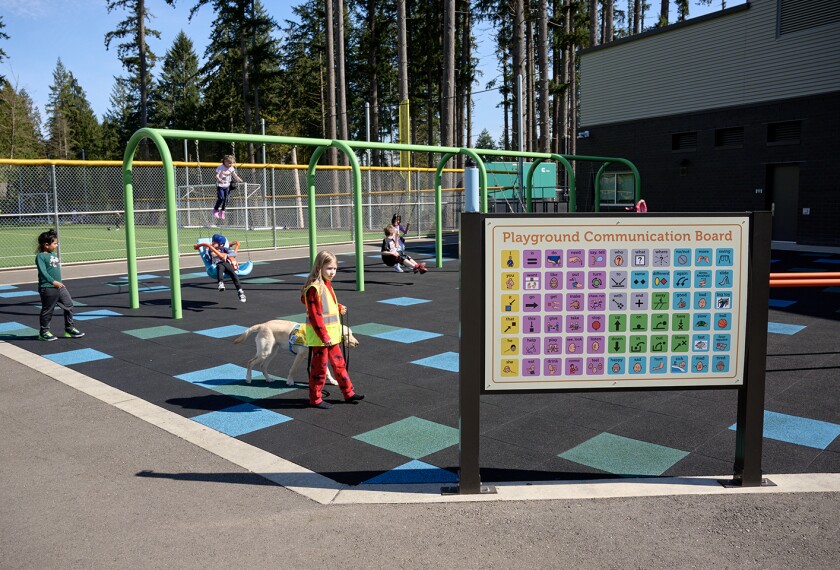
Students at Ruby Bridges Elementary School in Woodinville, Wash., play during recess on April 2, 2024. Students have access to cards with images and words on them so all students, including those who do not speak, can communicate on the playground.
Meron Menghistab for Education Week

Educators at Thomas Kelly College Preparatory have homed in on freshman year as a key time to make sure students have a strong connection to the Chicago high school.

“If you’re a 9th grader, nothing is more important to you than belonging,” Grace Gunderson, a counselor at the 1,700-student school who leads its newly formed freshman success team, said in a recent Education Week special report. “If we can get those kids involved in band, or ‘Hey, I play on the soccer team,’ or ‘Hey, I always eat lunch in Ms. Gunderson’s office,’ now, they have a connection. They have a reason to keep coming to school.”

The 2021 Youth Risk Behavior Survey, which is administered by the U.S. Centers for Disease Control and Prevention, found that students feeling connected to their school was associated with a lower prevalence of several risk factors, such as poor mental health, drug use, and missing school because students felt unsafe. In that survey, 61 percent of high schoolers reported feeling connected to peers and the adults in their schools.

A more recent survey of middle and high school students by YouthTruth, a nonprofit that surveys students and families for school districts, asked specifically about students’ connections to their teachers. The results of that survey aligned closely with the EdWeek Research Center findings.

On both of the survey questions, the EdWeek Research Center’s analysis did not find any statistically significant differences among students by race or gender.

Taken together, the data in the charts below show that while high schools have room for improvement in ensuring that all students feel that they belong and are connected to the adults in their schools, there is a solid foundation to build from.

education week logo subbrand logo RC RGB

Data analysis for this article was provided by the EdWeek Research Center. Learn more about the center’s work.

Events

Jobs Regional K-12 Virtual Career Fair: DMV
Find teaching jobs and K-12 education jubs at the EdWeek Top School Jobs virtual career fair.
This content is provided by our sponsor. It is not written by and does not necessarily reflect the views of Education Week's editorial staff.
Sponsor
Artificial Intelligence Webinar
Making AI Work in Schools: From Experimentation to Purposeful Practice
AI use is expanding in schools. Learn how district leaders can move from experimentation to coordinated, systemwide impact.
Content provided by Frontline Education
This content is provided by our sponsor. It is not written by and does not necessarily reflect the views of Education Week's editorial staff.
Sponsor
Student Well-Being & Movement Webinar
Building Resilient Students: Leadership Beyond the Classroom
How can schools build resilient, confident students? Join education leaders to explore new strategies for leadership and well-being.
Content provided by IMG Academy

EdWeek Top School Jobs

Teacher Jobs
Search over ten thousand teaching jobs nationwide — elementary, middle, high school and more.
View Jobs
Principal Jobs
Find hundreds of jobs for principals, assistant principals, and other school leadership roles.
View Jobs
Administrator Jobs
Over a thousand district-level jobs: superintendents, directors, more.
View Jobs
Support Staff Jobs
Search thousands of jobs, from paraprofessionals to counselors and more.
View Jobs

Read Next

Student Well-Being & Movement From Our Research Center 6 Reasons Teachers Don’t Feel Equipped to Teach SEL
Lack of time and limited resources make it hard for teachers to emphasize social-emotional skills.
1 min read
Children drawing images of faces with emotions.
iStock/Getty
Student Well-Being & Movement Spotlight Spotlight on the Athletic Advantage: How Districts Are Turning School Sports Into Community Assets
Find out how you can improve student engagement, belonging, and mental health through inclusive sports programs, esports, and gaming.
Student Well-Being & Movement 40 Minutes of Recess Is Now the Law in This State
Elementary schools will have to provide 40 minutes of recess, after years of declining time nationwide.
3 min read
Preschool students run on the new cushioned rubber surface while others use the double slide at Taft Early Learning Center in Uxbridge, Mass., on March 12, 2025.
Preschool students run on the new cushioned rubber surface while others use the double slide at Taft Early Learning Center in Uxbridge, Mass., on March 12, 2025. In Oklahoma, elementary schools will have to provide 40 minutes of recess daily starting this fall.
Brett Phelps for Education Week
Student Well-Being & Movement Q&A Strict Screen-Time Limits? Pediatricians Make Case for Flexibility
A pediatrician who helped craft new screen-time guidelines explains why flexibility matters.
4 min read
Vector illustration of two young elementary students wearing bookbags and holding hands as they enter into a mobile phone with smaller phones connecting in the atmosphere around him. All on a dark blue background with the phones lit up.
DigitalVision Vectors
