
School Climate & Safety What the Research Says

Digital Distractions in Class Linked to Lower Academic Performance

By Lauraine Langreo — December 08, 2023 2 min read
Kids in middle school working on assignment together
  • Save to favorites
  • Print

A majority of teenagers in the United States reported becoming distracted when using digital devices in class, and it has some correlation with their academic performance, according to results from the 2022 Program for International Student Assessment.

The PISA questionnaire, which the Organization for Economic Development and Cooperation administers to 15-year-olds every three years, asked students how often they were distracted by using digital devices (such as smartphones, websites, or apps) during their math lessons and how often they were distracted by other students using those resources.

About two-thirds of U.S. students reported that they get distracted by using digital devices, and about 54 percent said they get distracted by other students who are using those resources, the PISA results found.

See Also

Diverse group of middle school students working on laptops in a classroom setting.
iStock/Getty

Those numbers are on par with the global average: 65 percent of students in countries that are part of the OECD said they get distracted by using digital devices, and 59 percent reported getting distracted by other students who are using digital devices.

These distractions show a strong correlation with lower academic performance, according to the report analysis. On average across OECD countries, students who said that they were distracted by other students using digital devices in class in at least some math lessons scored 15 points lower in mathematics than those who reported that this never or almost never happens.

The results “highlight the importance of finding effective ways to limit the distraction caused by using digital devices in class,” according to the report.
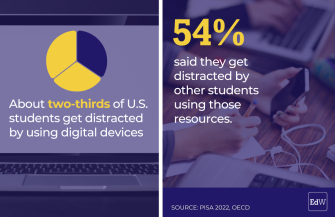
About two-thirds of U.S. students get distracted by using digital devices. 54% said they get distracted by other students using those resources.

Many schools and districts in the United States have restricted student cellphone use during the school day because the devices have become an enormous distraction in the classroom. A Common Sense Media report found that teenagers receive a median of 273 notifications a day, with nearly a quarter coming in during school hours. U.S. lawmakers have introduced legislation that would require a study on the effects of cellphone use in schools on students’ mental health and academic performance.

In the Brush school district in Colorado, Superintendent Bill Wilson said part of the reasoning for restricting cellphone use during instructional hours in his district is to help students “focus on learning and take one element of distraction and disruption out of their life at least for the time that they were at school.”

However, most U.S. schools now also have 1-to-1 computing environments in which every student has a school-issued learning device, and those digital devices can be a distraction, too. It’s more challenging to completely restrict laptop use in class when much of student learning now happens online. Many educators are simply being more intentional about when and how they use digital devices in the classroom.

“We’re really working hard to be very mindful of what we choose to put kids on computers for,” said Kristy Zaleta, the principal of Rogers Park Middle School in Danbury, Conn. For instance, students can use their laptops to practice math lessons using personalized learning software, but that practice time is limited to 30-45 minutes per week in school. Other lessons revolve around physical manipulatives and hands-on activities, she said.

The following charts show how often students are distracted by their own use of digital devices as well as other factors related to students’ use of technology, according to the 2022 PISA data.

Events

Teacher Preparation Webinar What Teacher Education Should Look Like in the Age of AI
Explore the current trends around the use of AI in teacher preparation and continuing education with data from the EdWeek Research Center.
English Learners Webinar How Can School Districts Better Support English Learners With Disabilities?
Join this webinar to hear recent findings from the EdWeek Research Center and discover practical strategies for improvement.
This content is provided by our sponsor. It is not written by and does not necessarily reflect the views of Education Week's editorial staff.
Sponsor
Classroom Technology Webinar
Better Tools, Not More: What Educators Say About Teaching and Technology
Optimism is up. AI use is rising. Coherence is the next challenge. Hear what the 2026 Educator Confidence Report reveals about the field.
Content provided by HMH

EdWeek Top School Jobs

Teacher Jobs
Search over ten thousand teaching jobs nationwide — elementary, middle, high school and more.
View Jobs
Principal Jobs
Find hundreds of jobs for principals, assistant principals, and other school leadership roles.
View Jobs
Administrator Jobs
Over a thousand district-level jobs: superintendents, directors, more.
View Jobs
Support Staff Jobs
Search thousands of jobs, from paraprofessionals to counselors and more.
View Jobs

Read Next

School Climate & Safety For Students Walking to School, the Route Can Be Deadly. What Can Make It Safer?
School districts, including New York City, have rolled out a number of strategies to reduce risks.
5 min read
A student leaving Greenspun Junior High School in Henderson, Nev., enters a car in the travel lane of Valle Verde Drive on Sept. 14, 2022. Pedestrian fatalities near schools are most likely to occur in the early morning and early evening hours, federal data show.
Rachel Aston/Las Vegas Review-Journal via TNS
School Climate & Safety Opinion It's 3 p.m. Do You Know What Teens Are Doing?
A veteran school reformer is focused on how teens are spending their time after the school day ends.
•
5 min read
The United States Capitol building as a bookcase filled with red, white, and blue policy books in a Washington DC landscape.
Luca D'Urbino for Education Week
School Climate & Safety How Extreme Weather Threatens Student Learning and Academic Progress
Too-hot classrooms put the brain in "survival management mode," one expert said.
5 min read
Many Philadelphia schools lack adequate electrical service to support effective whole-school air conditioning on Sept. 8, 2023. Bayard Taylor, in Hunting Park , has window units but they do not cool the whole building.
Window air conditioning units at Bayard Taylor School in Philadelpia, pictured here on Sept. 8, 2023, do not cool the whole building. High classroom temperatures can make it harder for students to learn and perform well on tests, a new report outlines.
Elizabeth Robertson/The Philadelphia Inquirer via TNS
School Climate & Safety 'Swatting' Disrupts Schools. New Federal Guidance Shows How to Respond
False reports of school shootings can cause chaos and fear for teachers and students.
•
3 min read
The Jackson Police Department responded to a hoax threat to the Middle School at Parkside on May 8, 2025. Investigators determined the call to be a prank, just like a similar call made to the school a day prior.
The police department in Jackson, Mich., responded to a "swatting" incident directed at the city's Middle School at Parkside on May 8, 2025. Many schools across the country have experienced similar fake threats, which can scare teachers, students, and parents, and disrupt the school day.
J. Scott Park/MLive.com via TNS
