Many students receive services from other public and private agencies besides schools. But educators typically lack access to data about those experiences or how they shape young people’s lives.
Enter the Youth Data Archive.
The project, run by the John W. Gardner Center for Youth and Their Communities, at Stanford University, works with local communities to collect data from multiple child-serving agencies to inform policy and program decisions.
“Youth operate in what I call an institutional train wreck,” said Milbrey L. McLaughlin, the center’s founding director and an education professor at Stanford. “All the youth-serving institutions are fragmented and incoherent. They don’t add up to a coherent system of support for young people.”
The Youth Data Archive, or YDA, allows school districts, city and county agencies, and community-based groups to ask critical research and policy questions affecting young people in their communities. By collecting and analyzing data from different providers, the archive can help identify patterns regarding which youths receive services and how those services might be improved.
Among English-language learners in Redwood City, Calif., students who attended certain afterschool programs were more likely to increase their scores on a state English test and to achieve English fluency, after adjusting for other student characteristics.
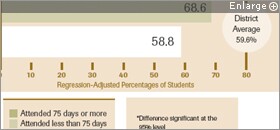
SOURCE: Youth Data Archive
The research project, which began 2½ years ago, is now working with four communities in northern California: Alameda County, Santa Clara County, the city of San Francisco, and San Mateo County.
Within each community, the YDA works with agencies in the public-health, child-welfare, and juvenile-justice systems, for example, as well as public and private community-based groups and school districts to identify the types of data they collect and the questions they’re interested in using the archive to explore.
Asking Critical Questions
The Youth Data Archive develops a data-use agreement with each participating agency and community organization that outlines the types of information to be shared, how the data will be stored, and all security measures. Each participant identifies representatives to work with the YDA to help shape the research agenda.
To protect confidentiality, all data are housed off site at the SPHERE Institute (short for Social Policy and Health Economics Research and Evaluation), a Burlingame, Calif.-based nonprofit group.
The YDA researchers work to match data for individual students from multiple providers, so officials can track the services young people receive over time. The data are not used to provide services for individual students. Rather, they’re used to answer policy and program questions that the participating agencies have posed.
Before matching data across agencies, the YDA must receive the agencies’ assent to employing those data to explore a particular research question.
Craig Baker, the executive director of the Gardner Center, said that as a neutral third party, it can facilitate conversations across agencies that might be hard for them to have on their own. It also can help educate communities about the questions they might ask, and the data they would need to answer them.
A similar effort, known as the Kids Integrated Data System, was launched in 1999 by researchers at the University of Pennsylvania. It merges data from seven city agencies and the Philadelphia school district. (“Project Eyes Diverse Data Sets for Insight On Children,” Oct. 4, 2006.)
In comparison with that effort, said Mr. Baker, the Youth Data Archive has grown more organically, depending on the community. San Francisco, for example, already had a shared-use database involving three public agencies, while Santa Clara County had to start from scratch. The Stanford researchers also hope to include small and large community-based groups in the database, as well as larger government agencies.
Making a Difference
The YDA has done its most extensive work so far in Redwood City, a midsize city in the San Francisco Bay Area.
In the 1990s, city officials, area school districts, and county agencies formed Redwood City 2020 to support the success of local youths and their families. Growing out of those efforts, Redwood City developed school-based family-resource centers at four sites that serve as hubs for such services as mental-health counseling, parent education, and home-visiting programs.
“Basically, we wanted to know if our services were making a difference in the academic outcomes of the students we served,” said Karin Kelley-Torregroza, who at the time was the director for school-community partnerships for the Redwood City schools.
To address that question, the Youth Data Archive linked enrollment information for the family-resource centers with school records and social-services information from the County of San Mateo Human Services Agency. The study confirmed that the centers were targeting the children and families most in need of help.
Effect on Scores
Equally important, researchers found that students who received mental-health services through the resource centers in 2004-05 had scores on the state English test that improved by 5.4 points more than those of similar students in a control group at comparable schools in the district. In math, the researchers found a positive but not statistically significant relationship.
“It finally demonstrated what we thought was true,” said Ms. Kelley-Torregroza, now the director for children, youth, and family services at the nonprofit group Portland Impact, in Portland, Ore. “It helped us to show the school district, county, and other funders the importance of continuing to sustain these successful services.”
Another study examined the relationship between attending after-school programs at the local Boys and Girls Club and gains in English fluency for youngsters learning English.
Using the Youth Data Archive, researchers matched data from individual students in the 8,500-student Redwood City school district with attendance data from the club. They found that students who attended the club regularly demonstrated greater improvement on tests of English-language development and were more likely to attain fluency in English, compared with their counterparts who attended less often or not at all.
“We couldn’t have done any of this by ourselves,” said Peter Fortenbaugh, the director of the Boys and Girls Club of the Peninsula.
The researchers are now doing additional quantitative and qualitative studies to examine what practices at the club might have helped students learn English, or whether students who were more likely to learn English quickly were also more likely to attend the center.
Despite the potential benefits, creating such archives is not without its challenges. Those include building trust among the parties involved; ensuring buy-in from the people within each agency who actually handle the data, in addition to their superiors; and working to improve the completeness, consistency, and comparability of the information.
“The analyses are really only as good and useful as the data that are contributed,” said Kara Dukakis, the associate director of the Youth Data Archive. “Part of the value of doing some of these analyses is to show the folks who are collecting the data that the more they collect, the deeper they can go, the better the analyses are going to be, and the more they can tell from them.”
The work to date has been supported by some $720,000 in contributions from Stanford University and private foundations. But, eventually, the researchers hope to charge a nominal fee, in the range of $5,000 to $10,000, to participating agencies to sustain such work.
“I just think this is the missing piece in youth policy,” said Ms. McLaughlin, the founding director of the Gardner Center. “You can’t have a strong youth policy unless you have this kind of data.”


