
Social-emotional skills are vital for students to develop in school to be prepared to work in an economy powered by artificial intelligence, many educators, business executives, and tech experts say.
It will be a person’s ability to empathize, communicate, and think creatively and critically that will distinguish them from AI chatbots. That means students must hone those so-called “soft skills” now, before they begin their careers.
But can AI help students learn those uniquely human skills?
Educators are starting to explore ways to leverage the technology in support of social-emotional learning. Education Week attended sessions and spoke with educators presenting at the ISTELive 26 + ASCD annual conference in Orlando, Fla., from June 28 to July 1 about how AI can be used to teach students soft skills.
They said generative AI chatbots give students opportunities to practice empathy, perspective-taking, self-awareness, social awareness, and relationship skills in low-pressure ways.
“AI should reduce the barriers to human connection and really make a point to allow students to practice” social-emotional skills, said Amanda Brown, a technology implementation specialist for the Montgomery County schools in Maryland.
While some educators see potential in AI to boost SEL, at least with the right safeguards in place, many other educators are concerned that AI will ultimately undermine students’ abilities to develop relationships and critical thinking skills.
Some popular AI platforms built for schools have tools that allow educators to customize their own chatbots to prioritize social-emotional learning.
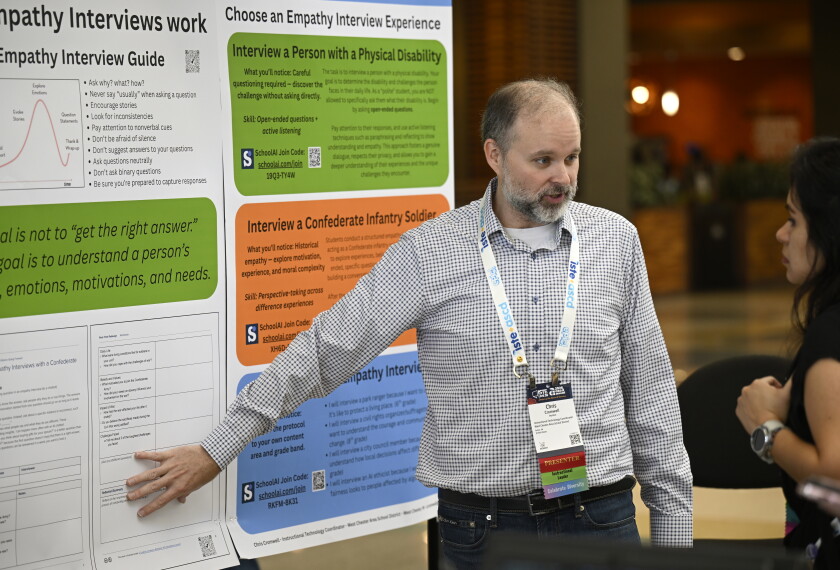
Chris Cromwell, an instructional technology coordinator for the West Chester Area school district in West Chester, Pa., created chatbots using SchoolAI’s “spaces” feature that can be integrated into different middle school classrooms. The goal is to use the chatbots to help build students’ empathy and perspective-taking skills.
Other education companies, such as MagicSchool, also have customizable chatbot features built into their products and services.
One chatbot Cromwell created is designed to answer students’ questions as though it is a person with a physical disability. Students learn to ask respectful questions that help them understand the difficulties the chatbot character faces. They then design a prototype for a tool or product to help the character as part of their unified arts and technical education class.

Another chatbot character he created is a soldier from the U.S. Civil War. That chatbot prompts students in an 8th grade U.S. history course to interact with and ask questions of a simulated person whose perspective and experiences are different from their own, said Cromwell. For this chatbot, students are given a worksheet to help guide them to ask more open-ended questions.
The third chatbot he built allows students in the 8th grade gifted education program to converse with a character of their choosing, ranging from “firefighter” to “AI ethicist,” Cromwell said.
Cromwell said he has focused on empathy and perspective-taking because they’re important skills students need to succeed in school and life.
“Just making those connections so that empathy doesn’t live in today’s empathy lesson when the counselor comes in and [says] ‘we’re going to learn to be kind and nice to each other,’” he said. “But showing [students] how it can really fit into all of their everyday lives.”
A SchoolAI dashboard for teachers allows them to read students’ conversations with the chatbots in real time to ensure they’re staying on task.
Cromwell also pointed out that using the character chatbots gives teachers an opportunity to talk to students about how these characters do not have real human feelings or understanding, no matter how convincing they sound. That teaches the students why it is important not to develop relationships with the bots. That’s an important AI literacy lesson because a growing number of kids and adults are turning to chatbots for advice and companionship, he said. Parents, lawmakers, and researchers have been raising alarm bells over the para-social relationships some young people have developed with general-purpose chatbots.
Using AI chatbots to practice having a difficult conversation
Brown also uses SchoolAI to customize a chatbot she calls CalmBot, which walks students through restorative conversations (via text or speech), helping them work through conflicts with classmates. A student may say they were pushed by a friend, and the chatbot will ask questions such as “how did that make you feel?” and “what did you need in that moment?”
That prompts kids to recognize their emotions and needs, a key component of social-emotional learning. It also helps students develop social awareness, self-management, responsible decisionmaking, and relationship skills, she said.
To create the chatbot, Brown used a prompt that includes examples of what situations students may be facing, guidelines on the types of responses the bot should provide, instructions on asking follow-up questions, and details on her goal for the conversation.
Customized chatbots can help students practice tough conversations before having them, too, Brown said, such as when returning to school after a suspension.
“What if they were able to practice those conversations in a way that’s not so high stakes?” she asked. “Because sometimes, when we have those students who are going to escalate easily, putting them in a room with a bunch of people looking at them and saying, ‘this is what you did wrong,’ and saying, ‘now, here is this behavior contract you have to sign,’ is not going to be the best way to get them to pick up what you’re putting down.”
For another AI-generated SEL exercise, Brown uses Google’s Gemini Gems and the program Book Creator to coach students through a narrative writing exercise in which they write stories about themselves. This gives students an opportunity to practice self-awareness, agency, and communication, Brown said.
Teachers can also use AI to aid in their own perspective-taking by viewing school through their students’ eyes. In another talk at the ISTE/ASCD conference, author, consultant, and educator Tony Frontier gave an example of how teachers can prompt a generative AI chatbot such as ChatGPT, Gemini, or Claude to give them a student’s perspective on how much schoolwork they are assigned. Teachers can give a chatbot an assignment they plan to give to students and ask the bot for a detailed breakdown of the work required to complete it. This can be eye-opening for teachers, who sometimes don’t understand how many steps and hours are actually required to complete the task, Frontier said.
This can spur important conversations about whether an assignment is really teaching what educators intend, or if it’s creating too much busy work for students.


