Federal

Spellings to Listen, But Not Retreat, on NCLB

By Erik W. Robelen & Lynn Olson — February 08, 2005 3 min read

U.S. Secretary of Education Margaret Spellings said last week that there “is room to maneuver” through the administrative process in carrying out the No Child Left Behind Act. But, she cautioned, “I don’t want people to think that No Child Left Behind is up for grabs. It’s not.”

See Also

Ms. Spellings, who took office Jan. 20, emphasized in a Feb. 4 interview with Education Week that there are some “bright-line pieces of this statute that are nonnegotiable.” One of those, she said, is annual testing in grades 3-8, which she called “integral to the implementation of everything.”

President Bush’s administration has given a lot of time and resources to help states put the tests in place, she said, “so don’t be coming down here and telling me you haven’t done it.”

President George W. Bush, left, participates in the swearing-in ceremony for the Secretary of Education Margaret Spellings, center, at the U.S. Dept. of Education on Jan. 31, 2005 in Washington. On the far right holding a bible is her husband Robert Spellings.

Despite many calls to amend the law in Congress, Ms. Spellings also expressed no desire to go that route. “I hope that the Department of Education will be the first place that people seek a solution,” she said.

But she maintained that refinements and modifications could be done through administrative actions “without running to the Congress and asking for a statutory change.”

At the same time, the secretary made it clear that states shouldn’t expect waivers from the law under her watch. She argued that before the Bush administration took office in 2001, “it was ‘waiver city,’ and I think people got, maybe, a little complacent.”

Many states had failed to comply with all the provisions under the 1994 reauthorization of the Elementary and Secondary Education Act. The No Child Left Behind law is the current version of the ESEA.

“There is room to maneuver through the administrative process without waivers,” Ms. Spellings said, noting that in some areas the administration has already done that. “But this ‘waive everything’—no. That’s a slippery slope.”

Overall, Ms. Spellings said she is glad that much of the conversation has turned to technical refinements of the law. “I think we’ve rounded the corner,” she said. “I think people think that this law is here to stay.”

Qualified Teachers

At least when it comes to ensuring a “highly qualified” teacher in every classroom, the Education Department last week seemed to signal that there could be some additional leeway for states.

After extended negotiations between the agency and North Dakota officials, the two sides agreed that veteran elementary teachers in that state will be able to meet the law’s “highly qualified teacher” provisions if they have an elementary education major and are fully licensed.

“I wouldn’t characterize it as a reversal by any stretch,” Ms. Spellings said. She noted that the state now has a “high, objective, uniform state standard of evaluation,” or HOUSSE, which it had lacked previously.

Under the law, teachers already in the classroom can demonstrate that they are highly qualified either by having a major or passing a test in their subject, or by meeting alternative standards developed by each state based on broad federal guidelines. Studies have shown those standards vary widely across states.

North Dakota officials justified to the department that the state requirements for an elementary education major include more than 40 hours of coursework in the core academic subjects, sufficient to demonstrate subject-matter competency.

Ms. Spellings said she needed to review state plans for meeting the highly-qualified-teacher provisions of the law before she could respond to criticisms.

“I just got here,” she noted.

The secretary declined to provide many specifics about President Bush’s high school proposals, beyond what has been released thus far. The president has proposed greater accountability for high schools, in part through expanded testing, as well as additional supports and interventions for students performing below grade level. (“Bush’s High School Agenda Faces Obstacles,” this issue.)

“Basically, we believe that the same sound principles that undergird No Child Left Behind in grades 3-8 ought to be extended in the high schools,” the secretary said, “and that includes regular measurement and reporting that data in a disaggregated way.”

One issue is that since most high schools do not receive federal Title I money, they would not, as the law is currently written, be subject to the consequences spelled out in the act, such as the requirement to provide school choice and supplemental services.

Ms. Spellings said, “These are the things we’re going to negotiate with the Congress, obviously.”

She noted that many governors are starting to talk about “high school proficiency and readiness [for work and college] and completion in their own states.”

“I’m anxious to see how they’re doing these things,” she said, noting that state policies typically apply to all schools, not just Title I schools.
A version of this article appeared in the February 09, 2005 edition of Education Week as Spellings to Listen, But Not Retreat, on NCLB

Events

This content is provided by our sponsor. It is not written by and does not necessarily reflect the views of Education Week's editorial staff.
Sponsor
Special Education Webinar
Bridging the Math Gap: What’s New in Dyscalculia Identification, Instruction & State Action
Discover the latest dyscalculia research insights, state-level policy trends, and classroom strategies to make math more accessible for all.
Content provided by TouchMath
This content is provided by our sponsor. It is not written by and does not necessarily reflect the views of Education Week's editorial staff.
Sponsor
School Climate & Safety Webinar
Belonging as a Leadership Strategy for Today’s Schools
Belonging isn’t a slogan—it’s a leadership strategy. Learn what research shows actually works to improve attendance, culture, and learning.
Content provided by Harmony Academy
This content is provided by our sponsor. It is not written by and does not necessarily reflect the views of Education Week's editorial staff.
Sponsor
School & District Management Webinar
Too Many Initiatives, Not Enough Alignment: A Change Management Playbook for Leaders
Learn how leadership teams can increase alignment and evaluate every program, practice, and purchase against a clear strategic plan.
Content provided by Otus

EdWeek Top School Jobs

Teacher Jobs
Search over ten thousand teaching jobs nationwide — elementary, middle, high school and more.
View Jobs
Principal Jobs
Find hundreds of jobs for principals, assistant principals, and other school leadership roles.
View Jobs
Administrator Jobs
Over a thousand district-level jobs: superintendents, directors, more.
View Jobs
Support Staff Jobs
Search thousands of jobs, from paraprofessionals to counselors and more.
View Jobs

Read Next

Federal Trump Talks Up AI in State of the Union, But Not Much Else About Education
The president didn't mention two of his cornerstone education policies from the past year.
4 min read
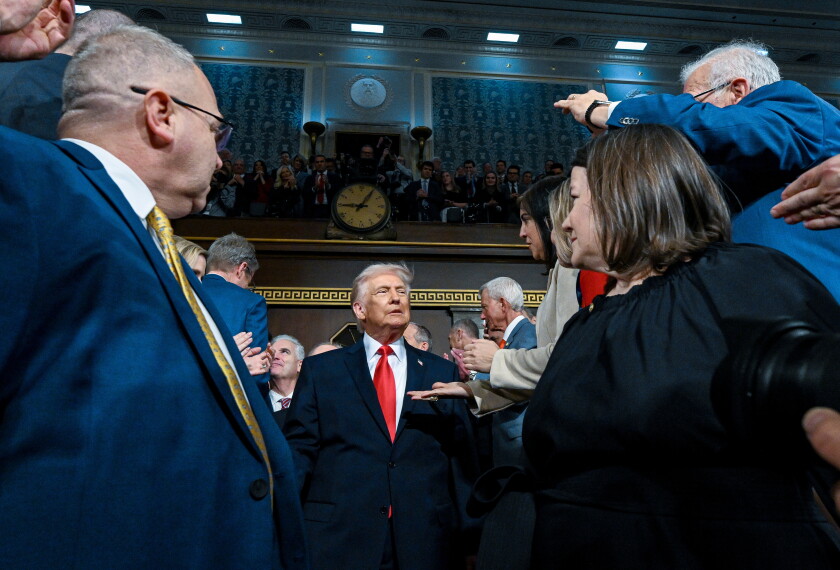
President Donald Trump enters to deliver the State of the Union address to a joint session of Congress in the House chamber at the U.S. Capitol in Washington, Tuesday, Feb. 24, 2026.
President Donald Trump enters to deliver the State of the Union address to a joint session of Congress in the House chamber at the U.S. Capitol in Washington, Tuesday, Feb. 24, 2026. The president devoted little time in the speech to discussing his education policies.
Kenny Holston/The New York Times via AP, Pool
Federal Education Department Will Send More of Its Programs to Other Agencies
Education grants for school safety, community schools, and family engagement will shift to Health and Human Services.
4 min read
Various school representatives and parent liaisons attend a family and community engagement think tank discussion at Lowery Conference Center on March 13, 2024 in Denver. One of the goals of the meeting was to discuss how schools can better integrate new students and families into the district. Denver Public Schools has six community hubs across the district that have serviced 3,000 new students since October 2023. Each community hub has different resources for families and students catering to what the community needs.
A program that helps state education departments and schools improve family engagement policies is among those the Trump administration will transfer from the U.S. Department of Education to the U.S. Department of Health and Human Services. In this photo, school representatives and parent liaisons attend a family and community engagement discussion on March 13, 2024, in Denver to discuss how schools can better integrate new students and families into the district.
Rebecca Slezak For Education Week
Federal New Trump Admin. Guidance Says Teachers Can Pray With Students
The president said the guidance for public schools would ensure "total protection" for school prayer.
3 min read
MADISON, AL - MARCH 29: Bob Jones High School football players touch the people near them during a prayer after morning workouts and before the rest of the school day on March 29, 2024, in Madison, AL. Head football coach Kelvis White and his brother follow in the footsteps of their father, who was also a football coach. As sports in the United States deals with polarization, Coach White and Bob Jones High School form a classic tale of team, unity, and brotherhood. (Photo by Jahi Chikwendiu/The Washington Post via Getty Images)
Football players at Bob Jones High School in Madison, Ala., pray after morning workouts before the rest of the school day on March 29, 2024. New guidance from the U.S. Department of Education says students and educators can pray at school, as long as the prayer isn't school-sponsored and disruptive to school and classroom activities, and students aren't coerced to participate.
Jahi Chikwendiu/Washington Post via Getty Images
Federal Ed. Dept. Paid Civil Rights Staffers Up to $38 Million as It Tried to Lay Them Off
A report from Congress' watchdog looks into the Trump Admin.'s efforts to downsize the Education Department.
5 min read
Commuters walk past the headquarters of the U.S. Department of Eduction, which were ordered closed for the day for what officials described as security reasons amid large-scale layoffs, on March 12, 2025, in Washington.
The U.S. Department of Education spent up to $38 million last year to pay civil rights staffers who remained on administrative leave while the agency tried to lay them off.
Mark Schiefelbein/AP
