School & District Management

Governors’ Association Offers Steps to Help States Improve High Schools

By Lynn Olson — February 08, 2005 2 min read
  • Save to favorites
  • Print

Gov. Mark Warner of Virginia, the chairman of the National Governors Association, has unveiled a list of 10 steps that states could take to accelerate improvements in high schools.

He released “Getting It Done: Ten Steps to a State Action Agenda” during his address to a meeting of the Education Writers Association here on Jan. 29.

“Getting it Done: Ten Steps to a State Action Agenda” is available online from the National Governors Association. ()

He described the list as “some ideas that governors can actually implement on a statewide basis relatively quickly and relatively cheaply,” to engage them in more systemwide reform. Several of the ideas focus on preparation for higher education. For example, the recommendations include:

• Defining a rigorous college-preparatory and work-readiness curriculum for high school graduation and rewarding schools that voluntarily adopt it;

• Creating statewide common course agreements so that college-level work in high school counts toward a postsecondary credential;

• Expanding access to college-level learning opportunities for low-income and minority students, English-language learners, and students with disabilities, through avenues like Advanced Placement, dual-enrollment courses in college and high school, and virtual high schools; and

• Giving college- and work-readiness assessments in high school to identify what courses and additional support students need before they graduate.

Those and other ideas on the list will help set the stage for the upcoming National Education Summit on High Schools, scheduled to be held Feb. 26-27 in Washington. The event is being co-hosted by the NGA and Achieve Inc., a Washington-based nonprofit organization that advocates higher academic standards.

Mr. Warner, who has made high school improvement a priority for his term at the helm of the NGA, said he expects all 50 state governors to attend the conference.

In the coming weeks, the governors’ association also will release a companion guidebook with best practices from states already implementing the recommendations.

‘Big Challenge’

The list released last week by the NGA also encourages states to challenge business, education, parent, community, and religious groups to back initiatives that improve college awareness.

Every state is also urged to set up a permanent education roundtable or commission to foster coordination between early-childhood, K-12, and higher education, and to devise statewide “pathways to industry certification.”

Among the ideas that are focused most squarely on students, the NGA list includes financial incentives to encourage disadvantaged high school students to take college-preparatory coursework, along with financial support to help students pass high school exit examinations. The list also includes designing literacy and mathematics programs to help get low-performing students back on track to take college-prep courses by 10th grade.

But outlining goals and objectives for states is a far cry from making them a reality. “The big challenge we’ll be putting before governors and CEOs and others is to get the system expectations” aligned between high schools, businesses, and higher education, said Michael Cohen, the president of Achieve, during the EWA meeting. “This is not a simple thing; this is not a short-term objective.”
Related Tags:

A version of this article appeared in the February 09, 2005 edition of Education Week as Governors’ Association Offers Steps to Help States Improve High Schools

Events

This content is provided by our sponsor. It is not written by and does not necessarily reflect the views of Education Week's editorial staff.
Sponsor
College & Workforce Readiness Webinar
Smarter Tools, Stronger Outcomes: Empowering CTE Educators With Future-Ready Solutions
Open doors to meaningful, hands-on careers with research-backed insights, ideas, and examples of successful CTE programs.
Content provided by Pearson
Recruitment & Retention Webinar EdRecruiter 2026 Survey Results: How School Districts are Finding and Keeping Talent
Discover the latest K-12 hiring trends from EdWeek’s nationwide survey of job seekers and district HR professionals.
This content is provided by our sponsor. It is not written by and does not necessarily reflect the views of Education Week's editorial staff.
Sponsor
Professional Development Webinar
Recalibrating PLCs for Student Growth in the New Year
Get advice from K-12 leaders on resetting your PLCs for spring by utilizing winter assessment data and aligning PLC work with MTSS cycles.
Content provided by Otus

EdWeek Top School Jobs

Teacher Jobs
Search over ten thousand teaching jobs nationwide — elementary, middle, high school and more.
View Jobs
Principal Jobs
Find hundreds of jobs for principals, assistant principals, and other school leadership roles.
View Jobs
Administrator Jobs
Over a thousand district-level jobs: superintendents, directors, more.
View Jobs
Support Staff Jobs
Search thousands of jobs, from paraprofessionals to counselors and more.
View Jobs

Read Next

School & District Management How 4 Superintendents Are Bracing for Federal Funding Uncertainty Under Trump
Superintendent of the Year finalists discussed how they're preparing for potential cuts.
3 min read
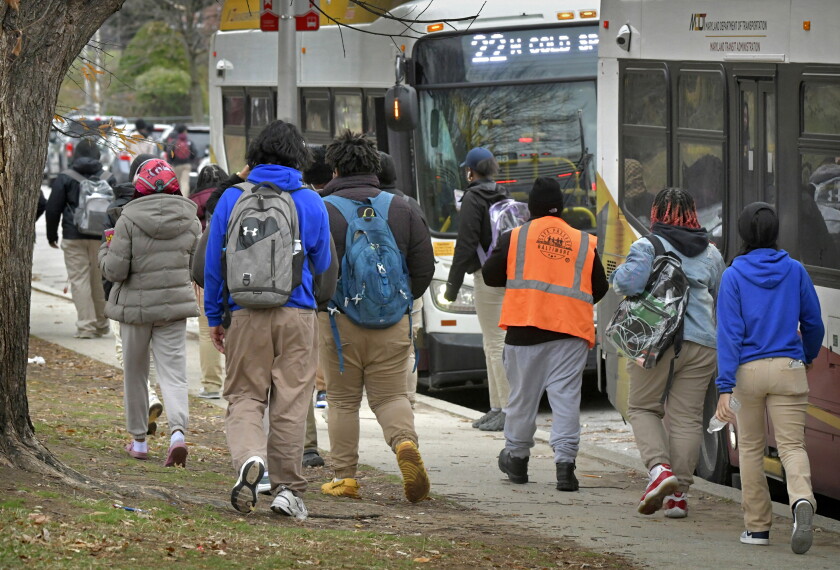
Students at Merganthaler Vocational-Technical High School board MTA buses at the end of the school day on Dec. 13, 2024 , in Baltimore. federally funded programs allows students to access resources they might otherwise not get—like tutoring and after-school programs, according to Baltimore Superintendent Sonja Santelises.
Students at Merganthaler Vocational-Technical High School board buses at the end of the school day on Dec. 13, 2024 , in Baltimore. Federally funded programs in the city's schools allow students access to services they might otherwise not get, such as tutoring and after-school programs, Baltimore Superintendent Sonja Santelises said at a recent panel discussion of the finalists for AASA's Superintendent of the Year award.
Amy Davis/Baltimore Sun/TNS
School & District Management Q&A Why This Leader Is Willing to Risk Losing His Job to Support Immigrant Students
This small Vermont district defies backlash to support immigrant families.
6 min read
A Somali flag, right, flies alongside the United States and Vermont flags outside the Winooski School District building, Wednesday, Dec. 10, 2025, in Winooski, Vt.
A Somali flag, right, flies alongside the United States and Vermont flags outside the Winooski School District building, Wednesday, Dec. 10, 2025, in Winooski, Vt. The district's effort to show support for Somali students drew intense backlash.
Amanda Swinhart/AP
School & District Management How These 3 States Are Building a Principal Pipeline
Principal apprenticeship programs aim to remove barriers to school leadership.
5 min read
Principal and apprentice having a conversation in school courtyard.
E+
School & District Management Opinion 4 Practical Steps Leaders Can Take to Support Student Learning
When it comes to best practice for data-driven instruction, teachers will take clues from leaders.
3 min read
Screenshot 2025 12 18 at 8.01.20 AM
Canva
