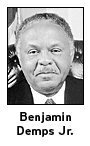
The contentious relationship between Kansas City, Mo., Superintendent Benjamin Demps Jr. and school board members has temporarily derailed the district’s desegregation case and spurred state lawmakers to speed up plans to take over the troubled system.
Public disagreements between board members and Mr. Demps over management issues and the possible state takeover also have put the superintendent’s future with the 29,500-student district in doubt.
The uncertainty surrounding Mr. Demps’ tenure prompted the district’s lawyers to withdraw a court motion for “unitary” status, which would declare Kansas City free of the vestiges of segregated schooling and release it from more than two decades of court supervision under a desegregation order. The school system must prove to the court that it has stable leadership.
The disagreements between the board and the superintendent also galvanized some state lawmakers’ efforts to pass legislation to seize control of the Kansas City schools in August. That would be nearly a year earlier than the district’s June 2002 deadline to regain its state accreditation by improving student achievement and meet other state goals.
|
Trying to mend the relationship and ease concerns about leadership, the board agreed to hire a lawyer to serve as a mediator between the superintendent and board members to help improve their relations and define their roles. Mr. Demps, who has served as Kansas City’s superintendent since 1999, is attempting to renegotiate his two-year contract, which ends June 30.
The board also reversed its controversial recommendation to reprimand Mr. Demps after he suggested that the state should not delay its takeover plans because the heated debate over the issue had diverted attention from efforts to raise student test scores. The board opposes such state intervention.
David A. Smith, the associate superintendent for communications, said Mr. Demps is seeking a clearer delineation of board and superintendent powers in his new contract. Mr. Demps wants the board to preside over policy issues, Mr. Smith added, while leaving day-to-day operations to the superintendent.
“That’s not the history of the board in this district,” Mr. Smith acknowledged.
Mr. Demps has declined to comment publicly, he added, because the superintendent doesn’t want to disrupt contract negotiations, “nor does he want to in any way inflame any tension that exists between him and his board.”
Helen J. Ragsdale, the school board president, said she hopes mediation talks will begin in April. Regardless of the outcome, Ms. Ragsdale, who supports Mr. Demps, said the negotiations with the superintendent should be considered separately from the district’s quest for unitary status.
All those issues are unfolding as more than 17,000 Kansas City students prepare to take the Missouri Assessment Program tests next month. Students’ test results will be used to determine whether Kansas City is granted provisional accreditation status, possibly averting state control.
“I’m sure within [teachers’] own minds, it’s a concern,” Ms. Ragsdale said. “But our teachers have been teaching, and our children have been learning.”
‘The Last Hope’
Earlier this month, opponents of state intervention celebrated a small victory as the education committee of the Missouri House of Representatives narrowly defeated a Democratic-sponsored bill that would have triggered an immediate state takeover of the Kansas City schools.
But before lawmakers recessed for a five-day break last week, state Sen. Peter D. Kinder, a Republican, attached the takeover legislation as an amendment to a pending Senate bill that would establish a reading test and a summer reading program.
“I want to keep this issue alive, and I fear that when the heat is turned off, this board feels like it can relax and go back to business as usual,” said Mr. Kinder, who is the Senate president. “Mr. Demps is the last hope for that school district.”
Still, critics of a state takeover believe the legislative effort is racially motivated. More than 80 percent of the district’s enrollment is made up of minority students, primarily black children.
The Rev. Sam E. Mann the pastor of St. Mark’s Presbyterian Church in Kansas City said the takeover, which has been advocated by white politicians, has little if any support among African-Americans. He acknowledged, however, that poor student test scores frustrate many African-Americans.
Still, he said, the school board should not shoulder the blame alone for the district’s woes. “You’re going to ask the state to take over, and the state’s the one that messed it up in the first place,” warned Mr. Mann, a member of a coalition of religious leaders, community activists, and legislators opposed to state control of the Kansas City schools. “That’s just more white people trying to run [the district].”
Mr. Mann argued that state lawmakers have a financial interest in the district because the schools make the city less appealing for business investment.
But Sen. Kinder stressed that race should not be injected into the takeover debate: “We need to get beyond shouting ‘race,’” he said.
The Missouri education department is preparing for a possible transition of power in Kansas City. But Jim Morris, the director of public information for Commissioner of Education D. Kent King, said education officials don’t have all the answers and realize that racial issues would have to be confronted directly.
“If outside intervention is the only solution, then [the commissioner] and the state board are going to give it our best shot, realizing that in some quarters we won’t be welcomed with open arms,” Mr. Morris said.
Ms. Ragsdale, the Kansas City board president, contends, meanwhile, that state legislators are “playing political football with our children.” She said the district should be given the opportunity to rebuild without court supervision or state meddling.
“I think they should back off and leave us alone,” she said. “Let this district—for once—have local control over our schools.”


