In 2003, about half of school-age students with disabilities spent most of their school day in classrooms with their typically developing peers. By 2013, that number had risen to 61 percent.
At least part of that change can be tied to wider use of co-teaching, an instructional method that pairs a general and a special education teacher in the same classroom. Co-teaching is meant to provide specialized services to students with disabilities in regular classrooms, while ensuring they also get access to the same academic material as their peers.
But poorly implemented co-teaching practices may be taking the “special” out of special education, say many who train teachers and districts in best collaboration practices. School administrators and even teachers themselves end up believing special educators must strive to be indistinguishable from their general education peers.
“When [co-teaching] is really, really strong, it is clear that there are two different teachers with two types of expertise,” said Marilyn Friend, a co-teaching guru who has studied collaboration for decades and provided professional development to schools and districts around the country.
Professional development for co-teaching has focused on a handful of models that general and special educators can use to meet the needs of diverse learners in one classroom. Each model offers benefits and drawbacks.
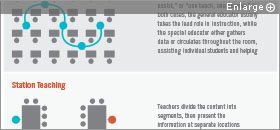
Source: Co-teaching: Concepts, Practices, and Logistics, by Marilyn Friend
And when it’s not strong?
“You might as well keep pulling kids out [of the classroom],” said Ms. Friend, a professor emerita of education at the University of North Carolina at Greensboro. “Because they’re not going to get what they need.”
New Energy
Recent policy initiatives at the state and federal level have given collaboration new urgency.
The No Child Left Behind Act, for example, pushed for all classrooms to be staffed by “highly qualified” teachers, defined in part as having subject-area expertise. Special educators who are co-teaching, however, don’t have to meet that requirement if they are working with a partner who is highly qualified in a core academic subject.
States are also taking a closer look at boosting their inclusion rates, at the urging of the U.S. Department of Education.
Finally, college- and career-ready standards, and the assessments that go along with them, have created their own incentive to get more students in special education learning the regular grade-level curriculum.
But while co-teaching is considered to be a potential solution for those issues, the practice doesn’t look the same in every district or school—and sometimes, not even for every teacher.
Different Experiences
Lynda Auxter, a special education elementary teacher in the 2,200-student Wyckoff, N.J., district, said her co-teaching experience included times where she would bounce between classrooms for different instructional blocks. The hectic schedule left her feeling like an aide to her colleagues instead of a fellow teacher. The school administration agreed, at the urging of Ms. Auxter and her colleagues, to create a better schedule. Ms. Auxter now spends the entire day in one 5th-grade classroom with a general educator.
“We worked really hard to make it our classroom,” Ms. Auxter said, with an emphasis on “our.” For example, she said, “Sometimes [the general educator] does that whole-group lesson. Sometimes, I do whole-group lessons. Sometimes, she pulls special and general small groups; sometimes, I pull special and general small groups.”
The partnership has been both professionally fulfilling and appropriate for this class of students, but future years may be different. The needs of the children may be more intense than they are in her current class, Ms. Auxter said. “We don’t have anyone who is that much of an outlier,” she said. Dawn Jara, a high school special education teacher in the 10,300-student Fairfield, Conn., district, says that with 42-minute class periods, she barely has time to interact with students before heading off to another class. And some of the general educators have been resistant to having students with disabilities in their classrooms, a problem Ms. Jara said can be linked to packing a lot of students with disabilities and other struggling learners in the same class.
“We’ve created this burnout. We’re not giving teachers the resources, and we’re not giving them the professional development that they need,” she said.
Ms. Jara said one of her best partnerships is with 10th grade English teacher Richard Novack. Both teachers push each other on best educational practices, she said.
“He sees me as an equal. He doesn’t see me as a helper or a teacher’s aide,” Ms. Jara said. “We have that healthy balance.”
Developing Common Practices
With such different experiences, school districts and states are working to create common co-teaching practices. Collaboration should not rely solely on whether co-teaching partners happen to have personal chemistry, they say.
They’re also working to ensure that special education teachers still get to work intensively with students who have identified disabilities. Sometimes, that means not just working on the lesson of the day but also on foundational knowledge.Special education students need an additional layer of individualized instruction, said Amanda Kloo, an associate professor of education who has written several papers on collaboration practices. Instead, she said, collaboration training sometimes focuses too much on a particular model of instruction.
“If we’re really talking about learning outcomes, long-term goals and individual progress, [co-teaching] needs to go beyond access and go to progress,” said Ms. Kloo, who teaches at Belmont Abbey College in Belmont, N.C.
Susan Feeney, the director of special education for a district in suburban Chicago, said teachers there found they were so focused on content that “now we’re realizing, ‘Oh my gosh, our teachers don’t remember what specially designed instruction is any more.’ They lost their special-ed-ness.”
The 5,400-student Community High School District 218 in Oak Lawn, Ill., brought in Ms. Friend, the North Carolina consultant, to provide professional development for staff members, Ms. Feeney said.
“The biggest thing is having a respect for what each other’s role is. The general education teachers are starting to say, ‘We’re getting this,’ ” said Kerri Piscitelli, the district’s special education curriculum director.
Kentucky launched a statewide co-teaching initiative in 2012 called Co-Teaching for Gap Closure. The participating educators currently teach in elementary, middle, and high schools in more than 60 districts, said Bonnie W. Tomberlin, a consultant in the state’s office of next-generation learners. The program ensures that school administrators are on board, and both the general and the special education teachers receive periodic in-classroom coaching.
The Kentucky program has stressed to regular and special education teachers that they are jointly responsible for all the children in a classroom, Ms. Tomberlin said.
“It becomes a huge ‘Aha!’ moment for [teachers],” she said. “They understand, ‘Oh, I don’t have to sit at the back of the room at the table with my kids. I don’t have to send these children to the back of the classroom and make them feel like a pariah.’ ”
But districts nationwide are still dramatically different when it comes to effective co-teaching, Ms. Friend said. While some educators are tussling over the finer details of effective instruction, others are still working to get buy-in from teachers and principals. Co-teaching won’t work unless a commitment to collaboration and inclusion in a school is already in place, she said.
Co-teaching also tends to expose other stress points in a school, such as administrative support, teacher skill, and mismatched education plans for student needs, she said.
“I tell administrators, I don’t know what your ripple effects will be, but there will be ripple effects from this,” she said. “They can’t be hidden anymore.”