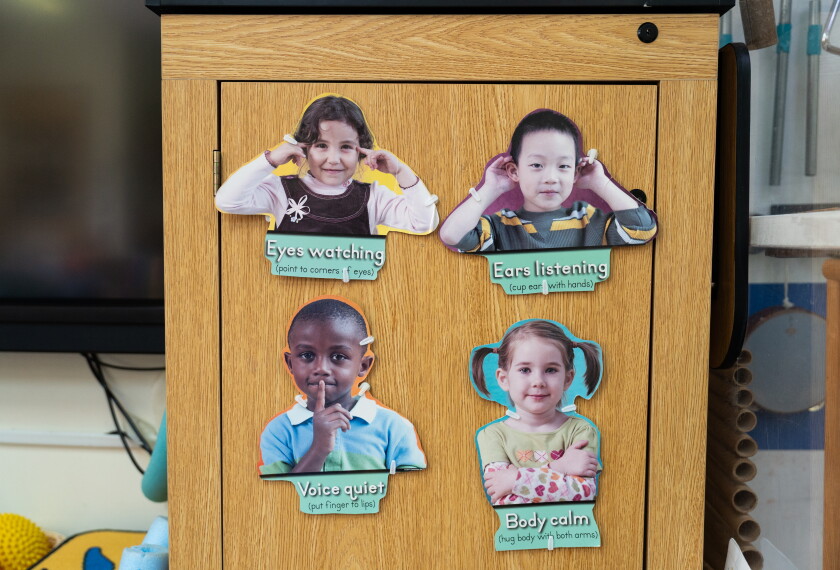
The United States lags behind most of the world’s leading economies when it comes to providing early-childhood-education opportunities, despite improvements in recent years, a study by the Organization for Economic Cooperation and Development shows.
According to the report released last week by the Paris-based OECD, the United States ranks 28th out of 38 countries for the share of 4-year-olds enrolled in pre-primary education programs, at 69 percent. That’s compared with more than 95 percent enrollment rates in France, the Netherlands, Spain, and Mexico, which lead the world in early-childhood participation rates for 4-year-olds. Ireland, Poland, Finland, and Brazil are among the countries that trail the United States.
The United States also invests significantly less public money in early-childhood programs than its counterparts in the Group of Twenty, or G-20, economies, which include 19 countries and the European Union. On average, across the countries in the OECD report, 84 percent of early-childhood students were enrolled in public programs or in private settings that receive major government resources in 2010. Just 55 percent of U.S. preschool students were enrolled in publicly supported programs in 2010; 45 percent attended independent private programs.
“The United States is still pretty far behind much of the rest of the industrialized world,” in terms of publicly supported early-childhood opportunities, Andreas Schleicher, the OECD’s deputy director for education and the special adviser on education policy to its secretary-general, said in a briefing.
He noted that the benefits of early-childhood education are apparent in the outcomes for individual students, but are less obvious at the school system or country level. He pointed to France, where participation is nearly universal, but overall outcomes for students who take the OECD’s Program for International Student Assessment, or PISA, are not nearly as strong as they are in Finland, which ranks even lower than the United States on participation in formal early-childhood programs.
Parental Influence
But overall, students in OECD countries who have attended early-childhood programs tend to perform better on PISA than those who did not, said Mr. Schleicher.
The OECD’s annual international comparison of education systems included the early-childhood indicators for the first time this year, just as state and federal policymakers in the United States increasingly home in on the need for expanding access to quality early education for 3- and 4-year-olds as a key to preparing students for academic success later.
Other new measures examined how a parent’s education influences a child’s academic-attainment levels and factors that affect how immigrant children perform academically. They found that the United States presents some of the longest odds for college attainment for children born to parents who did not finish high school, ranking near the bottom on this indicator for upward social mobility. Just 29 percent of U.S. students whose parents did not finish high school are likely to go on to college, compared with over 70 percent in Iceland, and more than 60 percent in Turkey, Portugal, and Ireland. Only Canada and New Zealand ranked behind the United States on the social-mobility measure.
Among other key findings for the United States, the report also notes that:
• The United States ranks 14th in the world in the percentage of 25- to 34-year-olds who have earned a postsecondary degree.
• American students rely more heavily on private sources to pay for higher education than their peers in other OECD countries.
• Teachers in the United States are paid less and spend more time teaching than their peers in most other OECD countries.